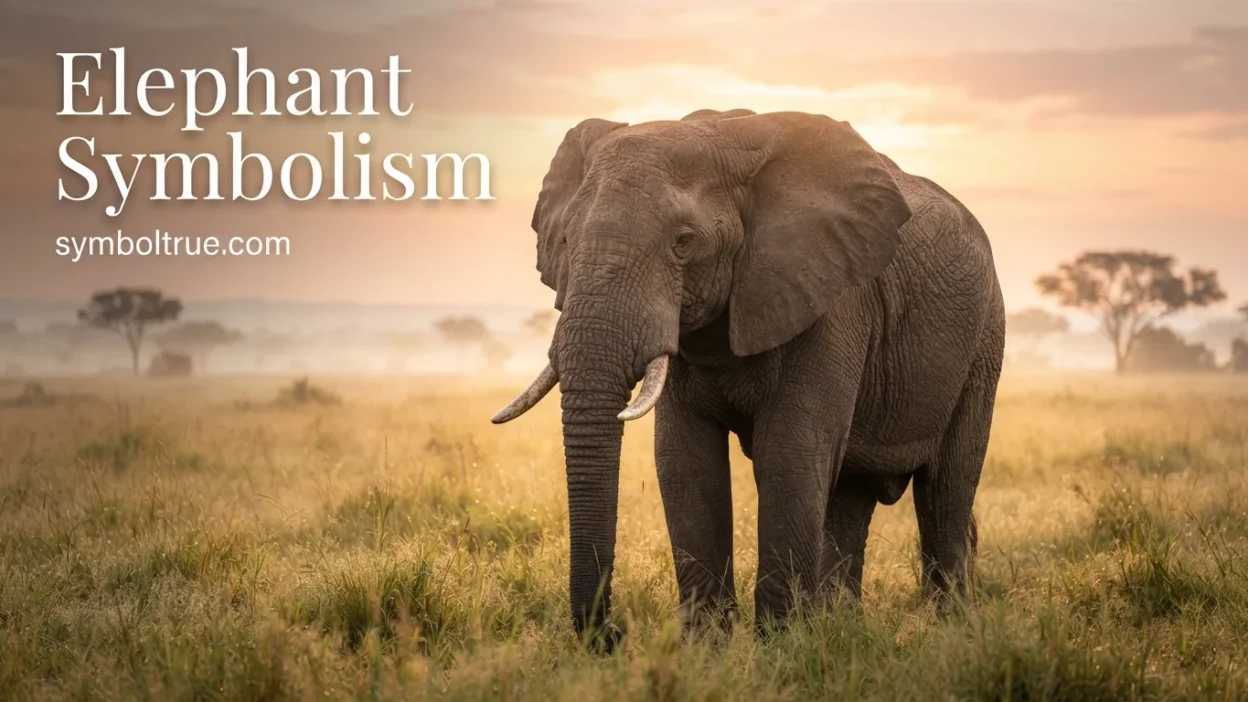
Elephants have fascinated people for thousands of years because of their strength, intelligence, emotional depth, and close family bonds.
Elephant symbolism is often connected with wisdom, loyalty, patience, protection, good fortune, and inner strength. Across different cultures, the elephant can represent both physical power and a calm, thoughtful way of moving through life.
Elephant Symbolism Meaning (Clear Definition)
The simplest definition of elephant symbolism is strength guided by wisdom and patience.
An elephant is enormous and powerful, yet it is not usually associated with unnecessary aggression. Instead, its calm presence, strong social relationships, long memory, and protective nature give it a deeper symbolic meaning.
Elephant symbolism can represent:
- Wisdom and knowledge
- Strength and resilience
- Patience and calmness
- Loyalty and family
- Protection and security
- Good luck and prosperity
- Memory and experience
- Leadership and confidence
- Emotional intelligence
The exact meaning can change depending on the culture, situation, color, behavior, or personal experience connected with the elephant.
What Does Elephant Symbolism Represent?
Elephants represent several powerful qualities that people can apply to everyday life.
Strength
The elephant is one of the strongest land animals, making it a natural symbol of physical and inner strength. Its symbolism can remind you that true strength does not always need to be loud.
Wisdom
Because elephants are associated with intelligence, learning, and experience, they often symbolize wisdom. An elephant can represent the value of learning from the past instead of repeating old mistakes.
Patience
Elephants move with a steady and deliberate nature. Their symbolism can encourage patience, especially when progress seems slow.
Loyalty and Family
Elephants are strongly associated with family groups and social bonds. For this reason, elephant symbolism often represents loyalty, companionship, family love, and belonging.
Protection
An elephant can symbolize a protective presence. Its enormous size and ability to defend members of its group make it a meaningful symbol of safety and guardianship.
Good Fortune
In many cultural traditions, elephants are connected with prosperity, success, abundance, and good luck. Elephant figures are sometimes displayed as symbols of positive energy and fortune.
| Elephant Symbol | Common Meaning |
|---|---|
| Elephant | Strength, wisdom, patience |
| Elephant herd | Family, community, loyalty |
| Elephant with raised trunk | Good fortune, success, positive energy |
| White elephant | Spiritual importance, purity, sacredness |
| Baby elephant | Innocence, growth, new beginnings |
| Elephant tusks | Power, dignity, protection |
| Elephant walking | Perseverance and steady progress |
Spiritual Meaning of Elephant Symbolism
Spiritually, elephant symbolism is often associated with wisdom, grounding, protection, patience, and overcoming obstacles.
The elephant’s great size can represent a strong foundation. It may remind a person to stay grounded when life becomes uncertain.
Its slow and steady movement can also symbolize trust in the journey. Not every form of progress needs to happen quickly.
For some people, encountering an elephant in a meaningful moment may feel like a reminder to remain patient, protect what matters, and use wisdom rather than force.
Elephant as a Symbol of Overcoming Obstacles
Elephants can also represent the ability to move through difficult circumstances. Their powerful bodies suggest endurance, while their calm nature suggests that obstacles can sometimes be handled through persistence rather than conflict.
Elephant Spirit Animal Meaning
In spiritual traditions that use animal symbolism, the elephant may be viewed as a guide connected with wisdom, family, leadership, emotional strength, and perseverance.
Its message can be understood as: move with strength, but let wisdom guide your strength.
Biblical / Religious Meaning of Elephant Symbolism
The elephant does not have a major symbolic role throughout the Bible in the same way that animals such as lambs, doves, lions, or serpents do. Therefore, many modern interpretations of elephant symbolism should not be presented as direct biblical teachings.
In broader religious and spiritual traditions, however, elephants have held important symbolic roles.
In Hindu traditions, Ganesha, the elephant-headed deity, is widely associated with wisdom, learning, success, and the removal of obstacles. This makes the elephant an especially powerful religious symbol in South Asian culture.
In Buddhist traditions, elephants can represent qualities such as mental strength, stability, patience, and spiritual development. The symbolism may vary depending on the tradition and artistic context.
The important point is that elephant symbolism is deeply connected with religious and cultural ideas in several parts of the world, but its meaning is not identical across every faith.
Elephant Symbolism in History and Culture
Elephants have played important roles in human history as symbols, working animals, religious figures, and powerful cultural icons.
In South Asia, elephants have long been associated with royalty, ceremony, warfare, religion, and prosperity. Their impressive size and intelligence made them symbols of authority and prestige.
In Hindu culture, Ganesha’s elephant head gives the animal an especially meaningful connection with wisdom, knowledge, and overcoming obstacles.
In parts of Africa, elephants have often been viewed as symbols of strength, leadership, family, memory, and respect for the natural world. Their social behavior and long lives contribute to these associations.
The white elephant has also developed a special cultural meaning in South and Southeast Asia. In several historical traditions, white elephants were associated with royalty, prestige, and sacred importance.
Elephant Symbolism Across Cultures
Although interpretations differ, several themes appear repeatedly:
- South Asian traditions: wisdom, prosperity, sacred power, and removing obstacles
- Buddhist traditions: patience, mental discipline, and spiritual strength
- African cultural symbolism: leadership, family, strength, and respect
- Royal traditions: authority, prestige, and dignity
- Modern symbolism: conservation, memory, emotional intelligence, and resilience
Elephant Symbolism in Literature and Art
Elephants appear frequently in literature, paintings, sculpture, film, stories, and decorative art.
In storytelling, an elephant can represent a wise character who has experienced hardship and gained understanding. Its large size can symbolize power, while its gentle behavior creates a contrast between strength and kindness.
Artists may use elephants to communicate themes of memory, family, nature, travel, spirituality, or human relationships with the natural world.
The elephant’s distinctive shape also makes it an instantly recognizable artistic symbol. Its trunk, tusks, large ears, and massive body can each contribute to a particular visual message.
In modern art and design, elephant imagery may represent resilience, environmental awareness, cultural heritage, or peaceful strength.
Dream Meaning of Elephant Symbolism
Dreaming about an elephant can have different meanings depending on what happens in the dream and how you feel during it.
An elephant in a dream may symbolize strength, wisdom, an important responsibility, a powerful memory, or a major challenge.
Common Elephant Dreams and Their Meanings
Dreaming of a calm elephant:
This may represent peace, emotional stability, wisdom, or a feeling of protection.
Dreaming of an angry elephant:
This can symbolize overwhelming emotions, unresolved conflict, or a situation that feels too powerful to control.
Dreaming of a baby elephant:
A baby elephant may represent innocence, personal growth, family connections, or something new that needs care.
Dreaming of a herd of elephants:
This can symbolize family, community, belonging, and the importance of supportive relationships.
Dreaming of an elephant chasing you:
This may reflect a problem, responsibility, or emotion that you have been avoiding.
Dreaming of a white elephant:
A white elephant may symbolize something rare, spiritually meaningful, valuable, or highly significant in your personal life.
Dream interpretation is personal rather than scientific. Your emotions and life circumstances are usually more important than any fixed dream dictionary definition.
Modern Meaning of Elephant Symbolism
Today, elephant symbolism continues to appear in jewelry, tattoos, home decoration, logos, conservation campaigns, and personal artwork.
An elephant tattoo may represent strength, family, remembrance, protection, or overcoming hardship. A family may choose elephant imagery because of the animal’s strong association with loyalty and close relationships.
Elephants are also powerful symbols of wildlife conservation. Their threatened status has made them representatives of biodiversity, environmental protection, and humanity’s responsibility toward nature.
Elephant Symbolism in Tattoos
An elephant tattoo can carry deeply personal meaning. Common interpretations include:
- Strength after difficult experiences
- Family and unconditional love
- Wisdom gained through life
- Protection of loved ones
- Perseverance
- Spiritual growth
- Remembrance of someone important
- Connection with nature
A tattoo featuring an elephant with its trunk raised is often chosen as a symbol of positivity, good fortune, confidence, or forward movement.
What Does a White Elephant Symbolize?
A white elephant commonly symbolizes purity, sacredness, rarity, royalty, prosperity, and spiritual importance. Its meaning is especially significant in several South and Southeast Asian cultural and religious traditions.
What Does an Elephant With Its Trunk Up Symbolize?
An elephant with its trunk raised is commonly associated with good luck, prosperity, celebration, confidence, and positive energy. This interpretation is especially popular in decorative and modern symbolism.
What Does an Elephant Symbolize Spiritually?
Spiritually, an elephant can symbolize wisdom, patience, grounding, protection, resilience, and the ability to overcome obstacles. Its calm strength is often seen as a reminder to face life’s challenges with confidence and understanding.
What Does an Elephant Symbolize in Dreams?
An elephant in a dream may represent strength, memory, family, responsibility, wisdom, or an important challenge. The meaning depends heavily on the elephant’s behavior and your emotions during the dream.
Is an Elephant a Symbol of Good Luck?
Yes, elephants are widely used as symbols of good luck and prosperity, particularly in popular South Asian and Southeast Asian traditions. An elephant with its trunk raised is especially associated with positive fortune.
Conclusion
Elephant symbolism brings together some of the most enduring human values: strength, wisdom, patience, loyalty, protection, and resilience. Whether encountered in religion, culture, dreams, art, or personal life, the elephant reminds us that real power can be calm, thoughtful, and compassionate.
Its message is simple but meaningful: stand strong, protect what you love, learn from your experiences, and keep moving forward with patience.

Henry Jack is a passionate writer at SymbolTrue, dedicated to exploring the meanings, history, and cultural significance of symbols. He creates clear, engaging, and well-researched content that helps readers understand symbols from around the world.