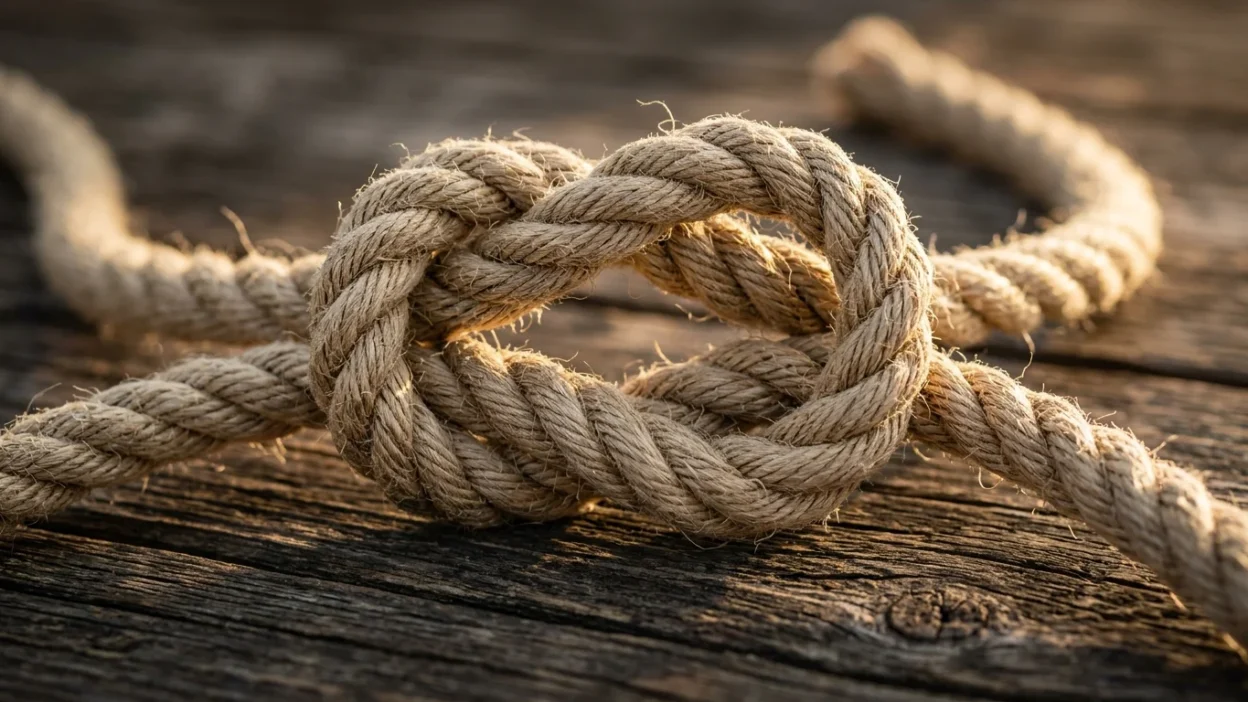
Rope knot symbolism represents unity, connection, commitment, strength, and the bonds that hold people or ideas together.
A knot forms when a rope is twisted or secured around itself, creating a connection that can be useful, protective, or difficult to undo.
Symbolically, this simple structure can represent lasting relationships, promises, personal challenges, and the complexity of life.
Across everyday life, traditional practices, literature, and art, knots have carried different meanings depending on their design and context. A tightly secured knot may suggest stability and loyalty, while a tangled knot can represent confusion or unresolved problems.
Understanding rope knot symbolism offers a meaningful way to explore human relationships, spiritual reflection, personal growth, and the connections that shape our lives.
Rope Knot Symbolism Meaning (Clear Definition)
Rope knot symbolism is the interpretation of a knot as a representation of connection, unity, commitment, security, complexity, or restriction.
A rope becomes a knot when it is tied in a particular way. This physical action creates a useful metaphor for how people form relationships, make promises, overcome difficulties, and sometimes become entangled in complicated situations.
The meaning depends on the type of knot and how it is used.
For example, a knot used to secure a boat may symbolize safety and reliability. A decorative knot on a bracelet may represent friendship or a personal bond. A tangled rope may suggest confusion, emotional struggles, or a problem that requires patience.
Unlike symbols with one established definition, rope knots have no single universal meaning. Their interpretation depends on cultural traditions, practical uses, personal experiences, and the surrounding circumstances.
What Does Rope Knot Symbolism Represent?
Rope knots can represent several important ideas.
1. Unity and Connection
One of the most natural meanings of a knot is unity. It brings separate sections of rope together and creates a connection between them.
Symbolically, this can represent family relationships, friendships, partnerships, and communities. It reminds us that connections can make individuals stronger when they work toward a shared purpose.
2. Commitment and Loyalty
A secure knot can represent a promise, agreement, or lasting commitment. This association appears in familiar expressions such as tying the knot, which refers to marriage.
The image of a knot suggests that two people have chosen to establish a meaningful bond. However, the strength and significance of that bond depend on the people involved rather than the symbol itself.
3. Strength and Stability
A properly tied knot helps keep objects secure. Because of this practical function, knots can symbolize dependability, resilience, and the ability to withstand pressure.
In personal symbolism, a strong knot may represent determination during difficult circumstances or the strength needed to maintain important relationships.
4. Problems and Complications
Not every knot is easy to untangle. A tangled rope can represent complicated emotions, disagreements, uncertainty, or unresolved situations.
This interpretation is common in figurative language. Expressions such as an emotional knot or a knotty problem describe situations that require careful thought before they can be resolved.
5. Protection and Security
Knots are essential in climbing, sailing, camping, construction, and many other practical activities. They help secure loads, connect equipment, and support safety when correctly selected and tied.
As a symbol, a secure knot may therefore represent protection, preparedness, and trust in something dependable.
Spiritual Meaning of Rope Knot Symbolism
Spiritually, rope knot symbolism can represent interconnectedness, commitment, inner strength, and the relationship between different parts of life.
These interpretations are personal or tradition-dependent rather than universal spiritual rules.
Connection Between People and the Universe
Some people view a knot as a reminder that everything is connected. Just as a rope can form a continuous structure through a knot, human experiences often influence one another in ways that are not immediately obvious.
This interpretation may encourage gratitude, compassion, and greater awareness of relationships.
Binding Intentions and Promises
In personal spiritual practices, tying a knot may serve as a physical reminder of an intention, goal, or promise.
For example, someone might tie a small knot in a cord while reflecting on a commitment to patience or personal growth. The knot functions as a reminder of that intention; its spiritual significance comes from the individual’s beliefs and practice.
Balance and Inner Strength
A well-made knot requires attention, technique, and an understanding of how different strands interact. Symbolically, this can represent finding balance between competing responsibilities or bringing different aspects of one’s life into harmony.
It may also remind someone that strength sometimes comes from cooperation rather than independence alone.
Releasing What Holds You Back
An untied or loosened knot can symbolize freedom, acceptance, or the resolution of an emotional burden.
For someone reflecting on personal change, untying a knot may represent letting go of an unhealthy habit, releasing resentment, or moving forward after a difficult experience.
There is no universally accepted spiritual interpretation of a rope knot. Its meaning depends on the person’s beliefs, cultural background, and reasons for using the symbol.
Biblical and Religious Meaning of Rope Knot Symbolism
The Bible does not establish one universal symbolic meaning for rope knots. However, ropes, cords, binding, and related images appear in biblical passages and can offer relevant context.
The Meaning of a Threefold Cord
Ecclesiastes 4:9–12 discusses the benefits of companionship, mutual support, and the strength found when people stand together. Verse 12 includes the image of a cord of three strands that is not quickly broken.
Many Christian readers interpret this passage as a picture of unity, cooperation, and the strength of relationships.
Although the passage uses a cord rather than defining rope knot symbolism specifically, the image can be meaningfully connected with the broader idea of bonds that provide strength.
Binding and Spiritual Commitment
In religious language, binding can sometimes describe an obligation, covenant, or close connection. Such meanings depend on the particular passage and its context.
A rope knot may therefore serve as a personal illustration of faithfulness, responsibility, or commitment, but it should not automatically be treated as a biblical sign.
Knots in Other Religious Traditions
Knots also appear in several religious and cultural settings. For example, the endless knot is an important symbol in Buddhist traditions, where it is commonly associated with interconnectedness and the relationship between different aspects of existence.
In some Hindu wedding traditions, garments may be tied together as part of marriage rituals, symbolizing the joining of two people and their families.
These examples demonstrate that knots can carry religious or ceremonial significance, but their meanings vary. A decorative rope knot should not be assumed to have the same meaning across all faiths.
Rope Knot Symbolism in History and Culture
Knots have served practical purposes throughout human history. People have used them to secure objects, construct shelters, sail boats, climb, carry loads, and create fishing equipment.
Their usefulness helped make knots familiar features of everyday life. Over time, particular knot designs also became associated with decoration, identity, ritual, and cultural expression.
Celtic Knot Symbolism
Celtic knotwork is widely recognized for its intricate interlacing patterns. These designs appear in illuminated manuscripts, stone carvings, metalwork, and other forms of historical art associated with Celtic cultural traditions.
Modern interpretations frequently connect Celtic knots with eternity, continuity, loyalty, and interconnectedness.
However, not every historical Celtic knot has a known symbolic meaning. Some designs are primarily decorative, and interpretations of specific patterns may be uncertain. It is important to distinguish documented historical evidence from meanings assigned by modern writers and artists.
The Chinese Knot
Chinese decorative knotting is a traditional craft that uses cords to create elaborate ornamental patterns.
Chinese knotwork is often associated with good fortune, happiness, prosperity, longevity, and harmonious relationships. Specific meanings can depend on the pattern, color, occasion, and cultural setting.
Decorative knots may appear during festivals, weddings, celebrations, and other important events. Their beauty and symbolism make them popular as gifts and ornaments.
The Endless Knot
The endless knot, especially in Tibetan Buddhist art, is an interlaced design without an obvious beginning or end.
It is commonly associated with interconnectedness, continuity, and the relationship between causes and effects. In Buddhist contexts, it can also be understood in relation to the interconnected nature of existence.
Although it resembles a rope knot, it is a distinct symbolic design rather than simply any knot tied in a piece of rope.
Knots in Maritime Culture
Knots are fundamental to sailing and maritime work. Sailors use different knots for securing sails, fastening lines, joining ropes, and attaching equipment.
Because these knots have practical consequences, they can symbolize skill, readiness, reliability, and experience.
The symbolism arises naturally from their function: a well-chosen knot helps maintain control and security in demanding conditions.
Rope Knot Symbolism in Literature and Art
Writers and artists often use knots as visual or literary metaphors because they can communicate complicated ideas through a simple image.
Knots as Symbols of Love
A knot can represent two people choosing to build a shared life. Jewelry, wedding illustrations, and romantic artwork sometimes use intertwined cords to express loyalty, affection, or lasting connection.
The symbolism is especially clear when separate strands become part of a single design.
Knots as Symbols of Fate
In some stories, a knot represents the connections between events, choices, and people. A character’s decisions may become entangled with other people’s actions, producing consequences that are difficult to escape.
This interpretation can suggest that life is interconnected and that individual choices rarely exist in complete isolation.
Knots as Symbols of Conflict
An intricate knot can represent a mystery, an emotional struggle, or a complicated situation.
Writers may describe a problem as a knot that must be untied. The act of untangling then becomes a metaphor for understanding, patience, and problem-solving.
Knots in Visual Design
Artists and designers use knot patterns in jewelry, textiles, tattoos, illustrations, and decorative objects.
A flowing knot design may suggest continuity and elegance, while a heavy, tightly bound knot may communicate tension or restriction.
The visual style matters. A circular interlaced knot can feel harmonious, whereas a tangled mass of rope may evoke disorder or stress.
Rope Knot Symbolism in Dreams
Dream interpretations are subjective, and there is no reliable evidence that a particular knot predicts future events. Nevertheless, people may use dream imagery as a starting point for personal reflection.
The meaning of a rope knot in a dream can depend on the dream’s details and the emotions experienced during it.
Dreaming of Tying a Knot
Tying a knot may reflect a desire to establish a commitment, organize a situation, or bring separate parts of life together.
Consider whether you are making an important decision or developing a new relationship.
Dreaming of an Untied Knot
An untied knot may suggest relief, change, or the possibility of resolving a problem.
It might also reflect uncertainty about a commitment that once felt secure.
Dreaming of a Tangled Rope
A tangled rope may mirror feelings of confusion, stress, or being overwhelmed by responsibilities.
Rather than treating the dream as a prediction, consider whether there is a situation in your waking life that needs attention or a clearer plan.
Dreaming of a Strong, Secure Knot
A secure knot may represent stability, trust, or confidence in a relationship or goal.
The dream might simply reflect something that currently feels dependable in your life.
Dreams do not have fixed meanings. Your personal experiences and emotional responses are more useful for reflection than any universal dream dictionary.
Positive Symbolism of Rope Knots
Rope knots can communicate several positive ideas.
- Unity: Bringing different people or elements together.
- Commitment: Honoring promises and maintaining meaningful relationships.
- Strength: Remaining steady during challenging circumstances.
- Security: Creating a dependable connection.
- Loyalty: Staying connected to people, values, or responsibilities.
- Continuity: Maintaining a relationship or tradition over time.
- Cooperation: Recognizing that combined effort can accomplish more than isolated effort.
- Resilience: Finding ways to adapt and remain connected through difficulties.
For example, a knot-themed bracelet might serve as a reminder of friendship. An interlaced design might represent family bonds, while a simple rope knot in artwork could communicate perseverance.
These meanings are most effective when they reflect the intentions of the person choosing the symbol.
Negative or Hidden Symbolism of Rope Knots
Knots can also represent situations in which connection becomes restrictive or difficult to manage.
Restriction and Loss of Freedom
A tightly bound rope may symbolize feeling trapped by obligations, expectations, or relationships.
This interpretation highlights the difference between a healthy bond and a connection that limits personal freedom.
Confusion and Emotional Stress
A tangled knot can suggest complicated circumstances, conflicting feelings, or problems that have accumulated over time.
The image may encourage someone to examine a situation carefully rather than trying to solve everything at once.
Control and Manipulation
In some contexts, binding imagery can represent control, pressure, or an attempt to limit another person’s choices.
This is a contextual interpretation, not an inherent meaning of every knot.
Unresolved Problems
A knot that cannot be untied may represent frustration or a problem that seems resistant to easy solutions.
However, the same image can also encourage persistence. What initially appears impossible may become manageable with patience, new information, or help from others.
Common Interpretations of Rope Knot Symbolism
The following table summarizes common symbolic interpretations. These are general associations rather than fixed definitions.
| Knot image or situation | Possible symbolic meaning |
| A strong, secure knot | Stability, trust, reliability |
| Two ropes tied together | Unity, partnership, cooperation |
| A decorative knot | Beauty, tradition, continuity |
| A tangled knot | Confusion, conflict, complexity |
| A knot being untied | Freedom, resolution, release |
| A knot that will not loosen | Frustration, resistance, unresolved issues |
| A circular interlaced knot | Continuity, interconnectedness |
| A knot tied around an object | Security, attachment, responsibility |
| A knot in a wedding design | Commitment, marriage, lasting connection |
| A broken or loosened knot | Change, separation, or the ending of a commitment |
Context is essential when interpreting any of these images. A knot used for a practical task may have no intended symbolic meaning at all.
Why Does Rope Knot Symbolism Matter Today?
Rope knot symbolism remains relevant because people continue to use knots in art, jewelry, fashion, tattoos, ceremonies, and personal gifts.
Its appeal comes from the connection between a familiar physical object and recognizable human experiences.
In Jewelry and Tattoos
Knot designs can express friendship, family loyalty, love, personal resilience, or a commitment to a particular value.
Before choosing a culturally specific knot, it is worth learning about its origins and established associations.
In Relationships
A knot can serve as a reminder that relationships require care and attention. Strong connections develop through trust, communication, and shared effort rather than symbolism alone.
The image can also encourage reflection on whether a relationship provides security or has become unnecessarily restrictive.
In Personal Growth
Untying a knot offers a useful metaphor for addressing challenges one step at a time.
It suggests that confusion does not always require force. Sometimes, progress comes from patience, examining the problem, and finding the right approach.
In Design and Storytelling
Knot patterns offer designers and writers a simple way to communicate complex themes. Their shape can suggest unity, continuity, tension, mystery, or transformation without requiring a lengthy explanation.
Ultimately, the symbol remains meaningful because it can express both the benefits and the difficulties of human connection.
FAQs:
1. What does a rope knot symbolize?
A rope knot commonly symbolizes unity, commitment, connection, strength, and security. Depending on its appearance and context, it can also represent complications, restrictions, or unresolved problems.
2. What is the spiritual meaning of a rope knot?
Spiritually, a rope knot may represent interconnectedness, personal commitment, balance, and the bonds between people. These meanings vary according to individual beliefs and cultural traditions.
3. Does a rope knot symbolize love?
Yes, a rope knot can symbolize love, loyalty, and lasting relationships. This association is particularly familiar in wedding imagery and the expression tying the knot.
4. What does an untied knot symbolize?
An untied knot may represent freedom, release, change, or the resolution of a difficult situation. Its meaning depends on the circumstances in which it appears.
5. What does a tangled knot symbolize?
A tangled knot often represents confusion, complicated emotions, conflict, or problems that require patience to resolve. It can also symbolize the complexity of human relationships.
6. What does a knot symbolize in the Bible?
The Bible does not assign one universal meaning to rope knots. However, Ecclesiastes 4:9–12 uses the image of a threefold cord to illustrate companionship and strength through unity.
7. What does a Celtic knot symbolize?
Celtic knotwork is often interpreted today as a symbol of continuity, interconnectedness, eternity, and loyalty. However, the meaning of individual historical designs is not always known with certainty.
8. What does a rope knot mean in a dream?
A rope knot in a dream may provide a starting point for reflecting on relationships, commitments, stress, or unresolved problems. Dreams do not have universally established meanings or reliably predict future events.
9. Is a rope knot a symbol of protection?
A secure knot can symbolize protection and safety because knots are used to fasten objects and secure equipment. Some people also use knot imagery as a personal reminder of security or stability.
Conclusion
Rope knot symbolism reflects the many ways people connect, commit, protect, and sometimes struggle with the things that bind their lives together. A strong knot can represent unity, loyalty, and stability, while a tangled knot may suggest confusion or unresolved challenges. Untying a knot can symbolize release and personal growth.
Although cultural, spiritual, and artistic interpretations differ, the central idea remains recognizable: connections can provide strength, but they also require care and understanding. Whether found in a traditional design, a piece of jewelry, a dream, or an everyday rope, a knot offers a simple reminder of the complexity and value of human relationships.

Abigail Alice is a passionate writer at SymbolTrue, exploring the history, meanings, and cultural significance of symbols worldwide. She creates clear, engaging, and well-researched content that helps readers uncover the fascinating stories behind everyday and ancient symbols.