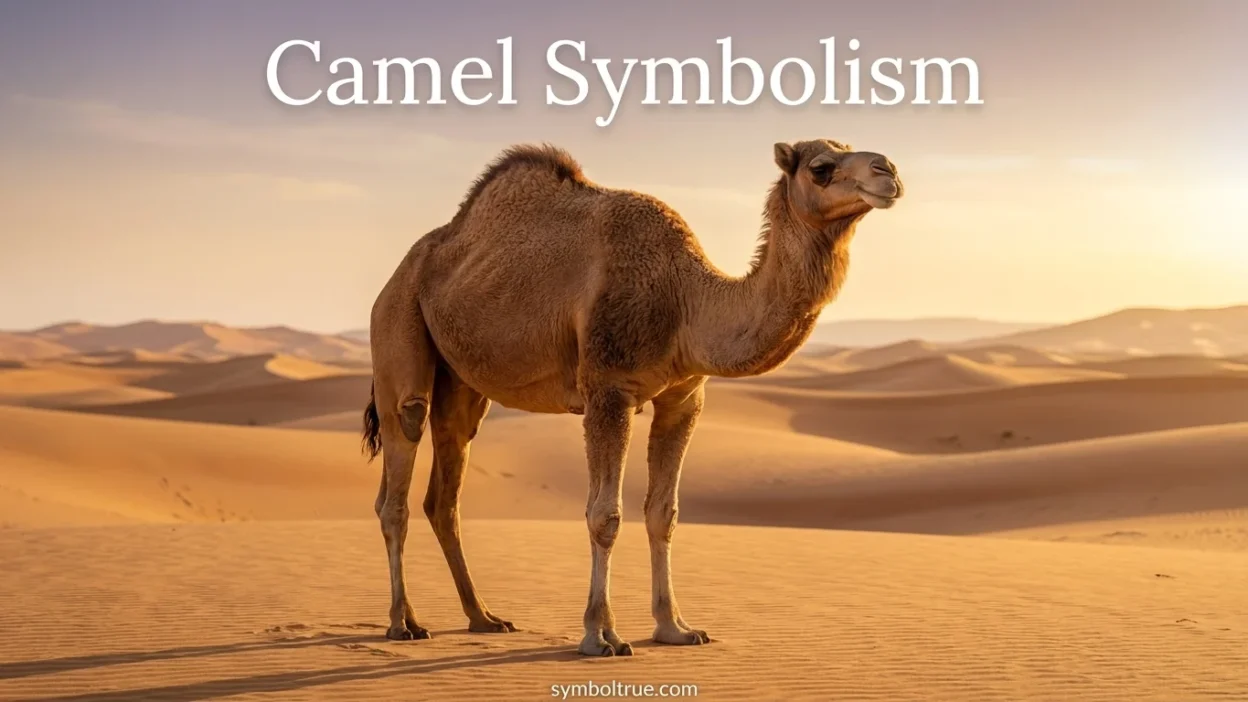
Camel symbolism is deeply connected with patience, endurance, resilience, survival, strength, and the ability to carry heavy burdens. Because camels can travel long distances through harsh deserts with limited food and water, they have become powerful symbols of perseverance and inner strength.
If a camel repeatedly appears in your dreams, art, spiritual experiences, or daily life, its meaning may point toward your ability to endure difficult circumstances while continuing toward your destination.
Camel Symbolism Meaning (Clear Definition)
At its core, camel symbolism represents endurance and resilience. The camel is often viewed as a symbol of someone who can remain strong even when the journey is difficult or resources are limited.
Camels are naturally suited to challenging environments. Their ability to travel across deserts has made them associated with patience, survival, preparation, and determination.
In symbolic terms, a camel can represent:
- Patience – moving forward without rushing
- Endurance – continuing despite hardship
- Resilience – recovering from difficult experiences
- Strength – carrying physical or emotional burdens
- Survival – adapting to challenging conditions
- Wisdom – knowing when to conserve energy
- Journey – making steady progress toward a destination
The deeper message of camel symbolism is simple: you do not always need to move quickly to make meaningful progress. Sometimes strength means continuing one step at a time.
What Does Camel Symbolism Represent?
Camel symbolism can have several meanings depending on the situation and cultural context.
Patience and Endurance
The camel is one of nature’s clearest examples of endurance. Its association with long desert journeys makes it a symbol of patience and the ability to tolerate difficult conditions.
Seeing a camel symbolically may encourage you to remain patient when results are taking longer than expected.
Strength and Burden
Camels are famous for carrying heavy loads across long distances. Because of this, they can symbolize responsibilities, obligations, and the strength needed to carry them.
A camel may represent a person who continues fulfilling responsibilities even when life feels heavy.
Resilience and Survival
Camel symbolism is also strongly connected to survival. The animal’s ability to function in demanding environments represents adaptability and practical strength.
It can remind you that difficult circumstances do not necessarily mean you have reached the end of your journey.
Preparation and Resourcefulness
The camel is often associated with conserving resources and preparing for challenging journeys. Symbolically, this can suggest careful planning, self-control, and using what you have wisely.
Travel and Life’s Journey
Historically, camels played an important role in long-distance travel and trade across desert regions. This has given them a strong symbolic connection with journeys, exploration, transition, and movement toward a goal.
| Camel Symbol | Common Meaning |
|---|---|
| Camel | Endurance and resilience |
| Desert journey | Life challenges and uncertainty |
| Carrying a load | Responsibility and burdens |
| Long-distance travel | Patience and perseverance |
| Water and survival | Resourcefulness and preparation |
| Slow movement | Steady progress |
| Camel caravan | Community, cooperation, and shared journeys |
Spiritual Meaning of Camel Symbolism
Spiritually, camel symbolism can represent faith, patience, endurance, and trust during difficult seasons of life.
The camel does not need a perfect environment to continue its journey. This makes it a powerful spiritual reminder that growth can happen even when circumstances are uncomfortable.
A camel appearing in a spiritual context may suggest that you should:
- Trust the journey rather than demand immediate results.
- Stay patient during periods of uncertainty.
- Protect your energy and use your resources wisely.
- Carry your responsibilities without losing yourself.
- Remain focused on your destination.
- Develop strength through difficult experiences.
Camel spiritual meaning can also be connected with quiet strength. The camel does not symbolize dramatic or sudden power. Instead, it represents the kind of strength that lasts.
Its message may be: keep going, conserve your strength, and trust that steady progress matters.
Biblical / Religious Meaning of Camel Symbolism
Camels appear several times in the Bible and are associated with travel, wealth, trade, hospitality, and life in the ancient Near East.
In biblical stories, camels could be used for transportation and carrying goods across long distances. They therefore provide an important picture of the demanding journeys people faced in ancient times.
One of the best-known biblical references involving a camel is Jesus’ teaching about wealth and entering the kingdom of God. The famous image of a camel passing through the eye of a needle emphasizes the difficulty of placing excessive trust in wealth.
In religious symbolism, the camel can therefore carry meanings related to humility, dependence, perseverance, and the dangers of attachment to material wealth.
Interpretations can differ between religious traditions, so the camel does not have one universal biblical meaning.
Camel Symbolism in History and Culture
Camels have played a major role in human civilization, especially across desert and semi-desert regions of Africa, the Middle East, and Asia.
For centuries, camel caravans helped people transport food, textiles, spices, and other goods across difficult landscapes. Their endurance made long-distance trade possible in places where other forms of transportation were less practical.
This history strengthened the camel’s symbolic association with:
- Trade and prosperity
- Travel and exploration
- Endurance
- Connection between distant communities
- Survival in harsh environments
- Patience during long journeys
In many cultures, the camel is more than an animal. It represents a dependable companion through challenging terrain.
Camel Symbolism in Arab and Desert Cultures
Camels have a particularly important place in many Arab and desert cultures. They have historically provided transportation and supported livelihoods in demanding environments.
Because of this close relationship, camel symbolism can include hospitality, status, wealth, patience, and survival.
The exact meaning varies according to the culture, historical period, and context in which the camel appears.
Camel Symbolism in Literature and Art
Camels frequently appear in literature and visual art as symbols of travel, difficult journeys, deserts, foreign lands, and perseverance.
In storytelling, a camel can represent more than the animal itself. A character traveling with camels may be entering an unfamiliar world, crossing a difficult landscape, or beginning an important transformation.
Artists may use a camel against a vast desert to create a sense of:
- Isolation
- Adventure
- Spiritual searching
- Patience
- Human survival
- Long journeys
- Connection with nature
The camel’s distinctive shape also makes it a recognizable cultural symbol of desert life and ancient travel.
Dream Meaning of Camel Symbolism
Dreaming about a camel can have different interpretations depending on what happens in the dream and how you feel during it.
A camel dream may symbolize patience, responsibility, endurance, travel, or a difficult journey that requires persistence.
Riding a Camel in a Dream
Riding a camel may symbolize that you are moving through an important period of transition. It can suggest progress, direction, or learning to trust the pace of your journey.
Seeing a Camel
Simply seeing a camel may represent endurance or a reminder to remain patient with a situation.
Camel Carrying a Heavy Load
A heavily loaded camel may reflect responsibilities or emotional burdens you are currently carrying.
Camel Caravan
A caravan of camels can symbolize community, teamwork, shared goals, or traveling through life’s challenges with others.
White Camel in a Dream
A white camel may be interpreted as a symbol of peace, hope, purity, or spiritual guidance, although dream meanings are personal rather than fixed.
Angry or Aggressive Camel
An aggressive camel may represent frustration, resistance, pressure, or a situation that feels difficult to control.
The most important part of interpreting a camel dream is your personal experience. Your emotions during the dream can be more meaningful than the animal itself.
Modern Meaning of Camel Symbolism
Today, camel symbolism remains relevant because modern life also requires endurance.
People often face long periods of work, uncertainty, responsibility, financial pressure, personal challenges, and major life changes. The camel offers a useful metaphor for handling these experiences without expecting everything to happen immediately.
Modern camel symbolism can represent resilience, sustainable effort, emotional strength, patience, and smart use of resources.
The camel also teaches an important lesson about energy. Being strong does not mean constantly pushing yourself. Sometimes true strength involves slowing down, conserving your energy, and continuing when you are ready.
Camel Symbolism as a Life Lesson
The camel can remind you that:
You are allowed to move slowly.
You do not have to prove your strength every moment.
A difficult journey can still lead somewhere meaningful.
Carrying responsibility does not mean carrying everything alone.
What Does a Camel Symbolize Spiritually?
Spiritually, a camel commonly symbolizes endurance, patience, resilience, and the ability to continue through challenging periods. It can serve as a reminder to trust your journey and use your energy wisely.
What Does a Camel Symbolize in a Dream?
A camel in a dream may symbolize a long journey, patience, responsibilities, survival, or perseverance. The exact interpretation depends on the dream’s setting and your emotions.
Is Seeing a Camel a Good Sign?
Camel symbolism can be viewed positively because the animal represents strength, endurance, preparation, and survival. However, its meaning depends on the personal or cultural context in which it appears.
What Does a Camel Represent in the Bible?
Camels appear in several biblical stories and contexts involving travel, wealth, transportation, and desert life. They are also part of Jesus’ teaching about the difficulty of placing excessive trust in wealth.
What Does a Camel Symbolize in Love?
In relationships, camel symbolism can represent patience, loyalty, commitment, and the ability to remain together through difficult periods. It may also suggest the importance of sharing emotional responsibilities rather than allowing one person to carry the entire burden.
Conclusion
Camel symbolism is ultimately a message of endurance, patience, resilience, and purposeful progress. The camel reminds us that meaningful journeys are not always fast or easy.
When life feels like a long desert crossing, its symbolism offers a simple lesson: conserve your strength, carry what truly matters, and keep moving toward where you want to go.

Ryan Thomas is a passionate writer at SymbolTrue, dedicated to exploring the meanings, history, and cultural significance of symbols worldwide. He creates engaging, well-researched content that helps readers discover the stories and symbolism behind everyday signs, icons, and traditions.