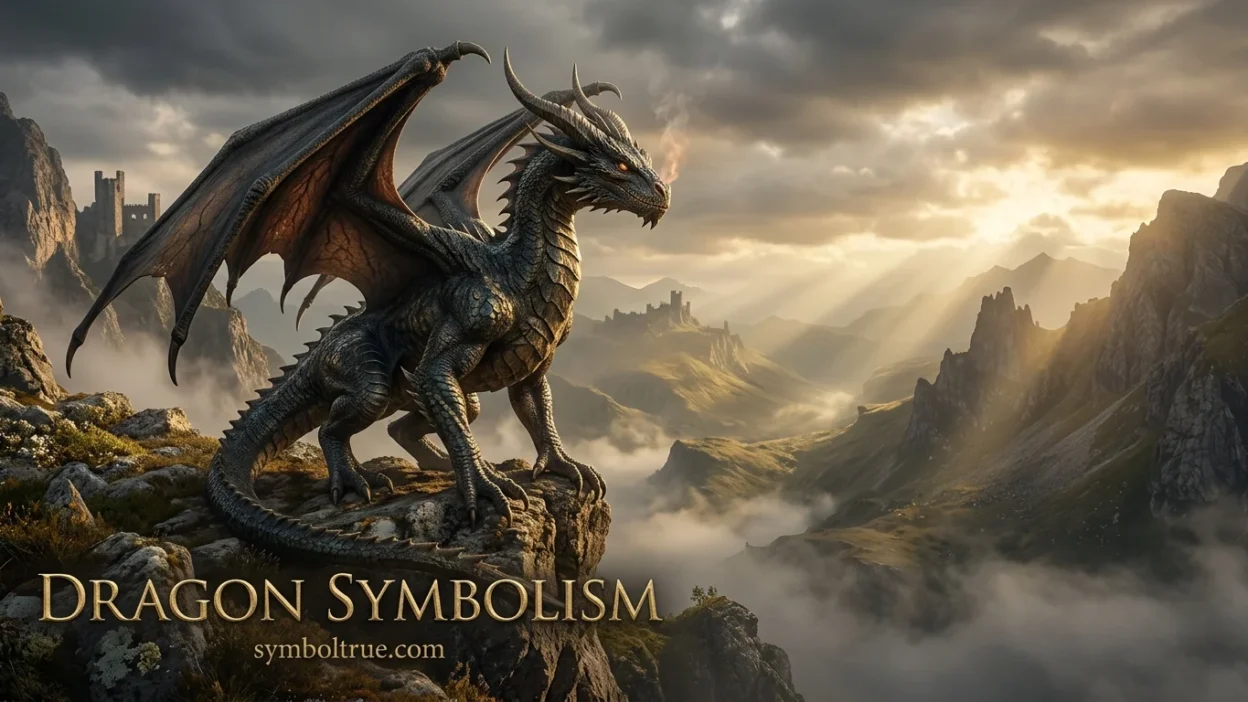
Dragons are among the most recognizable mythical creatures in human history. They appear in legends, religious stories, literature, art, dreams, and popular culture across many parts of the world.
Dragon symbolism can represent power, protection, wisdom, transformation, danger, mystery, or spiritual strength, depending on the culture and context.
A dragon does not have one universal meaning. In some traditions, dragons are respected as wise and powerful beings connected with nature and good fortune. In others, they are portrayed as dangerous creatures that must be defeated. Understanding these differences makes dragon symbolism much more meaningful.
Dragon Symbolism Meaning (Clear Definition)
Dragon symbolism refers to the ideas and qualities people have traditionally associated with dragons in mythology, religion, folklore, art, and storytelling.
Common symbolic meanings include:
- Power and strength
- Protection and guardianship
- Wisdom and knowledge
- Transformation and rebirth
- Courage and determination
- Mystery and the unknown
- Danger and destruction
- Spiritual energy
- Freedom and independence
- Prosperity and good fortune
The meaning depends heavily on the dragon’s appearance, behavior, cultural setting, and role in a particular story.
A dragon guarding treasure, for example, may symbolize protection and power. A dragon flying freely through the sky may suggest freedom, ambition, or transcendence. A dragon attacking a village may instead represent fear, chaos, or destructive forces.
What Does Dragon Symbolism Represent?
Dragon symbolism often represents a force that is larger and more powerful than ordinary human experience.
Power and Strength
One of the most common meanings of a dragon is strength. Dragons are frequently portrayed as enormous creatures capable of flying, breathing fire, controlling elements, or defeating armies.
Because of this, the dragon can symbolize personal power, confidence, authority, and the ability to face difficult challenges.
Protection and Guardianship
Dragons are also often shown protecting something valuable. They may guard treasure, sacred places, kingdoms, magical objects, or hidden knowledge.
In symbolic terms, this can represent the instinct to protect what matters most, including family, personal values, wisdom, or important goals.
Wisdom and Knowledge
Some dragon traditions associate these creatures with age, intelligence, and ancient knowledge. A dragon may therefore symbolize wisdom gained through experience.
This interpretation is especially useful when a dragon appears as a teacher, guardian, or mysterious guide rather than an enemy.
Transformation
Because dragons are supernatural creatures that exist outside ordinary human experience, they can symbolize transformation.
Dragon imagery may represent a major personal change, the development of confidence, or the process of overcoming an older version of oneself.
Spiritual Meaning of Dragon Symbolism
The spiritual meaning of a dragon varies greatly between traditions, so it should not be treated as one universal spiritual rule.
In symbolic or personal spirituality, a dragon may represent inner strength, courage, protection, transformation, and the ability to confront fear.
A dragon can also symbolize the powerful forces of nature. Fire-breathing dragons, for example, may be interpreted as symbols of energy, passion, purification, or destruction followed by renewal.
Dragon as a Spiritual Guardian
When dragons are viewed as guardians, they can symbolize protection from danger and the preservation of something valuable.
This does not necessarily mean that a dragon is literally believed to protect a person. In symbolic interpretation, the image can encourage someone to recognize their own protective instincts and inner strength.
Dragon as a Symbol of Inner Power
A dragon can also represent power that has not yet been fully recognized.
Seeing a strong dragon in symbolic imagery may encourage reflection on questions such as:
- What personal strength am I not using?
- What challenge am I afraid to face?
- What should I protect?
- What part of my life needs to change?
Biblical / Religious Meaning of Dragon Symbolism
Dragons appear in biblical language and religious interpretation, but their meanings are not identical across all traditions.
In the Book of Revelation, a great red dragon appears as a symbolic adversarial figure associated with evil and opposition to God. This imagery has strongly influenced Western Christian art and literature.
However, biblical references to serpent-like or sea creatures are sometimes translated differently depending on the passage and Bible version. Therefore, it is important not to assume that every ancient reference to a large serpent or creature means the same thing as the modern fantasy concept of a dragon.
In Christian symbolism, the dragon has often come to represent evil, temptation, chaos, or spiritual opposition. Stories of saints defeating dragons also became powerful symbolic narratives in medieval European culture.
Other religious and cultural traditions can have very different views of dragons. A dragon is not automatically a symbol of evil in every religious system.
Dragon Symbolism in History and Culture
Dragon symbolism has developed differently in different regions.
Chinese Dragon Symbolism
Chinese dragons traditionally have a very different image from the destructive dragon common in many European stories.
The Chinese dragon, or long, has historically been associated with water, rain, power, imperial authority, prosperity, and good fortune. Dragons can appear as powerful and respected beings rather than monsters that need to be destroyed.
Dragon imagery has played an important role in Chinese art, festivals, architecture, clothing, and traditional symbolism.
European Dragon Symbolism
European folklore often presents dragons as dangerous creatures associated with fire, treasure, destruction, or challenges.
Medieval legends frequently describe heroes or saints confronting dragons. These stories can symbolize the struggle between courage and danger, good and evil, or order and chaos.
Japanese Dragon Symbolism
Japanese dragon traditions were influenced partly by broader East Asian traditions. Dragons can be connected with water, rain, rivers, and supernatural power.
Japanese dragon imagery has appeared in religious art, mythology, tattoos, architecture, and decorative traditions.
South Asian Traditions
South Asian mythology contains powerful serpent-like beings such as nagas, which are not simply equivalent to Western dragons. Nagas can be connected with water, fertility, protection, wisdom, and sacred places in different traditions.
This distinction matters because similar-looking creatures can carry very different meanings depending on their cultural history.
Dragon Symbolism in Literature and Art
Dragons have been powerful symbols in literature and visual art for centuries.
In heroic stories, the dragon often becomes a test. A hero must confront something frightening and powerful before achieving a goal.
This makes the dragon a useful symbol for:
- Personal challenges
- Fear
- Courage
- Temptation
- Hidden treasure
- Forbidden knowledge
- Transformation
- Victory over adversity
Modern fantasy literature has expanded dragon symbolism even further. Dragons may now appear as villains, companions, teachers, rulers, guardians, or intelligent characters with their own motivations.
Art also uses dragons to communicate strength and mystery. Their wings, scales, claws, fire, and enormous size make them visually effective symbols of power.
Dragon Symbolism in Dreams
Dreams involving dragons can have many interpretations, and there is no scientifically established universal meaning for a particular dream image.
Symbolically, however, the context of the dream can provide useful clues.
Dreaming of a Friendly Dragon
A friendly dragon may represent strength, protection, confidence, or an important source of support.
It could also symbolize a powerful part of your personality that you are beginning to understand.
Dreaming of a Dragon Attacking You
An attacking dragon may symbolize fear, conflict, pressure, or a challenge that feels larger than your ability to control it.
The dream does not necessarily predict danger. Instead, it may reflect how your mind is processing a stressful situation.
Dreaming of Flying With a Dragon
Flying with a dragon may symbolically suggest freedom, ambition, confidence, or a desire to move beyond current limitations.
Dreaming of Defeating a Dragon
Defeating a dragon can symbolize overcoming an obstacle, facing a fear, or gaining confidence after a difficult experience.
The personal circumstances surrounding the dream are more important than any fixed dream dictionary definition.
Positive Symbolism of Dragon
Dragons can carry many positive symbolic meanings, including:
Strength
The dragon represents the ability to remain powerful when facing difficult circumstances.
Courage
A dragon can symbolize the willingness to confront fear instead of running from it.
Protection
Its guardian role can represent safety, loyalty, and the defense of something valuable.
Wisdom
An ancient dragon may symbolize knowledge developed through time and experience.
Transformation
The dragon can represent major personal growth and the courage required to change.
Prosperity
In several East Asian traditions, dragon imagery can be associated with good fortune, authority, abundance, and prosperity.
Negative or Hidden Symbolism of Dragon
Dragon symbolism is not always positive.
Depending on the context, a dragon can represent:
- Fear
- Anger
- Destruction
- Pride
- Greed
- Uncontrolled power
- Conflict
- Temptation
- Chaos
- Hidden danger
A dragon guarding a huge treasure may represent greed or possessiveness as much as protection. A powerful dragon can therefore symbolize both the healthy use of strength and the dangers of power without control.
This dual meaning is one reason dragon symbolism remains so interesting.
Common Interpretations of Dragon Symbolism
The following interpretations are among the most common:
| Dragon Symbolism | Possible Meaning |
| Fire-breathing dragon | Power, passion, destruction, transformation |
| Flying dragon | Freedom, ambition, spiritual aspiration |
| Sleeping dragon | Hidden strength or unused potential |
| Dragon guarding treasure | Protection, wealth, secrecy, greed |
| Friendly dragon | Guidance, confidence, protection |
| Angry dragon | Conflict, fear, uncontrolled emotion |
| Dragon defeating an enemy | Victory and courage |
| Dragon in water | Emotional depth, nature, mystery |
| Golden dragon | Wealth, success, authority, good fortune |
| Black dragon | Mystery, danger, hidden power |
| White dragon | Purity, wisdom, peace, or spiritual strength |
| Red dragon | Fire, passion, courage, conflict, power |
These meanings are symbolic possibilities rather than universal definitions. Cultural context should always be considered.
Why Does Dragon Symbolism Matter Today?
Dragon symbolism remains popular because dragons express ideas that people still experience in everyday life.
People face fear, ambition, uncertainty, personal transformation, competition, responsibility, and the need to protect what they value. The dragon provides a dramatic image for these experiences.
Today, dragon imagery appears in:
- Tattoos
- Jewelry
- Clothing
- Video games
- Movies and television
- Fantasy books
- Logos and designs
- Festivals
- Architecture
- Decorative art
- Personal artwork
For some people, a dragon tattoo may symbolize strength or independence. For another person, it may represent cultural heritage, protection, wisdom, or a love of mythology.
The meaning ultimately depends on the person and the context.
FAQs:
What is the main meaning of dragon symbolism
The main symbolic meanings of dragons include power, strength, protection, wisdom, transformation, mystery, and danger. The exact meaning depends on cultural and personal context.
Are dragons symbols of good or evil?
Dragons can symbolize either good or evil depending on the tradition. Some Western stories portray them as destructive enemies, while many East Asian traditions present dragons as powerful and beneficial beings.
What does a dragon symbolize spiritually?
In personal spiritual symbolism, a dragon may represent inner strength, protection, courage, transformation, wisdom, or powerful natural energy. These interpretations are personal and culturally dependent.
What does a dragon represent in Chinese culture?
Chinese dragon traditions have historically associated dragons with power, rain, water, authority, prosperity, and good fortune. They are generally very different from the purely monstrous dragon of some European legends.
What does a dragon mean in dreams?
A dragon in a dream may symbolically represent strength, fear, conflict, protection, ambition, or transformation. The dragon’s behavior and the dreamer’s feelings are important when interpreting the image.
What does a dragon tattoo symbolize?
A dragon tattoo can symbolize strength, courage, independence, protection, transformation, wisdom, cultural identity, or personal power. Its meaning depends on the person’s intention and the design.
What does a fire-breathing dragon symbolize?
A fire-breathing dragon can symbolize intense power, passion, destruction, creativity, anger, purification, or transformation. The surrounding context determines which interpretation fits best.
What does a dragon guarding treasure symbolize?
A dragon guarding treasure may represent protection, wealth, hidden knowledge, valuable personal qualities, or the fear of losing something important. It can also symbolize greed or possessiveness.
Conclusion
Dragon symbolism is rich because dragons have never carried just one meaning. Across different cultures and traditions, they can represent power, courage, protection, wisdom, transformation, prosperity, mystery, danger, or destruction.
Western legends often emphasize the dragon as a formidable challenge, while many East Asian traditions portray dragons as powerful and respected beings connected with nature, authority, and fortune. Religious stories can give the dragon additional meanings, including spiritual conflict or evil.
Ultimately, the meaning of a dragon depends on its cultural setting, appearance, role, and personal significance. Whether seen in mythology, art, dreams, literature, or modern life, the dragon continues to represent one of humanity’s oldest symbolic ideas: the encounter with a power greater than ourselves.

Abigail Alice is a passionate writer at SymbolTrue, exploring the history, meanings, and cultural significance of symbols worldwide. She creates clear, engaging, and well-researched content that helps readers uncover the fascinating stories behind everyday and ancient symbols.