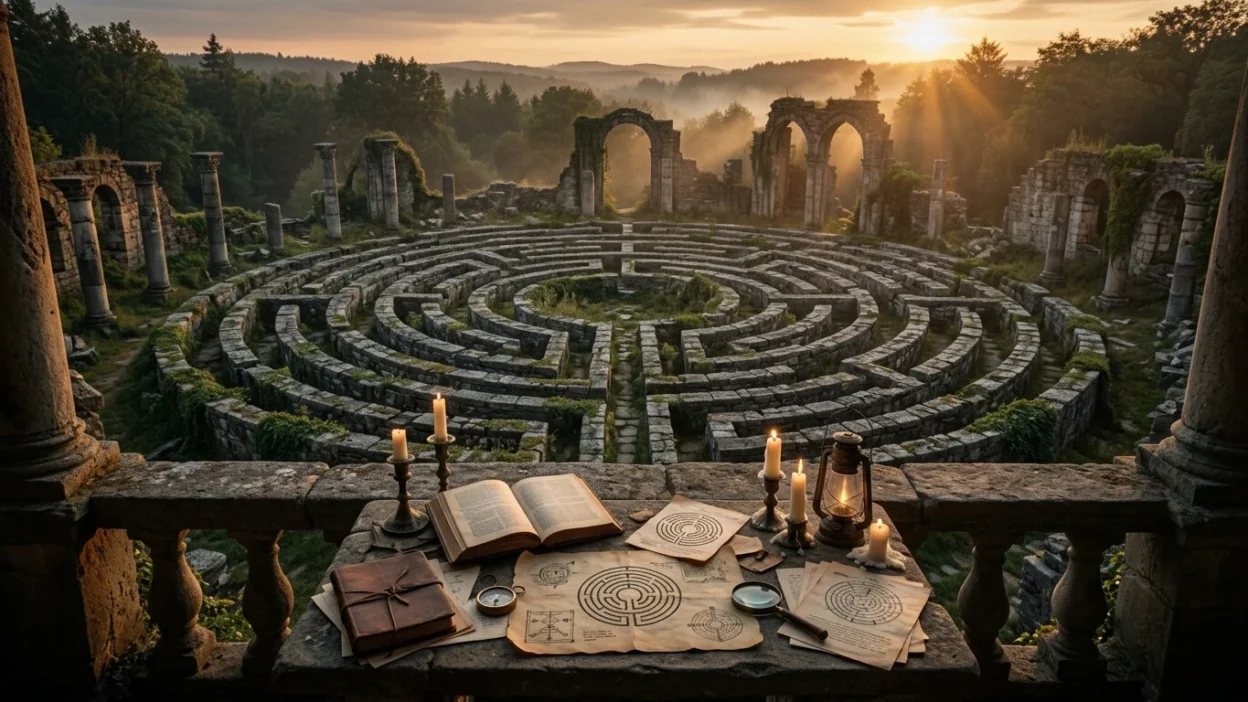
Labyrinth symbolism is commonly connected with the journey through life, personal growth, challenges, self-discovery, and the search for meaning. Unlike a typical maze, a traditional labyrinth usually has a single winding path leading toward a central point and back outward.
Because of this structure, the labyrinth can represent a journey rather than simply a problem to solve. You may enter without knowing exactly where the path will take you, encounter turns and delays, reach a center, and eventually find your way back.
The meaning can change depending on the culture, design, historical period, and personal interpretation. In modern spiritual settings, labyrinths are sometimes used for walking meditation and reflection, while in mythology and art they can represent danger, mystery, transformation, or an encounter with the unknown.
What Does Labyrinth Represent?
A labyrinth can represent several connected ideas:
- Life’s journey: The winding path can symbolize the unpredictable experiences of life.
- Self-discovery: Moving toward the center may represent looking inward and understanding yourself.
- Transformation: Reaching the center and returning can suggest personal change.
- Challenges: The confusing appearance of a labyrinth can represent obstacles and uncertainty.
- Patience: The path requires continued movement rather than instant results.
- Spiritual seeking: In some modern religious and contemplative practices, walking a labyrinth is used for prayer or reflection.
- Finding direction: The single path can symbolize trust in a process even when the destination is not immediately visible.
- Inner wisdom: The center may be interpreted as a place of insight, stillness, or realization.
The labyrinth therefore often carries a hopeful message: being lost in the process does not necessarily mean you are lost forever.
Spiritual Meaning of Labyrinth
Spiritually, the labyrinth is often interpreted as a symbol of an inward and outward journey.
Walking toward the center can represent turning attention inward. A person may use the experience to think about personal questions, relationships, faith, decisions, or life changes.
The center can symbolize a moment of stillness or reflection. Leaving the center and walking outward may then represent returning to ordinary life with a changed perspective.
These interpretations are not universal religious doctrines. They are ways contemporary practitioners and communities may understand the labyrinth.
Labyrinth as a Journey of Faith
Some people view the winding path as an image of spiritual life. Progress may not always be straight, and periods of uncertainty can occur even when someone feels they are moving toward a meaningful goal.
Labyrinth as Inner Reflection
The repetitive movement can create a quiet environment for contemplation. Rather than requiring a particular belief, this use can simply encourage a person to slow down and pay attention.
Labyrinth as Transformation
The journey toward the center and back outward can be understood metaphorically as entering one stage of life, experiencing change, and returning with greater awareness.
Biblical / Religious Meaning of Labyrinth
The Bible does not establish the labyrinth as a specific biblical symbol or religious command. Therefore, claims that the labyrinth has one fixed biblical meaning should be treated cautiously.
However, some Christians and other religious communities have incorporated labyrinth walking into contemporary practices of prayer, meditation, and reflection.
The symbolism is usually interpreted through broader religious ideas such as pilgrimage, spiritual searching, repentance, contemplation, and movement toward God.
The famous labyrinth at Chartres Cathedral is often associated with Christian pilgrimage and spiritual reflection in modern discussions. However, interpretations of its original medieval purpose should not be presented as certain without historical evidence.
In other words, a Christian use of a labyrinth today does not mean that labyrinth symbolism has one universally established biblical definition.
Labyrinth in History and Culture
One of the best-known ancient associations with the labyrinth comes from Greek mythology.
According to the myth of Theseus and the Minotaur, the Minotaur lived in a labyrinth associated with King Minos of Crete. Theseus entered the labyrinth and killed the Minotaur, using a thread provided by Ariadne to help him find his way back. The story became an important subject in Greek and Roman art.
The Metropolitan Museum of Art preserves Greek and Roman objects depicting episodes from this story, including a Roman sarcophagus dating to approximately 130–150 CE.
The Greek Mythological Meaning
Within the Theseus story, the labyrinth can be interpreted as a place of:
- danger
- uncertainty
- confinement
- courage
- confrontation with fear
- transformation
- escape
These meanings come from the narrative itself rather than from a universal rule that every labyrinth must symbolize the same things.
Labyrinths and Christian Art
Labyrinth designs also appeared in medieval European religious settings. Their later interpretation as symbols of pilgrimage and spiritual journeys has become particularly influential.
The labyrinth associated with Chartres Cathedral is one of the most famous examples. Modern visitors and spiritual communities often understand such paths as symbolic journeys, although historians distinguish between documented medieval evidence and later interpretations.
This distinction matters because historical symbols can acquire new meanings over time.
Labyrinth in Literature and Art
The labyrinth has remained powerful in literature and visual art because it naturally represents complexity and uncertainty.
Writers may use a labyrinth as a metaphor for:
- a difficult life situation
- the human mind
- memory
- mystery
- complicated relationships
- searching for truth
- fear of the unknown
- an apparently endless problem
Artists may use winding paths, circular structures, corridors, and maze-like spaces to create feelings of mystery or psychological tension.
The myth of Theseus and Ariadne has also continued to inspire artists. For example, the Metropolitan Museum of Art holds works connected with Ariadne, including Giorgio de Chirico’s Ariadne from 1913.
This continuing artistic interest shows why the labyrinth remains more than an ancient image. It can be adapted to express modern experiences of loneliness, confusion, memory, identity, and searching.
Labyrinth in Dreams
Dream interpretation is subjective, so there is no scientifically established meaning for dreaming about a labyrinth.
However, in common symbolic interpretation, a labyrinth dream may represent a complicated situation or an internal search.
Dreaming of Being Lost in a Labyrinth
This may reflect feelings of uncertainty or difficulty making a decision. It can metaphorically resemble a situation where several possibilities exist but the right direction is unclear.
Finding the Center
Reaching the center may symbolize gaining insight, reaching an important realization, or understanding something that previously seemed confusing.
Escaping a Labyrinth
Finding your way out may represent overcoming an obstacle or feeling ready to move beyond a difficult period.
Walking Calmly Through a Labyrinth
A peaceful experience may symbolize patience, acceptance, or confidence in your personal journey.
Dreams should not be treated as guaranteed predictions. Personal experiences and emotions are usually more important than a fixed dream dictionary.
Positive Symbolism of Labyrinth
The labyrinth has many positive symbolic associations.
Growth
A winding path can represent gradual personal development. Progress does not always happen in a straight line.
Patience
A labyrinth encourages the idea that meaningful destinations can require time.
Self-Discovery
The movement toward the center can represent learning more about your thoughts, values, and identity.
Hope
Even when the path seems complicated, a labyrinth can suggest that there is still a way forward.
Resilience
Repeated turns can symbolize continuing despite uncertainty or setbacks.
Reflection
A labyrinth can create a visual reminder to pause, think, and become more aware of the present moment.
Negative or Hidden Symbolism of Labyrinth
Labyrinths can also carry darker meanings.
Confusion
The winding structure naturally suggests uncertainty and difficulty.
Feeling Trapped
Because the path is enclosed in many designs, it can symbolize emotional or psychological confinement.
Fear of the Unknown
The destination may not be visible, making the labyrinth a useful metaphor for uncertainty.
Repetition
A person may interpret endless turns as being stuck in the same cycle.
Hidden Danger
In the myth of Theseus and the Minotaur, the labyrinth is associated with a dangerous creature and a life-threatening challenge.
This darker interpretation gives the labyrinth a dual character: it can represent both the challenge and the journey through the challenge.
Common Interpretations of Labyrinth
| Labyrinth Symbolism | Possible Interpretation |
| Winding path | Life’s unpredictable journey |
| Center | Insight, reflection, or personal goal |
| Entrance | Beginning of a new stage |
| Exit | Completion or return |
| Turns | Changes and unexpected experiences |
| Darkness | Uncertainty or the unknown |
| Walking | Progress and personal exploration |
| Being lost | Confusion or lack of direction |
| Finding the way | Problem-solving and resilience |
| Minotaur | Fear, danger, or an inner challenge |
| Ariadne’s thread | Guidance and a way through difficulty |
| Circular form | Continuity, cycles, and repeated life experiences |
These interpretations are symbolic rather than universal definitions. Context is important.
Why Does Labyrinth Matter Today?
The labyrinth remains relevant because modern life can often feel complicated and unpredictable.
People face difficult choices about relationships, education, careers, identity, family, and personal goals. The image of a winding path provides a simple way to describe these experiences.
Modern labyrinths are also used in some settings for quiet walking, contemplation, and spiritual reflection. For some people, the activity is religious; for others, it is simply a mindful way to slow down.
The symbol is especially meaningful because it presents uncertainty differently from a traditional maze. A maze is generally designed around wrong turns and dead ends, while a classical labyrinth is often built around a continuous path.
That distinction makes the labyrinth a powerful metaphor for trusting the journey rather than expecting a perfectly straight route.
FAQs:
What is the main meaning of a labyrinth?
The labyrinth commonly symbolizes a journey through uncertainty toward greater understanding, self-discovery, transformation, or a meaningful goal.
What does a labyrinth symbolize spiritually?
Spiritually, a labyrinth may symbolize an inward journey, contemplation, prayer, personal transformation, or the search for deeper meaning. These interpretations vary between individuals and traditions.
Is a labyrinth a biblical symbol?
There is no specific biblical teaching that defines the labyrinth as a biblical symbol. Some modern Christian communities use labyrinths for prayer and reflection, but this is a later religious practice rather than a clearly defined biblical command.
What does a labyrinth symbolize in Greek mythology?
In the myth of Theseus and the Minotaur, the labyrinth is associated with danger, confinement, mystery, and the challenge Theseus must overcome. Ariadne’s thread helps Theseus navigate his way back out.
What does walking a labyrinth symbolize?
Walking a labyrinth may symbolize a personal or spiritual journey. The center can represent reflection or insight, while the return journey may represent bringing that insight back into everyday life.
What does a labyrinth symbolize in dreams?
A labyrinth dream may be interpreted as a symbol of confusion, searching, difficult choices, personal growth, or an attempt to find direction. Dream symbolism is subjective and does not have one scientifically proven interpretation.
What does finding the center of a labyrinth mean symbolically?
Finding the center can symbolize reaching an important realization, discovering something about yourself, or arriving at a meaningful stage in a personal journey.
What does a labyrinth tattoo symbolize?
A labyrinth tattoo may represent personal growth, overcoming challenges, self-discovery, spiritual searching, resilience, or life’s winding journey. The meaning ultimately depends on the person wearing it.
Is a labyrinth the same as a maze?
Not exactly. A maze generally contains choices, wrong turns, and dead ends, while a traditional labyrinth usually has one continuous path toward the center. The two terms are sometimes used interchangeably in everyday language, but their designs and symbolic associations can differ.
Conclusion
Labyrinth symbolism centers on the idea of a journey through complexity toward understanding. It can represent life, self-discovery, patience, transformation, spiritual reflection, uncertainty, and the courage to continue moving forward.
Its history also adds depth to the symbol. From the Greek story of Theseus and the Minotaur to later artistic and religious uses, the labyrinth has repeatedly been adapted to express different human experiences.
Ultimately, the labyrinth does not have one universal meaning. Its symbolism depends on its historical context, cultural setting, design, and the person interpreting it. Yet its central image remains powerful: the path may twist and turn, but the journey itself can lead to greater understanding.

Ryan Thomas is a passionate writer at SymbolTrue, dedicated to exploring the meanings, history, and cultural significance of symbols worldwide. He creates engaging, well-researched content that helps readers discover the stories and symbolism behind everyday signs, icons, and traditions.