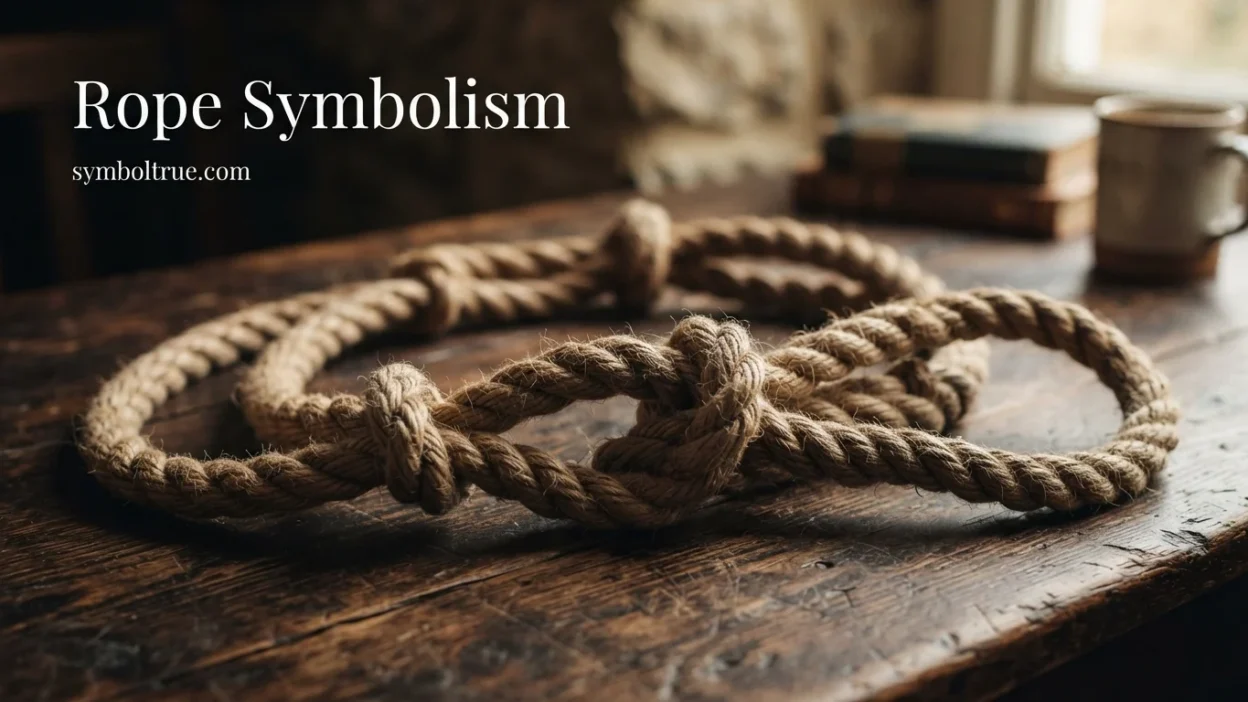
Rope symbolism often represents connection, strength, unity, support, and the ties that hold people or situations together. At the same time, rope can symbolize restriction, dependence, struggle, or feeling trapped, depending on how it appears and how it is used.
From ancient traditions and religious stories to dreams, literature, and modern art, the rope has carried many layers of meaning. Understanding the context is the key to interpreting its symbolism.
Rope Symbolism Meaning (Clear Definition)
The simplest meaning of rope symbolism is connection and strength through separate strands coming together. A single strand may be weak, but several strands twisted together can become strong enough to pull, secure, support, or carry weight.
Because of this physical quality, rope has naturally become a symbol of relationships, cooperation, resilience, and shared strength.
However, rope does not always have a positive meaning. It can also represent boundaries, restraint, obligation, control, or being unable to move freely.
The meaning usually depends on the situation.
For example:
- A strong rope can symbolize strength, stability, and resilience.
- A tied rope can represent commitment, unity, or restriction.
- A broken rope may symbolize separation, freedom, or the end of a relationship.
- A rope pulling something upward can represent help, hope, and support.
- A tangled rope can symbolize confusion or complicated relationships.
- A rope bridge can represent transition, courage, and overcoming obstacles.
- A rope used to bind someone can symbolize control, fear, or loss of freedom.
This contrast makes rope symbolism especially interesting. The same object can represent both connection and confinement.
What Does Rope Symbolism Represent?
Rope symbolism can represent several important ideas in human life.
Connection and Relationships
Rope is made by bringing strands together. This makes it a natural symbol of relationships and emotional bonds.
It may represent friendship, family ties, marriage, teamwork, or a connection between two people who support one another.
The stronger the rope, the stronger the symbolic bond may appear.
Strength and Resilience
Rope can withstand tension and carry heavy loads. As a symbol, it can represent the ability to remain strong during difficult circumstances.
Seeing rope in a symbolic context may suggest endurance, determination, or the strength needed to keep going.
Unity and Cooperation
Many ropes are created from multiple fibers or strands working together. This makes rope a powerful image of unity.
It can suggest that people are stronger when they cooperate rather than struggle alone.
Support and Protection
Ropes are commonly used to secure, hold, rescue, and stabilize. Because of this, rope symbolism can represent emotional or practical support.
A rope offered to someone may symbolize a helping hand during a difficult period.
Commitment and Responsibility
A knot can secure two ends together, making it a symbol of promises, commitments, and responsibilities.
In this sense, rope may represent something that connects people through an agreement or lasting obligation.
Restriction and Control
The darker side of rope symbolism appears when rope is used to restrain or imprison.
In such situations, rope can symbolize feeling controlled, restricted, dependent, or unable to make an independent choice.
| Rope SymbolCommon Symbolic Meaning | |
|---|---|
| Strong rope | Strength and resilience |
| Knotted rope | Commitment and unity |
| Broken rope | Separation or freedom |
| Tangled rope | Confusion and complications |
| Rope bridge | Transition and courage |
| Lifeline rope | Hope and support |
| Bound rope | Restriction or control |
| Coiled rope | Potential, readiness, or stored energy |
Spiritual Meaning of Rope Symbolism
Spiritually, rope symbolism can represent the invisible connections that hold people, experiences, and beliefs together.
A rope may suggest that life is not made entirely of isolated moments. Relationships, choices, memories, responsibilities, and beliefs can become connected over time.
A strong rope can therefore symbolize spiritual resilience. It may reflect the idea that a person can survive difficult experiences by remaining connected to faith, community, loved ones, or a deeper sense of purpose.
Rope as a Symbol of Spiritual Connection
A rope made from many strands can be viewed as a metaphor for interconnectedness.
Each strand has its own identity, but together the strands create something stronger. Spiritually, this can represent people coming together while still remaining individuals.
Rope as a Lifeline
A rope used for rescue has a particularly hopeful meaning.
It can symbolize guidance, protection, help, or the belief that support is available even during difficult moments.
If rope appears during an emotionally important period, it may encourage you to recognize the people, beliefs, or resources helping you remain steady.
Rope as a Symbol of Letting Go
A broken or released rope can have an entirely different spiritual interpretation.
It may represent letting go of an unhealthy attachment, leaving the past behind, or gaining freedom from something that has limited personal growth.
The symbolism is not necessarily negative. Sometimes releasing a connection is part of becoming stronger.
Biblical / Religious Meaning of Rope Symbolism
Rope does not have one universal meaning in the Bible or in every religious tradition. Its interpretation depends on the particular passage, image, or tradition.
In biblical language and Christian symbolism, ideas associated with cords, bonds, lines, and cords of connection can suggest relationships, commitments, restraint, or deliverance.
One well-known biblical image is the idea of a cord of three strands, found in Ecclesiastes 4:12. The passage emphasizes the strength that comes from companionship and mutual support. This has often been connected with the broader symbolic idea that unity makes people stronger.
Rope can also have a darker religious meaning when it is associated with captivity, punishment, or bondage. In that context, it may represent spiritual or physical oppression.
In religious art and storytelling, therefore, rope can symbolize both bondage and deliverance.
Other traditions also use cords, threads, knots, or woven materials as symbols of connection, vows, protection, or spiritual relationships. These meanings vary greatly across cultures, so it is important not to treat every religious use of rope as having the same interpretation.
Rope Symbolism in History and Culture
Rope has been essential to human civilization for thousands of years. People have used natural fibers to create ropes for fishing, hunting, construction, transportation, agriculture, sailing, and everyday work.
Because rope was so important to survival, it became associated with practical strength and human cooperation.
In maritime cultures, rope carries especially strong symbolism. Sailors depend on ropes to control sails, secure equipment, and keep vessels safe. This gives rope associations with discipline, teamwork, navigation, and survival.
Rope also appears in traditional crafts, ceremonies, and forms of decoration.
Knots can be particularly meaningful because they join or secure separate ends. A knot may symbolize a promise, a bond, permanence, or an agreement.
At the same time, historical uses of rope in punishment and imprisonment created darker associations. This is why rope symbolism can move between ideas of security and captivity.
Rope Symbolism in Literature and Art
Writers and artists often use rope because its meaning can change depending on the surrounding story.
A character holding a rope may symbolize hope or rescue. A character trapped by one may represent oppression or helplessness.
A rope stretched between two places can symbolize a difficult connection or a relationship that requires balance.
A broken rope may represent the end of a relationship, freedom from the past, or the collapse of something once considered secure.
In poetry, rope can also represent emotional ties. A person may feel “tied” to a place, memory, relationship, responsibility, or past experience.
Artists can use knots and intertwined ropes to explore themes such as identity, family, community, dependence, and human connection.
Because rope has both protective and restrictive uses, it gives artists a simple object with surprisingly deep emotional possibilities.
Dream Meaning of Rope Symbolism
Dreams involving rope can have different meanings depending on the details and emotions involved.
There is no single universal interpretation, but rope dreams often relate to relationships, control, responsibility, obstacles, support, or the desire for freedom.
Dreaming of Holding a Rope
Holding a rope may symbolize having something to rely on or trying to maintain control over a situation.
It can also represent your determination to stay connected to someone or something important.
Dreaming of a Broken Rope
A broken rope may represent separation, change, or release.
If the dream feels peaceful, it could symbolize freedom from an unwanted situation. If it feels painful, it may reflect fear of losing an important relationship.
Dreaming of a Tangled Rope
A tangled rope can represent complicated thoughts, difficult relationships, or a problem that seems harder to solve than expected.
The dream may reflect a desire to untangle a situation in your waking life.
Dreaming of Climbing a Rope
Climbing a rope can symbolize ambition, progress, struggle, and personal growth.
If you successfully reach the top, the dream may reflect confidence in overcoming an obstacle. If you struggle to climb, it may represent frustration or fear about reaching a goal.
Dreaming of Being Tied With Rope
Being tied may symbolize feeling restricted or controlled.
It can represent a relationship, responsibility, fear, or situation that makes you feel unable to move forward.
The emotions you experience in the dream are especially important when interpreting this type of imagery.
Modern Meaning of Rope Symbolism
Today, rope symbolism continues to appear in photography, tattoos, fashion, graphic design, film, social media imagery, and contemporary art.
A rope tattoo may symbolize strength, family connection, survival, loyalty, or overcoming hardship.
A knot may represent an unbreakable relationship or an important promise.
A broken rope may symbolize independence, healing, or leaving a difficult chapter behind.
A rope used as a lifeline often represents hope and support.
Modern interpretations tend to be highly personal. Someone who has overcome a difficult experience may see rope as a symbol of survival, while someone who has felt controlled may see the same object as a symbol of restriction.
This personal connection is what makes rope symbolism so powerful.
Common Secondary Meanings of Rope Symbolism
Several related concepts frequently appear when people interpret rope as a symbol:
- Connection symbolism: Represents emotional, social, or spiritual bonds.
- Strength symbolism: Suggests resilience and the ability to withstand pressure.
- Unity symbolism: Represents separate parts becoming stronger together.
- Bond symbolism: Can describe commitment, loyalty, or attachment.
- Freedom symbolism: A broken or released rope can represent liberation.
- Protection symbolism: A secured rope can represent safety and stability.
- Restriction symbolism: A binding rope can represent control or lack of freedom.
Is Rope Symbolism Always Positive?
No. Rope symbolism can be positive, negative, or neutral.
It may represent love, unity, support, and strength, but it can also represent control, dependence, restriction, or emotional burdens.
The context determines which meaning is most appropriate.
What Does a Broken Rope Symbolize?
A broken rope commonly symbolizes separation, freedom, release, or the end of a connection.
Its meaning depends on the situation. It can represent painful loss or a positive decision to move away from something restrictive.
What Does a Knot Symbolize Spiritually?
A knot can symbolize connection, commitment, unity, and lasting bonds.
Spiritually, it may represent relationships or promises that remain connected through challenges and change.
What Does Rope Symbolize in a Dream?
Rope in a dream may symbolize connection, support, control, responsibility, or the desire for freedom.
The meaning becomes clearer by considering whether the rope was strong, broken, tangled, used for climbing, or used to restrain someone.
Why Is Rope a Symbol of Strength?
Rope is made by combining strands, and the resulting structure can withstand significant tension.
This physical quality makes it a natural metaphor for resilience, cooperation, and the idea that unity can create greater strength.
Conclusion
Rope symbolism is ultimately about connection and tension. It can hold people together, provide support, help someone climb higher, or become a restriction that prevents movement.
Its deepest meaning often depends on one simple question: Is the rope helping you stay connected, or is it keeping you from moving forward?
Seen positively, rope can remind us that strength often comes from unity, support, commitment, and resilience. Seen differently, it can remind us that healthy growth sometimes requires loosening a bond and finding the freedom to move ahead.

Henry Jack is the Administrator of SymbolTrue, ensuring the website runs smoothly while overseeing content quality, user experience, and daily operations. He is passionate about helping readers explore symbols, meanings, and cultural insights.