Time is one of the most powerful symbols in human life. It represents change, growth, aging, opportunity, memory, and the movement from one stage of life to another. Time symbolism often reminds us that nothing stays exactly the same forever and that every moment carries meaning.
From ancient cultures and religious traditions to literature, art, dreams, and modern life, time can symbolize both hope and loss. A clock may represent the passing of life, while an hourglass can suggest that our opportunities are limited. Sunrise may symbolize a new beginning, while sunset can represent closure or the end of a chapter.
Understanding the symbolism of time can help us look at familiar objects and experiences in a deeper way.
Time Symbolism Meaning (Clear Definition)
Time symbolism is the use of time, clocks, seasons, cycles, ages, and other time-related ideas to represent deeper meanings such as change, mortality, growth, patience, opportunity, and renewal.
Time is rarely just about hours and minutes when used symbolically. It often represents the journey of life itself.
Some of the most common meanings associated with time include:
- Change: Time reminds us that life is always moving forward.
- Growth: The passage of time allows people, relationships, and ideas to develop.
- Mortality: Time can remind us that human life is temporary.
- Patience: Time can symbolize waiting and trusting a process.
- Opportunity: A particular moment may represent a chance that should not be missed.
- Memory: Time connects the present with experiences from the past.
- Renewal: Cycles of time suggest that endings can lead to new beginnings.
- Wisdom: Growing older is often associated with knowledge and experience.
In simple terms, time symbolism often asks us to consider where we have been, where we are now, and where we are going.
What Does Time Symbolism Represent?
Time can represent many different ideas depending on the context.
Change and Transformation
One of the strongest meanings of time is change. Everything develops, ages, disappears, or transforms with time.
A young tree becoming large and mature can symbolize personal growth. Similarly, an old photograph may represent how dramatically life can change.
Life and Mortality
Time is closely connected with human mortality. Birth, youth, adulthood, old age, and death form a natural progression.
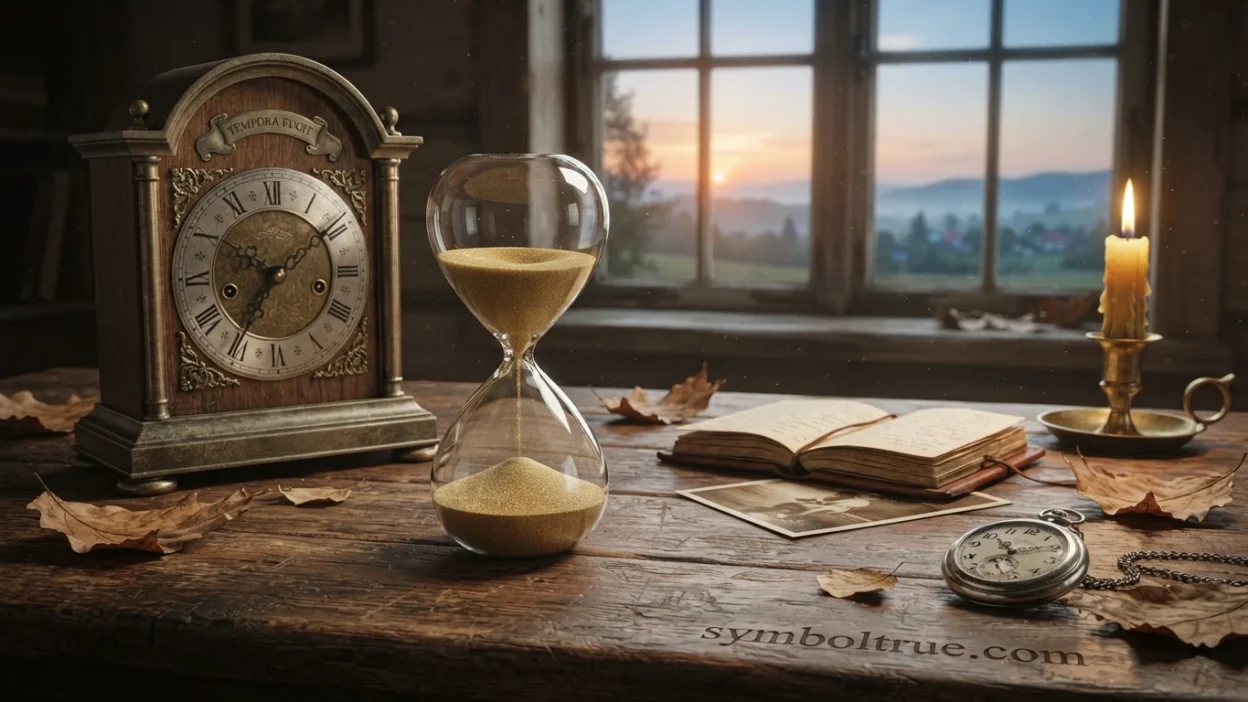
Because of this, clocks and hourglasses are sometimes used as reminders that human life is limited.
Patience and Progress
Time can also symbolize patience. Some things cannot be rushed.
Healing, learning, building relationships, and reaching important goals often require time. In this sense, time represents gradual progress rather than immediate results.
Memory and the Past
Time connects people with memories. Old photographs, watches, diaries, calendars, and historical objects can symbolize moments that have already passed.
This meaning can be comforting, but it can also create feelings of nostalgia or sadness.
Hope and the Future
Time is not only about the past. It can represent future possibilities.
The idea that tomorrow brings another opportunity makes time a symbol of hope, renewal, and second chances.
Spiritual Meaning of Time Symbolism
Spiritually, time often represents the journey of the soul, personal growth, divine timing, and the temporary nature of earthly life.
Many spiritual traditions encourage people to recognize that life is constantly changing. Time can therefore teach acceptance, patience, and awareness.
A repeated clock time may be interpreted by some people as a meaningful reminder to pause and reflect. However, such interpretations are personal rather than universal.
Time as Divine Timing
In spiritual thought, events are sometimes described as happening at the right moment rather than simply according to human plans.
This idea can encourage patience when life does not develop as quickly as expected.
Time as a Life Journey
Time can symbolize the stages of personal development. Difficult periods may eventually lead to greater understanding, while joyful periods may become treasured memories.
Time as Impermanence
Another important spiritual meaning is impermanence. Everything in the physical world changes.
Recognizing this can encourage people to appreciate the present instead of holding too tightly to what cannot remain forever.
Biblical / Religious Meaning of Time Symbolism
Time has an important symbolic role in religious thought, including Christianity and other major traditions.
In the Bible, time is often connected with creation, seasons, human life, waiting, divine purpose, and the contrast between earthly existence and eternity.
The biblical idea of “a time for everything” is especially influential. It presents life as containing different seasons and moments, each with its own purpose.
Time can therefore symbolize:
- Divine order
- Human mortality
- Patience and waiting
- Seasons of life
- Judgment and accountability
- Creation and renewal
- Eternity
In Christianity, earthly time is often viewed in contrast with eternity. Human life has a beginning and an end, while God is understood as eternal.
Other religious traditions also use cycles, seasons, festivals, ages, and life stages to express ideas about renewal, spiritual development, death, and rebirth.
Time Symbolism in History and Culture
Human societies have used time as a symbol for thousands of years.
Ancient civilizations created calendars to understand agricultural seasons, religious festivals, celestial movements, and important social events. As people developed more precise methods of measuring time, clocks and watches also became powerful cultural symbols.
The Hourglass
The hourglass is one of the clearest symbols of passing time. As sand moves from one chamber to another, it visually demonstrates that time is running out.
It can symbolize:
- Mortality
- Limited opportunity
- Patience
- Passing moments
- The temporary nature of life
The Clock
A clock can represent order, routine, deadlines, aging, or the pressure of modern life.
A broken clock may symbolize stopped progress, a frozen moment, or something from the past that has not been resolved.
Seasons
The four seasons are powerful symbols of the natural cycle of time.
| Time Symbol | Common Symbolic Meaning |
|---|---|
| Spring | Renewal, youth, hope, new beginnings |
| Summer | Growth, energy, abundance, maturity |
| Autumn | Change, harvest, reflection, transition |
| Winter | Rest, endings, stillness, preparation |
| Clock | Passing time, routine, mortality |
| Hourglass | Limited time, patience, mortality |
| Sunrise | Beginning, hope, renewal |
| Sunset | Completion, closure, transition |
| Calendar | Cycles, planning, important milestones |
Different cultures may give these symbols additional meanings based on their own traditions and beliefs.
Time Symbolism in Literature and Art
Time has been a major theme in literature and art because it reflects some of the deepest human experiences.
Writers often use time to explore memory, aging, regret, love, death, change, and the desire to return to the past.
A character remembering childhood may represent nostalgia. A clock ticking loudly may create a sense of urgency. A fading photograph may symbolize the inability to stop time.
Artists also use visual representations of time to communicate powerful ideas.
An old clock surrounded by fading objects can symbolize mortality. A growing tree can represent the passage of years. Repeated images of the same person at different ages can show transformation.
Common Literary Time Symbols
- Clock: The pressure and movement of time
- Hourglass: Limited life or opportunity
- Fading photograph: Memory and the past
- Aging person: Mortality and experience
- Seasonal change: Transformation and life cycles
- Sunrise: Hope and beginnings
- Sunset: Endings and reflection
- Repetition: Cycles and recurring experiences
Time can also be portrayed as something that heals, destroys, reveals, or changes people.
Dream Meaning of Time Symbolism
Dreams involving time can have different meanings depending on the dreamer’s emotions and circumstances.
Seeing a clock may reflect awareness of deadlines, responsibilities, aging, or a feeling that time is moving quickly.
An hourglass may symbolize concern about limited time or an important opportunity.
A dream about being late can represent anxiety about missing an opportunity or failing to meet expectations. A stopped clock may suggest feeling stuck or unable to move forward.
Common dream interpretations include:
- Running out of time: Pressure, anxiety, or fear of missing an opportunity
- Broken clock: Feeling stuck or disconnected from progress
- Stopped time: Emotional stagnation or a desire to preserve a moment
- Going backward in time: Nostalgia, regret, or a wish to change the past
- Fast-moving time: Feeling that life is changing too quickly
- Waiting for a specific time: Anticipation, patience, or uncertainty
Dream symbolism is highly personal, so the meaning of a time-related dream depends strongly on the dreamer’s emotions and life situation.
Modern Meaning of Time Symbolism
In modern life, time often symbolizes productivity, success, pressure, and balance.
Digital clocks, countdown timers, calendars, schedules, and deadlines have made time an important part of everyday life.
People often say they are “running out of time” when they feel overwhelmed. This expression shows how strongly time is connected with pressure and responsibility.
At the same time, modern discussions about slowing down and living in the present have given time another meaning: mindfulness.
Instead of constantly trying to save time or use every minute productively, people may choose to appreciate ordinary moments.
Time can therefore symbolize both the pressure to achieve and the freedom to simply experience life.
The Deeper Symbolism of Time
Time has a unique symbolic power because nobody can completely control it.
Money can be earned again. Objects can sometimes be replaced. But a particular moment cannot be recovered once it has passed.
This gives time a connection with gratitude.
A simple conversation, family gathering, childhood memory, or quiet morning may seem ordinary while it is happening. Later, it can become deeply meaningful.
Time symbolism therefore encourages us to value moments while we still have them.
It can also remind us that difficult periods do not necessarily last forever. Just as seasons change, personal circumstances can change too.
Positive and Negative Meanings of Time Symbolism
Time symbolism can carry both hopeful and difficult meanings.
Positive meanings include:
- Growth
- Wisdom
- Renewal
- Patience
- Hope
- Opportunity
- Healing
- New beginnings
Negative meanings can include:
- Aging
- Death
- Regret
- Missed opportunities
- Anxiety
- Loss
- Pressure
- Impermanence
The same symbol can communicate opposite ideas depending on its context. A clock, for example, can represent organization and stability for one person but stress and deadlines for another.
Why Is Time Such a Powerful Symbol?
Time is powerful because it is universal.
Every person experiences childhood, change, waiting, aging, memories, and uncertainty about the future. Although cultures understand time in different ways, the experience of passing time is shared across humanity.
Time also connects opposites: beginning and ending, youth and age, memory and possibility, loss and renewal.
That is why time appears so often in religious teachings, art, literature, dreams, and everyday expressions.
FAQs:
What does time symbolize?
Time commonly symbolizes change, growth, mortality, patience, memory, opportunity, and the journey of life. Its exact meaning depends on the situation and cultural context.
What does a clock symbolize spiritually?
A clock can symbolize divine timing, life’s limited nature, awareness, patience, and the importance of using one’s time wisely. Spiritual interpretations vary between traditions and individuals.
What does an hourglass symbolize?
An hourglass commonly symbolizes passing time, limited opportunities, mortality, and the temporary nature of life. The falling sand visually represents moments that cannot be recovered.
What does time symbolize in dreams?
Time in dreams may represent deadlines, anxiety, change, regret, anticipation, or a feeling of being stuck. The meaning often depends on what happened in the dream and how the dreamer felt.
Is time a symbol of change?
Yes. Time is one of the strongest symbols of change because everything develops, ages, transforms, or eventually comes to an end as time passes.
Conclusion
Time symbolism reminds us that life is always moving. It can represent growth, change, mortality, patience, memory, opportunity, and hope for what comes next.
A clock may remind us that moments are limited, while the changing seasons can show that every ending may lead to another beginning. Ultimately, the symbolism of time invites us to respect the past, appreciate the present, and move toward the future with greater awareness.

Henry Jack is the Administrator of SymbolTrue, ensuring the website runs smoothly while overseeing content quality, user experience, and daily operations. He is passionate about helping readers explore symbols, meanings, and cultural insights.