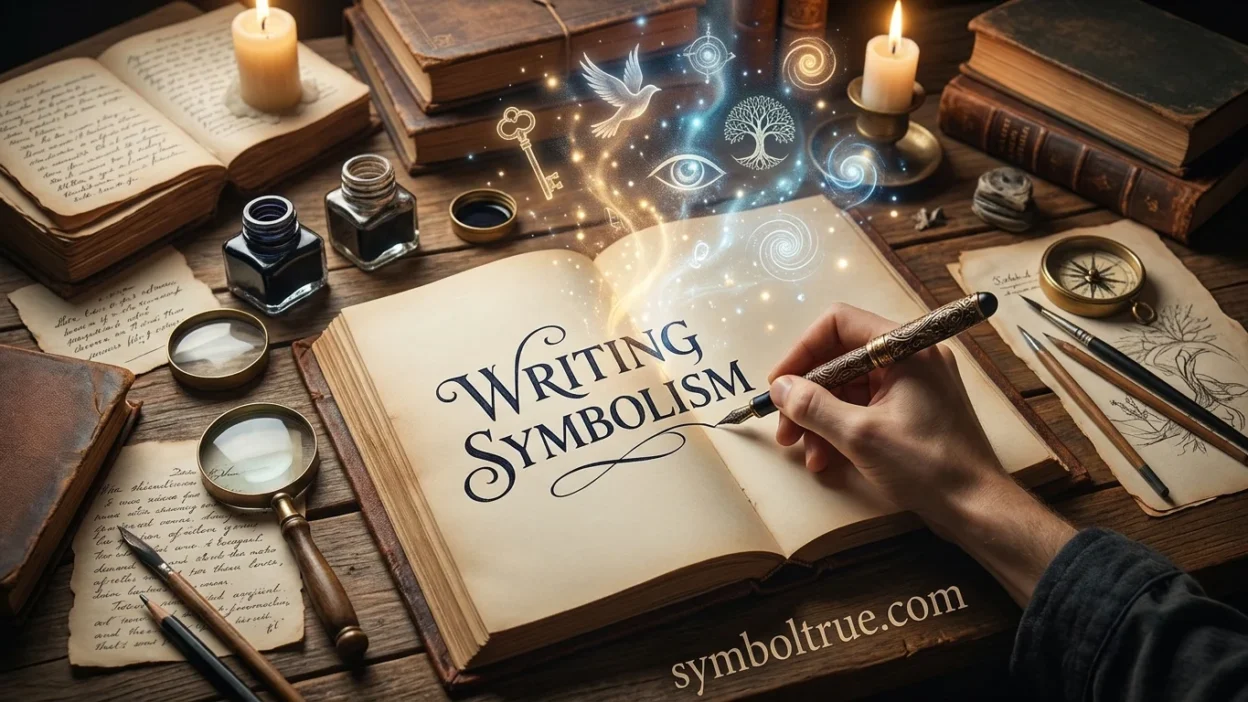
Writing is more than a way to communicate information. It can represent knowledge, identity, creativity, memory, freedom, and the human desire to share ideas across generations. Writing symbolism explores the deeper meanings associated with written words, handwriting, letters, books, manuscripts, and the act of putting thoughts on paper.
Across different cultures and historical periods, writing has represented the preservation of wisdom, the power of language, and the ability to make invisible thoughts visible. A handwritten letter may symbolize love, while an ancient manuscript can represent forgotten knowledge or cultural heritage. A journal may symbolize self-discovery, and a signed document can represent commitment or responsibility.
The symbolism of writing depends on its context, purpose, and the person interpreting it. Understanding these associations helps us appreciate how writing communicates emotions and ideas beyond the literal meaning of words.
Writing Symbolism Meaning (Clear Definition)
Writing symbolism refers to the deeper ideas, values, emotions, and concepts represented by writing and written objects. It includes the symbolic meanings associated with handwriting, books, letters, diaries, inscriptions, and written messages.
Writing often symbolizes the ability to preserve thoughts and communicate them beyond the limits of spoken conversation. Unlike speech, written language can remain available long after its author has finished speaking or has passed away.
For example:
- Knowledge and wisdom: Books and manuscripts often represent learning, education, and intellectual growth.
- Communication and connection: Letters and written messages can symbolize affection, friendship, and understanding.
- Memory and preservation: Diaries and historical documents represent experiences and information preserved over time.
- Identity and individuality: Handwriting and personal signatures can symbolize a person’s individuality and presence.
- Freedom and expression: Writing can represent the ability to share opinions, challenge established ideas, and express personal experiences.
- Commitment and responsibility: Contracts, promises, and signed documents can symbolize agreements and obligations.
These meanings are not universal rules. A letter, for example, might represent love to one person and grief to another, depending on the circumstances surrounding it.
What Does Writing Represent?
Writing can represent several important aspects of human life. Its symbolism becomes clearer when we consider what written communication allows people to accomplish.
1. Knowledge and Learning
Writing is closely associated with education because it allows information to be recorded, studied, and shared. Books, notebooks, and handwritten notes can symbolize the pursuit of knowledge.
An open book in a painting might represent curiosity or intellectual discovery. A notebook filled with observations may symbolize a person’s commitment to learning.
2. Communication and Connection
Writing allows people to communicate across distance and time. A letter from a loved one can represent emotional closeness even when two people cannot meet in person.
Emails, personal messages, and postcards can also symbolize connection. Their meaning often comes from the relationship between the writer and the recipient.
3. Memory and the Past
Written records preserve experiences that might otherwise be forgotten. Diaries, family letters, and old journals can symbolize personal history and the desire to remember meaningful moments.
An old handwritten note may carry emotional value because it preserves a person’s words in a recognizable form.
4. Identity and Individuality
Writing can reveal aspects of identity through word choice, handwriting, storytelling, and personal expression.
An author’s signature may symbolize creative ownership, while a journal may represent an individual’s private thoughts and evolving sense of self.
5. Power and Authority
Throughout history, written laws, official records, and royal decrees have been used to establish rules and communicate authority.
A signed document may symbolize a binding agreement, while a written law can represent the structure of a society. Writing can also challenge authority when people use it to question unfair systems or express dissent.
6. Creativity and Imagination
Poems, novels, scripts, and stories demonstrate how writing transforms imagination into something others can experience.
A blank page may symbolize possibility, while a completed manuscript may represent achievement, patience, and creative fulfillment.
Spiritual Meaning of Writing Symbolism
In spiritual interpretations, writing may represent reflection, intention, wisdom, revelation, and the search for meaning. These associations depend on individual beliefs and cultural traditions rather than a single universal spiritual system.
Writing as a Form of Self-Discovery
Keeping a journal can help people explore their feelings, examine personal experiences, and clarify their values.
Symbolically, this process may represent an inner journey. Writing down thoughts turns private experiences into visible words that can be examined and understood.
Writing as Intention and Commitment
Some spiritual practices involve writing goals, prayers, affirmations, or personal intentions.
In these contexts, writing can symbolize dedication and conscious purpose. The act of recording an intention may help someone remember what matters to them, although writing alone does not guarantee that a desired outcome will occur.
Writing as the Preservation of Wisdom
Sacred texts, philosophical works, and traditional teachings often use writing to preserve ideas across generations.
For readers who consider these texts spiritually important, written words may represent guidance, truth, moral reflection, or a connection with their tradition.
Writing as a Path Toward Healing
Personal writing is sometimes used to process difficult experiences or express emotions that are challenging to discuss aloud.
Its symbolism can involve release, acceptance, and renewal. However, the emotional meaning of writing differs from person to person, and writing is not a substitute for professional help when that help is needed.
Biblical and Religious Meaning of Writing Symbolism
Writing has important roles in several religious traditions. Its meaning varies according to the text, historical setting, and beliefs of the community interpreting it.
Writing in the Bible
In the Bible, writing is associated with recording commandments, preserving teachings, documenting events, and communicating messages.
For example, Exodus 31:18 describes the tablets of the testimony as written with the finger of God. This passage connects writing with divine commandments and religious authority within the biblical narrative.
Other biblical passages refer to written records, genealogies, books, and scrolls. These references demonstrate the importance of preserving laws, histories, and teachings within the religious tradition.
The symbolism of writing in the Bible may therefore include:
- Divine instruction: Written commandments and teachings.
- Remembrance: Recording events and promises.
- Authority: Documents associated with laws and covenants.
- Accountability: Written records connected with judgment or responsibility.
- Preservation: Passing religious teachings from one generation to another.
These interpretations should be understood within their biblical context rather than treated as meanings that apply to every example of writing.
Writing in Other Religious Traditions
Written texts also hold significant places in other religions.
In Islam, the Quran is central to religious life, and calligraphy has developed as an important art form in Islamic cultures. Quranic inscriptions may combine religious text with visual beauty and reverence.
In Judaism, the Torah and other sacred writings play central roles in religious learning, worship, and communal identity. The careful production and preservation of sacred scrolls reflect their religious importance.
In Buddhism, written scriptures and teachings have helped preserve and transmit different Buddhist traditions. Depending on the context, manuscripts can symbolize learning, discipline, and the continuation of the teachings.
These traditions are diverse, and their interpretations should not be reduced to one general meaning. Nevertheless, they illustrate how writing can serve as a vehicle for sacred knowledge and cultural continuity.
Writing in History and Culture
Writing has transformed human societies by making it possible to preserve information, organize institutions, and transmit knowledge beyond individual memory.
The Beginnings of Written Records
Some of the earliest known writing systems developed in ancient Mesopotamia and ancient Egypt during the late fourth millennium BCE. Early writing served practical purposes, including recordkeeping, administration, and the documentation of goods and transactions.
Over time, writing became associated with government, religion, literature, law, and scholarship.
Because written records could preserve information, they also became symbols of institutional authority and collective memory.
Ancient Manuscripts and Scrolls
Ancient manuscripts and scrolls often symbolize the preservation of knowledge. Their historical value may come from the information they contain, their age, their material construction, or their connection to a particular community.
A weathered scroll in a historical painting might suggest mystery, forgotten wisdom, or the survival of ancient traditions.
These symbolic associations are artistic interpretations, not necessarily the original purposes of the documents.
Writing and Cultural Identity
Languages and writing systems are closely connected with cultural identity. Written literature, traditional stories, poetry, and historical records can help communities preserve their heritage.
For example, Urdu poetry carries rich literary and cultural traditions, while written Punjabi folk tales preserve stories, values, and experiences associated with Punjabi-speaking communities.
Writing can also help protect endangered languages by recording vocabulary, grammar, oral histories, and traditional knowledge.
Writing as a Symbol of Freedom
Writing has often provided a means of expressing ideas that may be difficult to communicate openly.
Letters, essays, memoirs, and political literature can preserve personal experiences and challenge prevailing assumptions. In this context, writing may symbolize independence, courage, resistance, and the right to express oneself.
At the same time, written language has also been used to enforce censorship, maintain bureaucracy, and exercise control. Its symbolism therefore includes both empowerment and authority.
Writing Symbolism in Literature and Art
Writers and artists frequently use writing as a symbol rather than merely a method of communication.
The Blank Page
A blank page often symbolizes potential, uncertainty, and new beginnings.
For a writer, it may represent the freedom to create something original. It can also express anxiety about the future or difficulty finding the right words.
In visual art, a blank page may suggest an unfinished journey or an opportunity that has not yet been explored.
The Open Book
An open book commonly represents knowledge, discovery, learning, and understanding.
When depicted with light, it may suggest enlightenment or intellectual awakening. When shown beside a candle, it can symbolize study, reflection, or the pursuit of truth.
The surrounding imagery influences its meaning.
The Old Letter
An old letter can represent nostalgia, love, loss, secrets, or an unresolved connection.
In novels and films, discovering a forgotten letter may reveal hidden information about a character’s past. The letter becomes a symbol of memories that continue to influence the present.
The Pen
A pen often symbolizes creativity, authorship, communication, and the power of ideas.
The expression “the pen is mightier than the sword” is commonly understood to emphasize the influence of writing and ideas compared with physical force. Its meaning is figurative rather than a claim that writing always defeats violence.
Ink and Handwriting
Ink can symbolize permanence, expression, and the act of making an idea tangible. Handwriting may represent intimacy, individuality, or a direct connection with the person who wrote the words.
However, handwriting does not reliably reveal someone’s personality or moral character. Its symbolic meaning in art and literature should be distinguished from unsupported claims about psychological interpretation.
Writing Symbolism in Dreams
Dreams about writing may reflect personal concerns, memories, goals, or experiences with communication. There is no scientifically established universal dictionary that determines the meaning of every writing-related dream.
The following interpretations are possibilities for personal reflection, not predictions or guaranteed spiritual messages.
Dreaming of Writing in a Notebook
Writing in a notebook may remind you of planning, self-reflection, or an experience you want to remember.
Consider whether you are organizing your thoughts or trying to make an important decision in waking life.
Dreaming of Writing a Letter
A letter in a dream may bring attention to communication, emotional connection, or something left unsaid.
The interpretation may depend on whom the letter concerns and whether writing it feels comforting, difficult, or urgent.
Dreaming of Being Unable to Write
Difficulty writing may reflect frustration, uncertainty, or a feeling that you cannot express yourself clearly.
It may also be influenced by ordinary experiences, such as work pressure, school responsibilities, or a recent writing task.
Dreaming of Reading an Old Manuscript
An old manuscript may evoke history, forgotten memories, curiosity, or the search for answers.
If the dream feels mysterious, consider whether there is an unresolved question in your life. The dream itself does not establish that hidden knowledge or supernatural information is being revealed.
Dreaming of Writing Your Name
Writing your name may prompt reflection on identity, recognition, responsibility, or personal change.
Its significance depends on the emotions and circumstances associated with the dream.
Positive Symbolism of Writing
Writing has many positive symbolic associations because it enables people to preserve ideas, communicate feelings, and create meaningful records.
Common positive meanings include:
- Wisdom: The pursuit and preservation of knowledge.
- Clarity: Organizing thoughts and expressing ideas.
- Connection: Maintaining relationships across distance.
- Creativity: Turning imagination into stories, poems, and other works.
- Freedom: Sharing experiences and viewpoints.
- Growth: Reflecting on experiences and learning from them.
- Legacy: Leaving ideas and stories for future generations.
- Commitment: Recording promises, decisions, and intentions.
For example, a family recipe written in a grandparent’s handwriting may symbolize heritage and affection. A student’s notebook may represent effort and ambition, while a completed novel may symbolize perseverance and creative achievement.
These meanings arise from the role writing plays in people’s lives.
Negative or Hidden Symbolism of Writing
Writing does not always represent wisdom or connection. Depending on its context, it may also symbolize secrecy, manipulation, restriction, or emotional distance.
Secrets and Hidden Information
A sealed letter or encrypted message may symbolize information that is concealed from others.
In a story, this imagery can create suspense or suggest that important details remain unknown.
Lies and Manipulation
Written messages can be used to deceive, misrepresent facts, or manipulate people. A forged document may symbolize dishonesty, while a misleading letter may represent a breakdown of trust.
Rules and Restriction
Official paperwork, legal notices, and written regulations may symbolize order and responsibility. In a negative context, they can also suggest bureaucracy, limitations, or a loss of personal freedom.
Emotional Distance
Written communication can connect people, but it may also highlight separation when a message replaces a conversation that someone wishes they could have in person.
An unanswered letter may symbolize disappointment or uncertainty in a literary or personal context.
Permanence and Regret
Writing something down can make a thought or decision feel more permanent. A signed agreement or an angry message may symbolize the consequences of words that cannot easily be taken back.
These negative associations demonstrate that writing’s symbolism depends on how written communication is created, shared, and understood.
Common Interpretations of Writing Symbolism
Different writing-related objects carry different symbolic associations. The following table summarizes common interpretations.
| Writing symbol | Common symbolic meaning |
| Pen | Creativity, expression, influence |
| Pencil | Learning, flexibility, possibility |
| Blank paper | Potential, uncertainty, new beginnings |
| Open book | Knowledge, discovery, wisdom |
| Old manuscript | History, preserved knowledge, mystery |
| Handwritten letter | Intimacy, affection, memory |
| Diary or journal | Self-reflection, privacy, personal growth |
| Signature | Identity, agreement, responsibility |
| Ink | Expression, permanence, creativity |
| Written contract | Commitment, authority, obligation |
| Unreadable writing | Confusion, uncertainty, hidden meaning |
| Erased writing | Revision, regret, change |
| Written name | Identity, recognition, individuality |
| Library | Collective knowledge, learning, cultural memory |
These are common cultural and literary associations rather than fixed definitions. The same symbol may communicate a different idea depending on the setting, the artist’s intention, or the viewer’s experience.
Why Does Writing Symbolism Matter Today?
Writing remains important in modern life, even as digital communication increasingly replaces traditional pen and paper.
Digital Communication and Human Connection
Emails, text messages, online posts, and digital letters continue to represent communication and relationships.
A saved message from a loved one may become a meaningful record of a shared experience. In this context, the symbolic value of writing comes from the message and its personal significance rather than the physical paper.
Writing as a Record of Identity
Blogs, personal essays, online journals, and social media posts allow people to document experiences and express ideas.
These written records can become part of a person’s digital identity. They may preserve memories, demonstrate interests, and communicate values.
Writing and Education
Written language remains essential to education, research, and professional communication.
Notes, essays, reports, and books symbolize the process of learning and the organized transmission of knowledge.
Writing as Creative Expression
Poetry, fiction, screenwriting, and personal storytelling give people ways to explore emotions and imagine different perspectives.
Writing can also preserve stories that might otherwise be overlooked, allowing individual experiences to become part of a broader cultural conversation.
Writing and Personal Reflection
Writing in a journal or recording personal goals can help people reflect on experiences and monitor progress.
Its symbolic importance lies in the act of giving thoughts a visible form. For many people, this creates a sense of direction, continuity, and personal meaning.
FAQs:
1. What does writing symbolize?
Writing commonly symbolizes knowledge, communication, memory, identity, creativity, freedom, and the preservation of ideas. Its meaning depends on the context and the type of writing involved.
2. What is the spiritual meaning of writing?
In spiritual contexts, writing may symbolize intention, reflection, wisdom, guidance, or the preservation of sacred teachings. These interpretations vary across religious traditions and individual beliefs.
3. What does writing symbolize in literature?
In literature, writing may represent creativity, knowledge, power, memory, secrecy, or personal transformation. Objects such as pens, letters, diaries, and manuscripts often communicate these themes.
4. What does a pen symbolize?
A pen commonly symbolizes expression, creativity, authorship, and the influence of ideas. In some contexts, it may also represent authority, responsibility, or the power to record decisions.
5. What does a blank page symbolize?
A blank page often symbolizes potential, fresh beginnings, uncertainty, and creative freedom. It can also represent hesitation or the challenge of starting something new.
6. What does handwriting symbolize?
Handwriting may symbolize individuality, personal connection, intimacy, and identity. A handwritten letter can feel especially meaningful because it preserves the writer’s distinctive way of forming words.
7. What does writing symbolize in the Bible?
Within biblical contexts, writing can represent commandments, recorded history, religious teachings, remembrance, and authority. Specific meanings depend on the passage and its theological interpretation.
8. What does writing in a dream mean?
Dreaming about writing may relate to communication, self-reflection, memories, or personal goals. The dreamer’s emotions and current experiences may offer useful context, but no single interpretation applies to everyone.
9. Can writing symbolize freedom?
Yes. Writing can symbolize freedom when it gives people a way to express opinions, preserve experiences, challenge injustice, or share ideas. It can also be associated with censorship or control in other contexts.
10. What does an old letter symbolize?
An old letter may symbolize love, nostalgia, memory, family history, secrets, or unfinished conversations. Its meaning depends on the sender, recipient, and circumstances surrounding the letter.
Conclusion
Writing symbolism reveals how written words and writing-related objects can represent knowledge, memory, identity, creativity, communication, and freedom. In spiritual and religious contexts, writing may also symbolize wisdom, guidance, and the preservation of important teachings.
At the same time, writing can represent secrecy, authority, restriction, and responsibility. Whether expressed through a handwritten letter, an ancient manuscript, a blank page, or a digital message, its symbolic meaning depends on context and personal experience. Understanding these associations helps us appreciate writing not only as a practical form of communication but also as a powerful expression of human thought, culture, and emotion.

Henry Jack is the Administrator of SymbolTrue, ensuring the website runs smoothly while overseeing content quality, user experience, and daily operations. He is passionate about helping readers explore symbols, meanings, and cultural insights.