Alchemy symbolism is connected with transformation, purification, discovery, and the search for something greater.
Historically, alchemy was a diverse tradition that combined philosophical ideas, early chemical practices, medicine, spirituality, and symbolism. Alchemists often used mysterious images and coded language to represent both physical experiments and inner change.
Today, alchemy symbolism can be understood as a powerful metaphor for personal growth. Turning an ordinary substance into something valuable became a symbolic way of describing how difficulties, knowledge, and self-reflection can transform a person’s life.
Alchemy Symbolism Meaning (Clear Definition)
Alchemy symbolism refers to the meanings associated with alchemical images, substances, processes, colors, symbols, and ideas.
Historically, alchemists in different regions did not all follow one identical system. Their practices developed across ancient and medieval cultures, particularly in traditions associated with Egypt, the Islamic world, Europe, India, and China.
One of the most famous alchemical goals in European traditions was the transformation of base metals into gold. Another important idea involved the Philosopher’s Stone, a legendary substance believed in some traditions to possess extraordinary transformative properties.
Symbolically, these ideas came to represent much more than material wealth.
Alchemy can symbolize:
- Transformation
- Purification
- Personal growth
- Wisdom
- Inner discovery
- Spiritual development
- Renewal
- Balance
- The search for perfection
- Turning difficulties into opportunities
The central symbolic idea is simple: something ordinary can be transformed into something more valuable.
What Does Alchemy Represent?
Alchemy often represents the process of becoming rather than simply the final result.
An alchemical transformation can be viewed as a journey through difficulty, learning, purification, and renewal. In this interpretation, the raw material represents an unfinished state, while the transformed substance represents greater understanding or refinement.
Transformation
Transformation is perhaps the strongest meaning associated with alchemy.
The traditional image of changing one substance into another provides a natural metaphor for changing one’s life. A person may move from confusion toward understanding, fear toward courage, or hardship toward wisdom.
Purification
Alchemy also represents purification.
Alchemical processes often involved heating, separating, dissolving, distilling, and recombining substances. Symbolically, these processes can represent removing what is unnecessary and discovering what remains valuable.
The Search for Perfection
The pursuit of gold and other perfected substances has also been interpreted as a symbol of humanity’s desire to improve, discover, and reach a higher state.
This does not necessarily mean literal perfection. Symbolically, it can mean becoming more complete, knowledgeable, balanced, or self-aware.
Hidden Knowledge
Alchemical writings frequently used coded imagery and specialized language. Because of this, alchemy can symbolize hidden knowledge, mystery, curiosity, and the desire to understand things that are not immediately obvious.
Spiritual Meaning of Alchemy Symbolism
In spiritual interpretations, alchemy is often viewed as a metaphor for inner transformation.
Rather than literally turning metal into gold, spiritual interpretations may describe the process as turning difficult experiences into wisdom.
For example, someone who experiences failure may eventually gain patience, resilience, or self-knowledge. In this metaphor, the difficult experience becomes the raw material for transformation.
Alchemy can therefore symbolize:
- Awakening
- Inner healing
- Self-discovery
- Spiritual growth
- Emotional purification
- Greater awareness
- Rebirth and renewal
These are symbolic or interpretive meanings rather than established scientific facts.
The Alchemical Journey Within
A common modern interpretation connects alchemy with the idea that personal development involves confronting uncomfortable parts of oneself.
Fear, regret, uncertainty, and emotional pain can become opportunities for reflection. Through experience and conscious effort, a person may develop greater understanding.
This makes alchemy a compelling symbol of the journey from an unfinished state toward greater self-awareness.
Biblical / Religious Meaning of Alchemy Symbolism
Alchemy does not have one universally accepted biblical meaning.
The Bible does not establish alchemy as a formal symbolic system, and alchemy should not be presented as a biblical teaching. However, some people draw comparisons between alchemical ideas and broader religious themes such as purification, renewal, wisdom, and spiritual transformation.
For example, religious traditions may use metaphors involving refining, testing, cleansing, or transformation. These themes can resemble the symbolic language later associated with alchemy.
However, the similarities should be treated as interpretations rather than proof that biblical texts directly teach alchemical symbolism.
In a broader spiritual context, alchemy may remind people of the idea that difficult experiences can lead to growth and that inner character can be refined over time.
Alchemy Symbolism in History and Culture
Alchemy has a long and complicated history.
Early forms of alchemical thought developed in the ancient world, while later traditions became especially influential in the Islamic world and medieval and early modern Europe. Alchemical ideas also existed in different forms within other cultural traditions.
European alchemy became associated with goals such as transmutation, the Philosopher’s Stone, and the creation of substances believed to have extraordinary properties.
Islamic alchemical traditions contributed significantly to the development of laboratory techniques and the study of substances. Historical alchemy also influenced the development of practices that later became important to chemistry.
Gold as a Symbol
Gold was especially important because of its rarity, durability, and cultural value.
Symbolically, gold can represent:
- Purity
- Achievement
- Perfection
- Permanence
- Illumination
- Valuable knowledge
The transformation of base materials into gold therefore became a powerful image of improvement and refinement.
The Philosopher’s Stone
The Philosopher’s Stone is one of the most recognizable symbols associated with Western alchemy.
In historical traditions, descriptions and beliefs about the Stone varied. It was sometimes associated with the transmutation of metals and other extraordinary properties.
In modern symbolic interpretations, it often represents the ultimate goal of transformation—the discovery of something capable of turning potential into achievement.
Alchemy Symbolism in Literature and Art
Alchemy has had a strong influence on literature, visual art, fantasy, and popular culture.
Writers have often used alchemical imagery to represent secrets, transformation, forbidden knowledge, identity, and personal development.
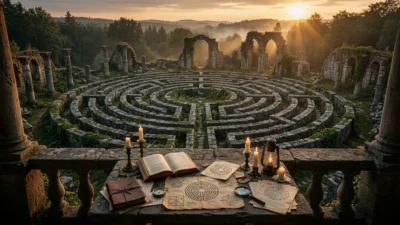
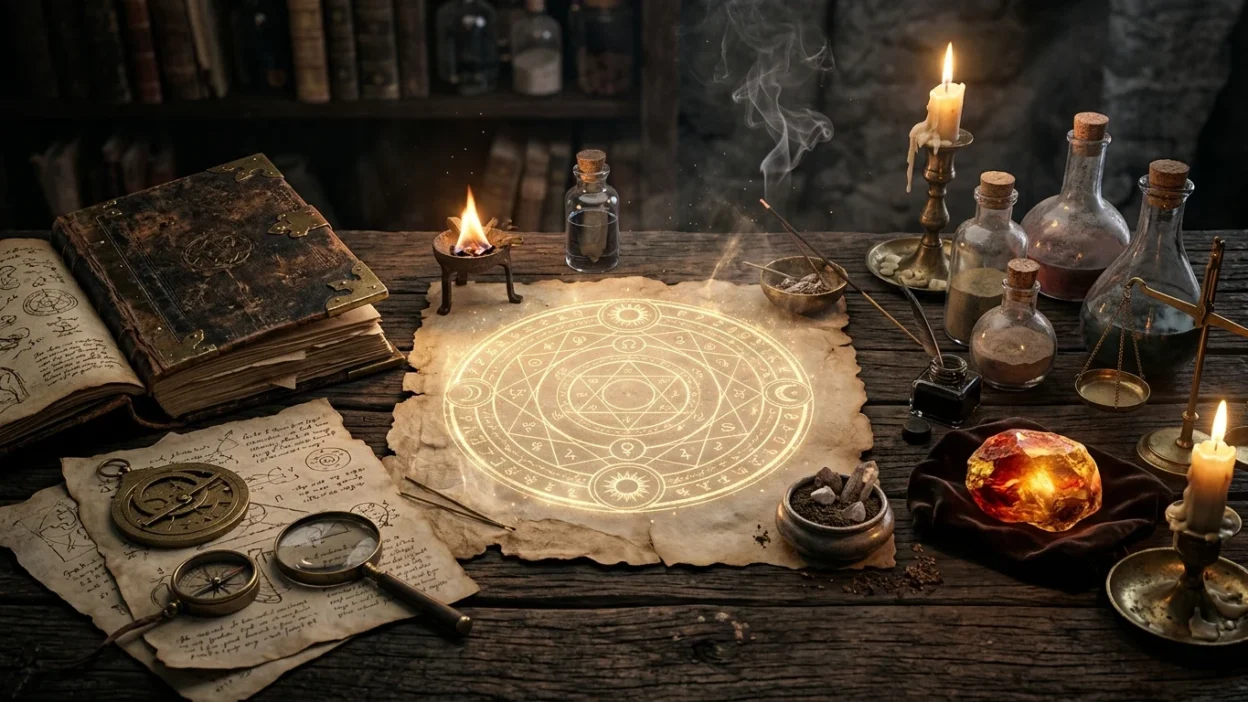
The image of a mysterious laboratory, glowing substance, ancient manuscript, or Philosopher’s Stone can immediately suggest hidden knowledge and transformation.
Artists may use alchemical symbols to explore themes such as:
- Life and death
- Creation and destruction
- Darkness and light
- Human potential
- Mystery
- Change
- Balance
In fantasy literature and modern entertainment, alchemy is frequently presented as a magical system. This is a creative interpretation and should be distinguished from historical alchemical practices.
Alchemy Symbolism in Dreams
Dream interpretations involving alchemy are highly personal. There is no scientifically established meaning for dreaming about alchemy.
Still, from a symbolic perspective, an alchemical dream may suggest themes of change, self-discovery, or transformation.
For example, dreaming about:
Gold
Gold may symbolize value, achievement, confidence, or something you consider precious.
An Alchemist
An alchemist in a dream might represent curiosity, experimentation, wisdom, or a desire to understand something complicated.
A Strange Laboratory
A laboratory may symbolize experimentation with a new direction in life.
Turning Something Into Gold
This could symbolically reflect the desire to transform a difficult situation into something useful or valuable.
The emotional atmosphere of the dream is important. A peaceful dream may suggest hopeful transformation, while a frightening dream could reflect uncertainty about major changes.
Positive Symbolism of Alchemy
Alchemy has many positive symbolic associations.
Transformation
It encourages the idea that change can create new possibilities.
Resilience
Alchemy can represent the ability to work through difficult conditions and emerge stronger.
Wisdom
The search for hidden knowledge can symbolize curiosity and lifelong learning.
Renewal
Alchemy may represent starting again after an ending.
Potential
Something unfinished can still contain significant potential.
Creativity
Alchemy’s combination of experimentation and imagination makes it a symbol of creative discovery.
These meanings explain why alchemical imagery continues to appear in modern art, literature, jewelry, tattoos, games, and personal symbolism.
Negative or Hidden Symbolism of Alchemy
Alchemy does not always represent positive transformation.
Its symbolism can also point toward obsession, secrecy, greed, or the dangerous desire to control nature.
The dream of creating gold, for example, can symbolize the pursuit of wealth at any cost. The search for secret knowledge can also represent isolation or an unhealthy obsession with mysteries.
Alchemy may therefore symbolize both creation and destruction.
Its deeper lesson can be understood as a reminder that transformation requires responsibility. Seeking power without wisdom can produce consequences just as easily as it can produce progress.
Common Interpretations of Alchemy Symbolism
Different people may interpret alchemy according to their own beliefs and circumstances.
| Alchemical Idea | Common Symbolic Interpretation |
| Gold | Value, achievement, purity, perfection |
| Philosopher’s Stone | Ultimate transformation or higher potential |
| Fire | Change, purification, energy |
| Water | Emotion, adaptability, renewal |
| Laboratory | Experimentation and discovery |
| Transformation | Personal growth and change |
| Purification | Removing what no longer serves you |
| Hidden symbols | Mystery and secret knowledge |
| Transmutation | Turning one state into another |
| Balance | Harmony between opposing forces |
These interpretations are broad symbolic associations, not universal definitions.
Why Does Alchemy Symbolism Matter Today?
Alchemy remains relevant because transformation is a universal human experience.
People change careers, recover from setbacks, develop new relationships, learn from mistakes, and rethink their beliefs. These experiences can feel like a process of turning one version of life into another.
The metaphor of alchemy gives people a simple way to think about this process.
A difficult experience does not automatically become something positive. However, reflection, learning, creativity, and intentional action can sometimes help a person gain something valuable from it.
That is why alchemy continues to work as a modern metaphor for personal development.
It can encourage questions such as:
What can I learn from this experience?
What part of my life needs to change?
What potential is hidden inside this difficult situation?
What do I need to release before I can move forward?
In this sense, alchemy symbolizes the possibility of meaningful change without claiming that transformation is always easy or guaranteed.
FAQs:
What is the main meaning of alchemy symbolism?
The main symbolic meaning of alchemy is transformation. It can represent turning something ordinary, difficult, or unfinished into something more refined or valuable.
What does alchemy symbolize spiritually?
Spiritually, alchemy is often interpreted as inner transformation, purification, self-discovery, and personal growth. These are modern symbolic interpretations rather than universally established religious teachings.
What does gold symbolize in alchemy?
Gold commonly represents purity, value, perfection, achievement, and the highest stage of transformation within many Western alchemical traditions.
What is the spiritual meaning of the Philosopher’s Stone?
In symbolic interpretations, the Philosopher’s Stone can represent ultimate wisdom, transformation, completeness, or the discovery of one’s highest potential. Historical beliefs about it varied.
Is alchemy a religion?
No. Alchemy was a diverse historical tradition involving philosophical, practical, spiritual, and experimental ideas. It should not be treated as one standardized religion.
Does alchemy have a biblical meaning?
There is no single biblical meaning of alchemy, and alchemy is not established as a biblical teaching. Some people compare alchemical themes of purification and transformation with broader religious ideas.
What does alchemy mean in dreams?
Alchemy in dreams may symbolically represent change, experimentation, self-discovery, or the desire to transform a difficult situation. Dream meanings depend heavily on personal context.
Why is alchemy associated with transformation?
Alchemy historically involved attempts to change substances through processes such as heating, separation, purification, and combination. These processes naturally became powerful metaphors for transformation.
Is alchemy the same as modern chemistry?
No. Historical alchemy and modern chemistry are different traditions. However, some alchemical practices, laboratory techniques, and observations contributed to the historical development of chemical knowledge.
Conclusion
Alchemy symbolism centers on one powerful idea: transformation. Its images of gold, fire, purification, hidden knowledge, and the Philosopher’s Stone have inspired symbolic interpretations of personal growth, wisdom, renewal, and human potential.
Historically, alchemy was a complex collection of traditions rather than a single universal system. Today, its symbolism remains meaningful because the idea of transforming challenges into knowledge and potential continues to resonate with people.
Whether viewed through history, art, literature, spirituality, or personal reflection, alchemy ultimately represents the journey from what we are toward what we may become.

Abigail Alice is a passionate writer at SymbolTrue, exploring the history, meanings, and cultural significance of symbols worldwide. She creates clear, engaging, and well-researched content that helps readers uncover the fascinating stories behind everyday and ancient symbols.