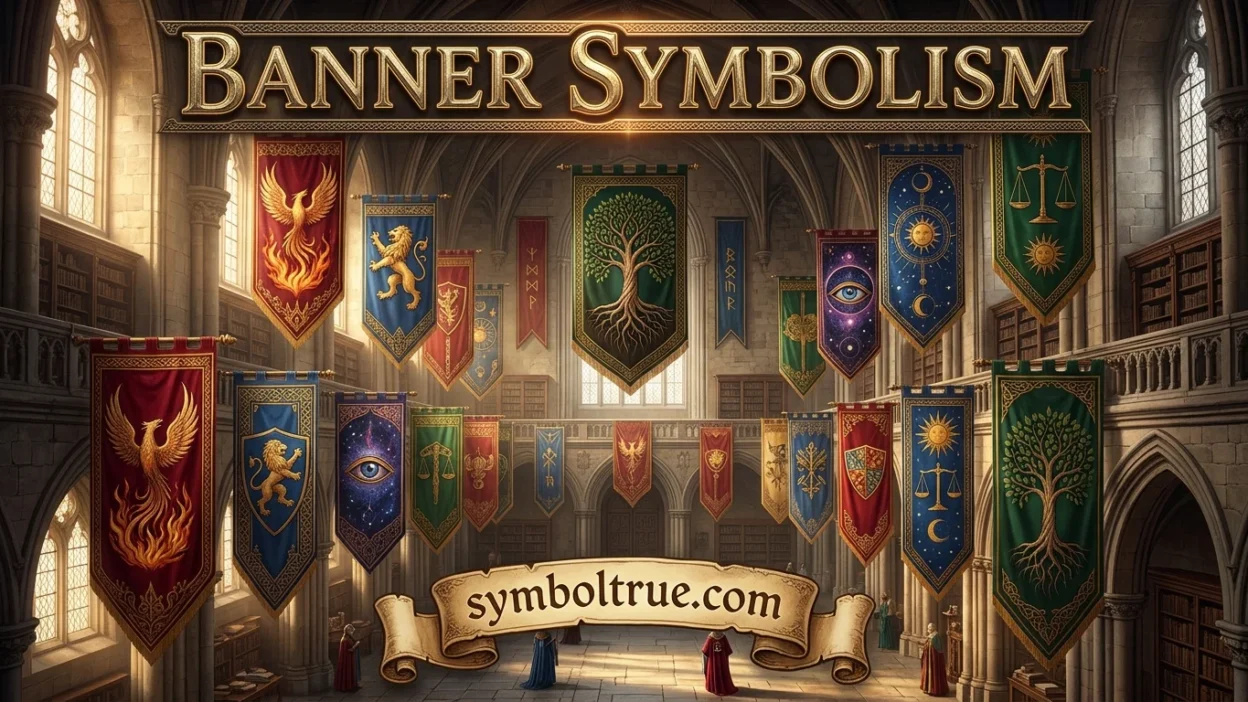
A banner is more than a piece of fabric displaying words, colors, or images. Throughout history, banners have represented identity, unity, leadership, celebration, and shared beliefs. Their presence at ceremonies, public gatherings, historical events, and religious occasions gives them meanings beyond their physical appearance.
Banner symbolism explores what these displays communicate and why people use them to express belonging, honor achievements, announce important messages, and represent collective values. Depending on their colors, designs, historical backgrounds, and purposes, banners can symbolize pride, freedom, hope, authority, remembrance, or resistance.
Understanding banner symbolism helps reveal how a simple visual object can carry powerful emotional, cultural, historical, and spiritual messages.
Banner Symbolism Meaning (Clear Definition)
Banner symbolism refers to the meanings and messages associated with banners, including their designs, colors, images, words, and cultural uses.
Traditionally, banners have served as recognizable signs of groups, communities, families, organizations, armies, and religious institutions. They help people identify shared identities and communicate important ideas without requiring lengthy explanations.
A banner can symbolize:
- Identity: Representing a person, family, organization, or community.
- Unity: Bringing people together around a shared purpose.
- Pride: Expressing appreciation for cultural or personal achievements.
- Leadership: Representing authority, responsibility, or direction.
- Victory: Celebrating success and overcoming challenges.
- Freedom: Communicating independence and self-expression.
- Remembrance: Honoring important people, events, or historical experiences.
- Hope: Sharing positive messages and encouraging progress.
The exact meaning depends on the banner’s design and the situation in which it appears.
For example, a banner displayed during a national celebration may represent patriotism, while one used at a graduation ceremony may symbolize achievement and new beginnings.
What Does Banner Symbolism Represent?
Banners can communicate several symbolic meanings depending on their purpose, appearance, and cultural background.
1. Identity and Belonging
One of the strongest meanings associated with banners is identity. A banner can represent a particular group and help its members recognize their shared background or interests.
Sports teams, schools, cultural organizations, and communities often use banners to express who they are.
2. Unity and Togetherness
Banners frequently symbolize unity because they bring attention to a common purpose.
When people gather beneath the same banner, they may feel connected through shared values, goals, traditions, or experiences.
3. Leadership and Authority
Historically, banners were used to identify rulers, military leaders, and important organizations.
Their visibility made them recognizable symbols of authority, command, and organized leadership.
4. Victory and Achievement
Banners displayed after competitions, battles, or important accomplishments can represent success.
A championship banner, for example, celebrates a team’s achievements and preserves the memory of its hard work.
5. Freedom and Resistance
In demonstrations and movements, banners often communicate demands for freedom, justice, equality, and social change.
They provide people with a visible way to express their opinions and stand together.
6. Honor and Remembrance
Some banners commemorate historical events, important individuals, or sacrifices.
They can preserve collective memories and communicate respect for people or causes that communities consider meaningful.
Spiritual Meaning of Banner Symbolism
In spiritual interpretations, banners may represent guidance, protection, faith, hope, and the presence of a higher purpose.
Their symbolic meaning varies across religious and cultural traditions. There is no single universal spiritual interpretation.
Banner as a Symbol of Spiritual Guidance
A banner can represent direction and purpose. Just as a visible banner helps people identify a group or gathering place, it may symbolically represent a guiding belief or spiritual path.
For some individuals, seeing a banner may encourage reflection on their values and life direction.
Banner as a Symbol of Protection
In certain traditional spiritual interpretations, banners are associated with protection and the defense of a community’s beliefs.
They may represent the idea of standing together against difficulties while maintaining faith and courage.
Banner as a Symbol of Hope
A bright or uplifting banner may symbolize optimism, encouragement, and the possibility of positive change.
In personal spiritual reflection, it can serve as a reminder to remain hopeful during uncertain situations.
Banner as a Symbol of Purpose
A banner carrying a meaningful message can represent dedication to a greater purpose.
It may encourage individuals to remain committed to their principles and responsibilities.
These interpretations are symbolic rather than universal spiritual rules. Personal experiences and cultural traditions influence how people understand them.
Biblical / Religious Meaning of Banner Symbolism
Banners have meaningful associations in several religious traditions, particularly in biblical imagery.
In the Bible, banners can represent God’s protection, leadership, identity, and the gathering of people around a shared belief.
Jehovah Nissi: The Lord Is My Banner
One of the best-known biblical references to banner symbolism appears in Exodus 17:15.
After the Israelites’ victory over the Amalekites, Moses builds an altar and names it Jehovah Nissi, commonly translated as “The Lord Is My Banner.”
This expression is traditionally understood as a declaration of God’s protection, help, and leadership.
The banner represents a source of confidence and spiritual strength rather than simply a physical object.
Banner as a Symbol of God’s Protection
In biblical interpretation, a banner can represent divine care and security.
It may remind believers that they are not alone during difficult circumstances and can seek strength through faith.
Banner as a Symbol of Gathering
Isaiah 11:12 uses the imagery of a banner in connection with gathering people together.
This supports the symbolic association between banners, unity, hope, and restoration.
Banner in Christian Spiritual Reflection
For many Christians, banner imagery can represent:
- Faith and trust in God.
- Spiritual identity and belonging.
- Divine guidance and protection.
- Hope during difficult times.
- Unity among believers.
Other religions and spiritual traditions may interpret banners differently, depending on their historical practices and sacred imagery.
Banner Symbolism in History and Culture
Banners have played important roles in human history. Before modern communication systems, they were practical tools for identifying groups, displaying authority, and sharing messages across distances.
Their symbolic meanings developed through military, political, religious, and cultural traditions.
Ancient Civilizations
Ancient societies used standards, flags, and banner-like objects to identify rulers, military units, and communities.
These objects helped distinguish one group from another, particularly during public gatherings and military campaigns.
Their presence also communicated power, loyalty, and collective identity.
Medieval Europe
During the medieval period, banners became important symbols of family heritage, noble identity, and military organization.
Heraldic designs, including animals, shapes, and distinctive colors, helped identify individuals and families.
Knights and military groups often carried banners into battle, making them recognizable symbols of allegiance and authority.
Religious Traditions
Banners have also appeared in religious ceremonies and celebrations.
Different communities use decorative banners to mark festivals, processions, sacred spaces, and special occasions.
Their designs may communicate religious teachings, devotion, and cultural heritage.
Political and Social Movements
In modern history, banners have become important tools for public expression.
Protesters, activists, and community organizations use them to communicate demands and represent shared causes.
A banner with a message about equality, freedom, or justice can become a recognizable symbol of a wider movement.
Modern Cultural Celebrations
Today, banners are common at weddings, graduations, sporting events, festivals, and national celebrations.
They help create a sense of occasion while expressing the identity and values of the people involved.
Banner Symbolism in Literature and Art
In literature and visual art, banners often communicate ideas that extend beyond their physical appearance.
Writers and artists use them to represent collective identity, authority, conflict, ambition, and emotional connections.
Banners as Symbols of Identity
In fictional stories, a banner may represent a kingdom, family, army, or community.
A character carrying a particular banner can demonstrate loyalty to a group or commitment to its values.
Banners as Symbols of Victory
Artists sometimes portray banners raised above battlefields or displayed after major achievements.
These images communicate triumph, courage, and the completion of a difficult struggle.
Banners as Symbols of Conflict
A banner can also represent opposing beliefs or competing interests.
When two different banners appear in the same artwork, they may symbolize a disagreement between communities, leaders, or ideologies.
Banners as Symbols of Hope
In inspirational artwork, a banner carrying a positive message may represent a new beginning or a shared dream.
Its position, colors, and surrounding environment can strengthen this interpretation.
Banner Symbolism in Dreams
Dream interpretations are subjective and depend on personal experiences, emotions, and cultural beliefs. Seeing a banner in a dream does not have one scientifically established meaning.
However, different dream situations may suggest useful symbolic themes for personal reflection.
Dreaming of Seeing a Banner
Seeing a banner may symbolize identity, belonging, or a desire to be part of something meaningful.
Consider whether the banner reminded you of a particular community, relationship, or personal goal.
Dreaming of Holding a Banner
Holding a banner may represent responsibility, confidence, or commitment to a belief.
It could reflect your desire to stand up for something important in your life.
Dreaming of a White Banner
A white banner may symbolically suggest peace, honesty, reconciliation, or a desire to resolve conflict.
In some historical contexts, a white flag has been associated with surrender or a request for a ceasefire.
Dreaming of a Torn Banner
A damaged banner may represent disappointment, weakened trust, or uncertainty about belonging.
It could also reflect concerns about a personal goal or relationship.
Dreaming of a Flying Banner
A banner moving in the wind may symbolize freedom, ambition, change, or progress.
The emotions experienced during the dream can help provide a more personal interpretation.
Dreaming of a Colorful Banner
A colorful banner may suggest celebration, creativity, diversity, or positive social connections.
Its meaning may depend on the colors and the situation in which it appears.
Positive Symbolism of Banner
Banners carry many positive associations because they are often used to celebrate achievements, express shared values, and encourage people.
Some of their most common positive meanings include:
1. Unity: A banner can bring individuals together around a shared identity or purpose.
2. Pride: It can express appreciation for personal, cultural, or collective achievements.
3. Hope: A meaningful banner can communicate optimism and encouragement.
4. Victory: It can commemorate success after hard work or difficult challenges.
5. Leadership: Banners may represent responsible guidance and a clear direction.
6. Freedom: They can communicate independence, self-expression, and the desire for equal rights.
7. Inspiration: Motivational messages displayed on banners can encourage people to take positive action.
8. Celebration: Decorative banners help express happiness during important events and milestones.
These positive meanings explain why banners remain popular in public and private celebrations.
Negative or Hidden Symbolism of Banner
Although banners frequently communicate positive ideas, they can also carry negative or complicated meanings.
Their interpretation depends on the message, historical context, and the people using them.
Conflict and Division
A banner can represent opposing groups, political disagreements, or social divisions.
When different communities identify strongly with separate banners, these symbols may become connected with conflict.
Control and Authority
Historically, banners have sometimes represented rulers, military power, and political control.
In certain contexts, they may symbolize unquestioned loyalty or pressure to follow a particular authority.
Surrender and Defeat
A lowered or abandoned banner can symbolize the loss of power, retreat, or defeat.
In military imagery, a captured banner may represent the defeat of the group it once identified.
Manipulation and Propaganda
Banners can also be used to spread misleading messages or encourage people to support harmful ideas.
Their strong visual impact makes them effective communication tools, but the message they communicate is not necessarily truthful or positive.
Lost Identity
A forgotten, damaged, or discarded banner may symbolize a weakened connection to personal history, community, or shared values.
However, this interpretation depends on the specific context rather than being a universal meaning.
Common Interpretations of Banner Symbolism
The meaning of a banner can change significantly according to its colors, condition, design, and location.
Here are some common interpretations:
| Banner Type or Feature | Common Symbolic Meaning |
| White banner | Peace, surrender, or reconciliation |
| Red banner | Courage, passion, revolution, or sacrifice |
| Blue banner | Trust, loyalty, calmness, or unity |
| Green banner | Growth, renewal, nature, or hope |
| Black banner | Mourning, resistance, authority, or remembrance |
| Golden banner | Honor, achievement, wealth, or prestige |
| Religious banner | Faith, devotion, and spiritual identity |
| National banner | Patriotism and national identity |
| Sports banner | Achievement, teamwork, and victory |
| Torn banner | Loss, conflict, or weakened identity |
| Raised banner | Pride, confidence, and celebration |
| Lowered banner | Respect, mourning, surrender, or remembrance |
These are general associations. Color meanings are not universal, and their interpretations can differ between cultures and historical periods.
Why Does Banner Symbolism Matter Today?
Despite modern technology and digital communication, banners continue to play an important role in society.
Their visual nature makes them effective tools for expressing ideas, identifying communities, and creating memorable experiences.
1. Communication Without Many Words
A banner can communicate an important message quickly.
A short phrase, recognizable symbol, or distinctive design can express an idea to many people at once.
2. Building Community Identity
Schools, businesses, sports teams, and cultural organizations use banners to strengthen their identities.
They help members feel connected to a shared purpose.
3. Preserving Cultural Traditions
Traditional banners can preserve historical designs, cultural practices, and community memories.
Displaying them during festivals and ceremonies helps keep traditions visible.
4. Supporting Social Causes
Banners remain useful in peaceful demonstrations, awareness campaigns, and community events.
They give people a recognizable way to communicate their concerns and support important causes.
5. Celebrating Personal Achievements
People use banners for birthdays, weddings, graduations, and other milestones.
These displays help communicate happiness, recognition, and appreciation.
6. Creating Visual Inspiration
Motivational banners in workplaces, classrooms, and public spaces can encourage positive attitudes and remind people of shared goals.
Their continuing popularity shows that visual symbols remain meaningful even in a digital world.
FAQs:
1. What does a banner symbolize?
A banner commonly symbolizes identity, unity, pride, leadership, victory, freedom, and shared beliefs. Its meaning depends on its design, purpose, and cultural background.
2. What is the spiritual meaning of a banner?
Spiritually, a banner may represent guidance, protection, hope, faith, and commitment to a higher purpose. Interpretations vary across religious and cultural traditions.
3. What does a banner represent in the Bible?
In the Bible, a banner can symbolize God’s protection, leadership, and the gathering of people. Exodus 17:15 refers to God as Jehovah Nissi, meaning “The Lord Is My Banner.”
4. What does a white banner symbolize?
A white banner is commonly associated with peace, surrender, reconciliation, and a desire to end conflict. Its meaning depends on the situation.
5. What does a red banner symbolize?
A red banner can represent courage, passion, sacrifice, revolution, or strong collective beliefs. Different cultures and movements may use red differently.
6. What does a banner symbolize in dreams?
A banner in a dream may represent identity, belonging, responsibility, personal beliefs, or ambition. Its meaning depends on the dreamer’s emotions and personal circumstances.
7. What does a torn banner symbolize?
A torn banner may symbolize defeat, loss, conflict, weakened relationships, or a changing sense of identity. It can also represent the end of an important chapter.
8. Why are banners important in history?
Banners were important because they helped identify leaders, military groups, families, and communities. They also communicated authority, loyalty, and collective identity.
9. What is the difference between a banner and a flag?
A flag is generally a standardized piece of fabric representing a country, organization, or group. A banner is a broader term that can include decorative displays, ceremonial symbols, promotional messages, and identifying designs.
10. Are banners always positive symbols?
No. Although banners often represent unity, pride, and celebration, they can also symbolize conflict, political control, division, surrender, or propaganda.
Conclusion
Banner symbolism reveals how a simple visual display can communicate powerful messages about identity, unity, faith, leadership, freedom, and achievement. Throughout history, banners have represented communities, celebrated victories, preserved traditions, and expressed important beliefs.
Their meanings are not always positive or universal. Cultural backgrounds, historical events, colors, and personal experiences all influence their interpretation.
Ultimately, a banner is more than fabric and decoration. It is a meaningful symbol that gives visibility to the values, memories, and ideas people choose to represent.

Abigail Alice is a passionate writer at SymbolTrue, exploring the history, meanings, and cultural significance of symbols worldwide. She creates clear, engaging, and well-researched content that helps readers uncover the fascinating stories behind everyday and ancient symbols.