Flags are powerful symbols that communicate identity, belonging, freedom, and shared values. Throughout history, people have used flags to represent nations, communities, movements, and important beliefs. Flag symbolism explores the deeper meanings behind flags, including their colors, patterns, shapes, and designs.
A flag is more than a piece of fabric. It can represent a country’s history, celebrate independence, honor sacrifice, or express hope for a better future. Depending on its design and cultural context, a flag may also symbolize peace, strength, protection, unity, or resistance.
Understanding flag symbolism helps us recognize how simple visual designs can carry powerful emotional, historical, and cultural messages.
Flag Symbolism Meaning (Clear Definition)
Flag symbolism refers to the meanings, ideas, values, and emotions represented by a flag and its visual elements. These elements include colors, symbols, patterns, shapes, and images that communicate messages about identity, history, beliefs, and collective experiences.
For example, a national flag often represents the independence, sovereignty, and unity of a country. A religious flag may communicate spiritual beliefs, while a protest flag can express resistance, solidarity, or a demand for social change.
The meaning of a flag depends on its origin and the people who use it. The same color or symbol can have different interpretations across cultures.
In simple terms, flag symbolism explains what a flag represents beyond its physical appearance.
What Does Flag Symbolism Represent?
Flags can communicate many different ideas. Their meanings often depend on the historical events, cultural traditions, and communities connected to them.
Here are some of the most common representations.
1. Freedom and Independence
One of the strongest meanings associated with flags is freedom. National flags frequently represent independence from foreign control and the right of people to govern themselves.
For example, a flag raised after independence can become a powerful reminder of a nation’s struggle for freedom.
2. Unity and Togetherness
Flags bring people together under a shared identity. During national celebrations, sporting events, and public gatherings, people often display flags to express belonging and collective pride.
3. Identity and Belonging
A flag can identify a country, organization, cultural group, or community. It gives people a recognizable symbol through which they express their connection to something larger than themselves.
4. Peace and Hope
Certain flags represent peace, cooperation, and optimism. White elements, doves, and other peaceful imagery may communicate these ideas, depending on the design and cultural context.
5. Strength and Courage
Flags have historically appeared on battlefields, military uniforms, and monuments. They can symbolize bravery, sacrifice, determination, and the willingness to defend shared values.
6. Heritage and Tradition
Many flags preserve historical designs, traditional colors, and symbols connected to a community’s past. They help keep cultural stories and collective memories alive.
Spiritual Meaning of Flag Symbolism
From a spiritual perspective, flags can represent faith, purpose, guidance, protection, and a sense of belonging.
Although there is no universal spiritual interpretation of flags, their symbolic meanings can reflect the beliefs of the people who create, display, or interpret them.
Some common spiritual associations include:
1. Guidance: A flag can symbolize direction and purpose, reminding people to follow their values and beliefs.
2. Protection: Certain religious and ceremonial flags represent spiritual protection or devotion to a higher power.
3. Unity: A shared flag may represent people connected through faith, spiritual traditions, or common principles.
4. Hope: A flag raised after difficult circumstances can symbolize renewed faith, encouragement, and the possibility of positive change.
5. Purpose: A flag can represent commitment to a meaningful cause, personal principles, or spiritual journey.
What Does a Flag Symbolize Spiritually?
Spiritually, a flag may represent the desire to stand for something meaningful. It can remind someone of their beliefs, personal responsibilities, and connection to a larger community.
For example, seeing a flag flying above a mountain might personally symbolize reaching a goal, overcoming difficulties, or finding a sense of direction.
These interpretations are personal and symbolic rather than universal spiritual rules.
Biblical / Religious Meaning of Flag Symbolism
Flags are not assigned one universal meaning throughout the Bible. However, banners and standards appear in biblical passages and carry important symbolic associations.
One notable example is Exodus 17:15, where Moses builds an altar and names it Yahweh-Nissi, commonly translated as “The Lord Is My Banner.”
This expression connects the idea of a banner with divine support, victory, and recognition of God’s presence.
Flags and Banners in the Bible
Several biblical themes help explain the symbolism of banners:
- Victory: Banners can represent triumph and the acknowledgment of divine assistance.
- Protection: A banner may serve as a reminder of God’s care and guidance.
- Identity: Standards helped distinguish crews and groups in ancient communities.
- Faith: Religious banners can express devotion and commitment to spiritual beliefs.
Numbers 2 describes the arrangement of the crews of Israel around their standards during their journey through the wilderness.
Religious Flags in Different Traditions
Religious flags also appear in various spiritual traditions around the world.
For example:
- Buddhist prayer flags are associated with prayers, compassion, peace, and the spreading of positive intentions.
- Christian banners may display crosses and other religious imagery representing faith and devotion.
- Islamic flags have different historical and cultural meanings, depending on their design and community.
- Hindu religious flags may appear during festivals and ceremonies, expressing devotion and spiritual identity.
It is important to remember that religious flags do not all share the same interpretation. Their meanings depend on specific traditions and historical contexts.
Flag Symbolism in History and Culture
Flags have played important roles throughout human history. Ancient civilizations used banners, military standards, and symbolic emblems to identify rulers, armies, and communities.
Over time, flags developed into recognizable representations of countries, political movements, cultural groups, and international organizations.
Ancient Flags and Banners
Ancient Egyptians, Romans, Persians, and other civilizations used standards and banners to identify military groups and represent authority.
These objects were often carried during battles and public ceremonies. They helped distinguish different groups and provided a visible symbol of leadership.
Flags and National Independence
During periods of revolution and independence, flags became powerful expressions of national identity.
People used them to communicate resistance, unity, and the desire for self-government.
For example, the American flag became closely associated with independence and the founding of the United States.
Similarly, the flag of Pakistan represents the country’s national identity, independence, and religious and cultural heritage.
Cultural Identity and Community
Flags can also represent regions, indigenous communities, cultural organizations, and social movements.
They help communities preserve their heritage and communicate their values to others.
Flag Symbolism in Literature and Art
Writers and artists frequently use flags to communicate ideas that go beyond national identity.
A flag in a painting, poem, novel, or film can represent freedom, political conflict, patriotism, rebellion, or the emotional connection between individuals and their communities.
Flags as Symbols of Freedom
In literature, a flag raised after a difficult struggle may represent independence and the achievement of a long-awaited goal.
Writers often use this image to communicate hope and determination.
Flags as Symbols of Conflict
A flag can also represent political disagreements, war, and competing beliefs.
In historical paintings, flags often identify opposing armies or communicate the struggle between different groups.
Flags as Symbols of Memory
Artists may include old, damaged, or faded flags to represent forgotten histories, sacrifice, loss, or the passage of time.
Flags in Modern Visual Art
Contemporary artists sometimes use flags to question national identity, political authority, social divisions, and cultural expectations.
Their work demonstrates that flags can be symbols of both unity and disagreement.
Flag Symbolism in Dreams
Dream interpretations are subjective, and there is no scientifically established meaning for dreaming about a flag. However, different dream traditions associate flags with identity, ambition, belonging, and personal beliefs.
Your emotions and the dream’s circumstances can influence its possible interpretation.
1. Dreaming of a Flying Flag
A flying flag may symbolize confidence, achievement, independence, or pride.
It could reflect a desire to express your identity or celebrate something important.
2. Dreaming of a White Flag
A white flag may represent peace, forgiveness, surrender, or the desire to end a disagreement.
It might reflect your feelings about resolving a difficult situation.
3. Dreaming of a Torn Flag
A torn flag could symbolize disappointment, uncertainty, conflict, or a weakening connection with a group or belief.
4. Dreaming of a National Flag
Seeing your country’s flag in a dream may reflect belonging, family heritage, national identity, or personal pride.
5. Dreaming of Many Flags
Multiple flags may represent diversity, different perspectives, international connections, or a desire to explore unfamiliar cultures.
6. Dreaming of Raising a Flag
Raising a flag might symbolize reaching a goal, standing up for your beliefs, or beginning a new chapter.
Remember that these are possible symbolic interpretations, not predictions or guaranteed messages.
Positive Symbolism of Flags
Flags are often associated with positive emotions and meaningful human experiences.
Some of their most common positive meanings include:
| Symbolic Meaning | Interpretation |
| Freedom | Independence and personal rights |
| Unity | People working toward shared goals |
| Hope | Optimism and new possibilities |
| Courage | Strength during difficult situations |
| Peace | Harmony and cooperation |
| Pride | Appreciation of identity and heritage |
| Loyalty | Commitment to a group or cause |
| Achievement | Success and overcoming challenges |
| Identity | Recognition of cultural or national belonging |
| Solidarity | Supporting others and shared struggles |
These positive associations explain why flags appear during celebrations, national holidays, sporting competitions, and important public events.
Negative or Hidden Symbolism of Flags
Although flags often represent positive values, they can also carry difficult or controversial meanings.
Their interpretation depends on the history and circumstances surrounding their use.
1. Conflict and Division
Flags can sometimes represent opposing political, national, or ideological groups.
In these situations, a symbol intended to unite one community may create disagreement with another.
2. War and Sacrifice
Military flags may represent courage and service, but they can also remind people of violence, loss, and the human cost of war.
3. Political Control
Throughout history, flags have been used by governments and political movements to communicate authority and promote particular ideologies.
4. Nationalism and Exclusion
National flags can express healthy cultural pride, but extreme forms of nationalism may use national symbols to promote discrimination or hostility toward outsiders.
5. Resistance and Protest
A flag associated with a protest movement may symbolize opposition to an existing system or a demand for social change.
This meaning may be positive for supporters but controversial for people who disagree with the movement.
A flag does not have one fixed meaning in every situation. Historical context and the intentions of its users are essential for understanding its message.
Common Interpretations of Flag Symbolism
Different flag designs communicate different ideas. Understanding their elements can help explain their symbolic significance.
What Do Flag Colors Symbolize?
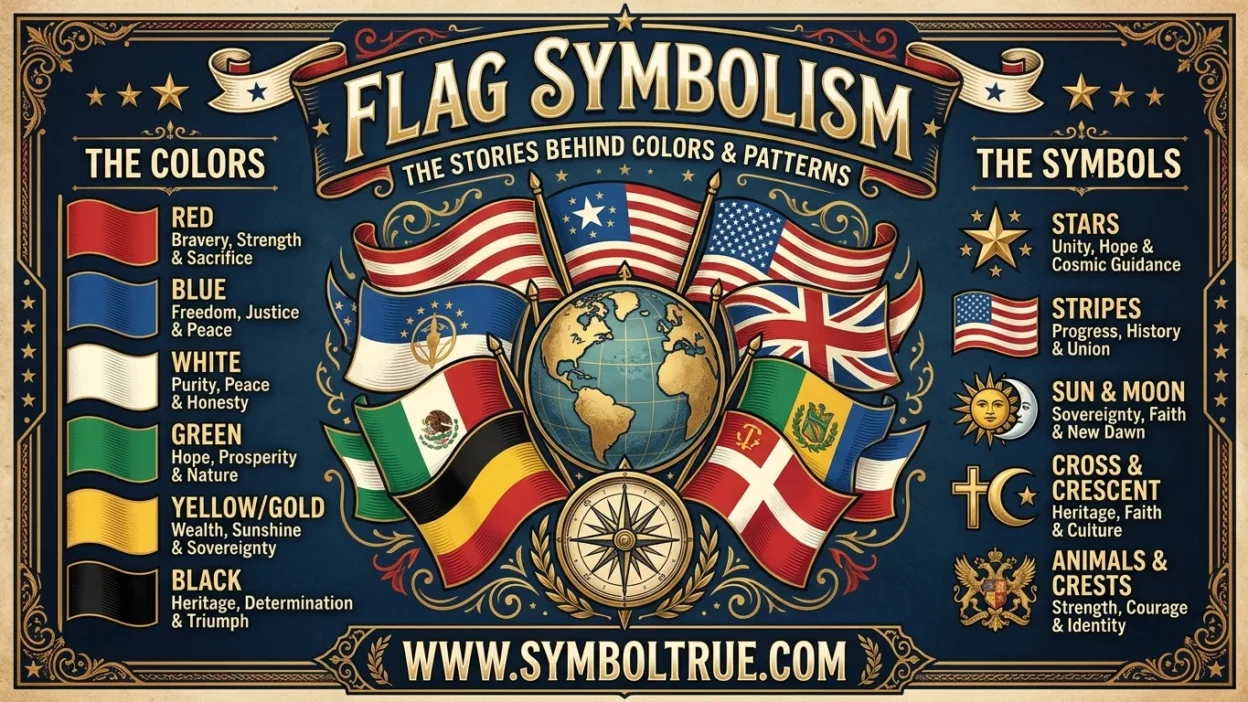
Colors are among the most noticeable features of flags. However, their meanings are not universal.
Here are some common color associations:
| Color | Common Symbolic Associations |
| Red | Courage, sacrifice, strength, revolution |
| White | Peace, purity, honesty |
| Blue | Freedom, stability, loyalty, justice |
| Green | Nature, growth, hope, faith |
| Yellow | Sunshine, prosperity, optimism |
| Black | Strength, remembrance, determination |
| Orange | Energy, creativity, enthusiasm |
| Purple | Dignity, royalty, spirituality |
These are general associations rather than fixed rules. The official meaning of a color should be understood through the history and explanation of the particular flag.
What Do Different Flag Designs Represent?
Flag designs also communicate important messages.
Stripes: Often represent historical regions, communities, or shared principles.
Stars: May symbolize unity, states, territories, or important ideals.
Crosses: Can represent Christianity, historical traditions, or national heritage.
Crescents: Have different historical and cultural associations, including their use in some Islamic cultural contexts.
Circles: May represent unity, continuity, or completeness.
Animals: Often communicate qualities associated with particular animals, such as strength, courage, or wisdom.
Sun and Moon: May represent life, renewal, time, or cultural traditions.
The exact meaning of these elements depends on the flag’s origin and official design history.
Why Does Flag Symbolism Matter Today?
Flag symbolism remains important because people continue to use flags to communicate identity, beliefs, and shared values.
In today’s interconnected world, flags are visible in international events, sports competitions, educational institutions, political movements, and digital communication.
Here are several reasons why understanding flag symbolism matters.
1. It Helps Us Understand Different Cultures
Learning about flags introduces us to the histories and traditions of different communities.
It encourages cultural awareness and respect.
2. It Preserves Historical Memories
Flags often remind people of independence movements, historical struggles, and important national events.
They help connect present generations with their shared past.
3. It Encourages Unity
During international competitions and national celebrations, flags provide a recognizable way for people to express support and belonging.
4. It Communicates Important Messages
Flags can communicate political positions, humanitarian causes, environmental concerns, and social movements.
5. It Builds Visual Understanding
Recognizing flag colors and symbols helps people understand how visual communication works.
Even a simple design can communicate complicated ideas without using written language.
FAQs:
1. What is the main meaning of flag symbolism?
Flag symbolism refers to the ideas and values represented by a flag. Common meanings include freedom, unity, identity, independence, peace, courage, and cultural heritage.
2. What does a flag symbolize spiritually?
Spiritually, a flag may symbolize faith, guidance, protection, hope, and belonging. Its interpretation depends on the religious tradition and personal beliefs associated with it.
3. What does a white flag symbolize?
A white flag commonly represents peace, surrender, or a request for a temporary end to conflict. Its meaning depends on the situation in which it appears.
4. What does a red flag symbolize?
A red flag can symbolize courage, sacrifice, strength, revolution, or danger. Its meaning changes depending on its cultural, historical, and social context.
5. What does a black flag symbolize?
A black flag can represent mourning, resistance, remembrance, rebellion, or determination. Its meaning varies significantly between different groups and historical periods.
6. Why are flags important to national identity?
Flags provide a recognizable symbol of a country’s history, independence, traditions, and shared identity. They help citizens express national belonging and pride.
7. What does seeing a flag in a dream mean?
Dreaming about a flag may reflect personal identity, ambition, belonging, confidence, or unresolved conflict. The interpretation depends on the dream’s details and the dreamer’s emotions.
8. What do stars on flags symbolize?
Stars commonly represent unity, individual states, territories, important ideals, or national aspirations. Their specific meaning depends on the flag’s design and history.
9. Are flag colors the same in every culture?
No. Flag colors do not have universal meanings. A color associated with peace in one culture may represent something entirely different in another.
10. Can flags represent both positive and negative ideas?
Yes. A flag can represent freedom and unity for one group while symbolizing conflict, exclusion, or painful historical experiences for another.
Conclusion
Flag symbolism reveals how colors, shapes, patterns, and images can communicate powerful messages about human identity and shared experiences. Flags commonly represent freedom, unity, courage, peace, heritage, and belonging, but their meanings can also involve conflict, sacrifice, and political division.
Whether displayed during national celebrations, used in religious ceremonies, or represented in literature and art, flags continue to connect people with their histories and beliefs. Understanding their symbolism helps us appreciate the deeper stories behind these familiar and meaningful symbols.

Henry Jack is a passionate writer at SymbolTrue, dedicated to exploring the meanings, history, and cultural significance of symbols. He creates clear, engaging, and well-researched content that helps readers understand symbols from around the world.


