Destiny is one of the oldest ideas people use to understand the direction of life. Destiny symbolism often represents fate, purpose, life paths, choices, and the feeling that certain events may have a deeper meaning.
Across cultures, destiny has been connected with stars, roads, clocks, threads, doors, circles, and other symbols. These images can express the idea of a future that unfolds beyond what we can fully predict.
However, destiny does not have one universal meaning. Its symbolism changes depending on culture, religion, personal beliefs, and the situation in which it appears.
Destiny Symbolism Meaning (Clear Definition)
Destiny symbolism refers to images, objects, ideas, or events that represent fate, life purpose, future possibilities, or a predetermined path.
The concept of destiny can be understood in different ways. Some traditions describe destiny as a path already shaped by divine or cosmic forces. Other viewpoints emphasize personal choices and suggest that people create their futures through decisions and actions.
Symbolically, destiny can therefore represent:
- A predetermined life path
- Purpose and direction
- Major life changes
- Unavoidable events
- Personal choices
- Hope for the future
- A search for meaning
- The unknown
- Transformation and growth
Destiny symbolism is especially powerful because it deals with a question nearly everyone faces: Where is my life going?
What Does Destiny Represent?
Destiny commonly represents the relationship between what happens to us and what we choose to do.
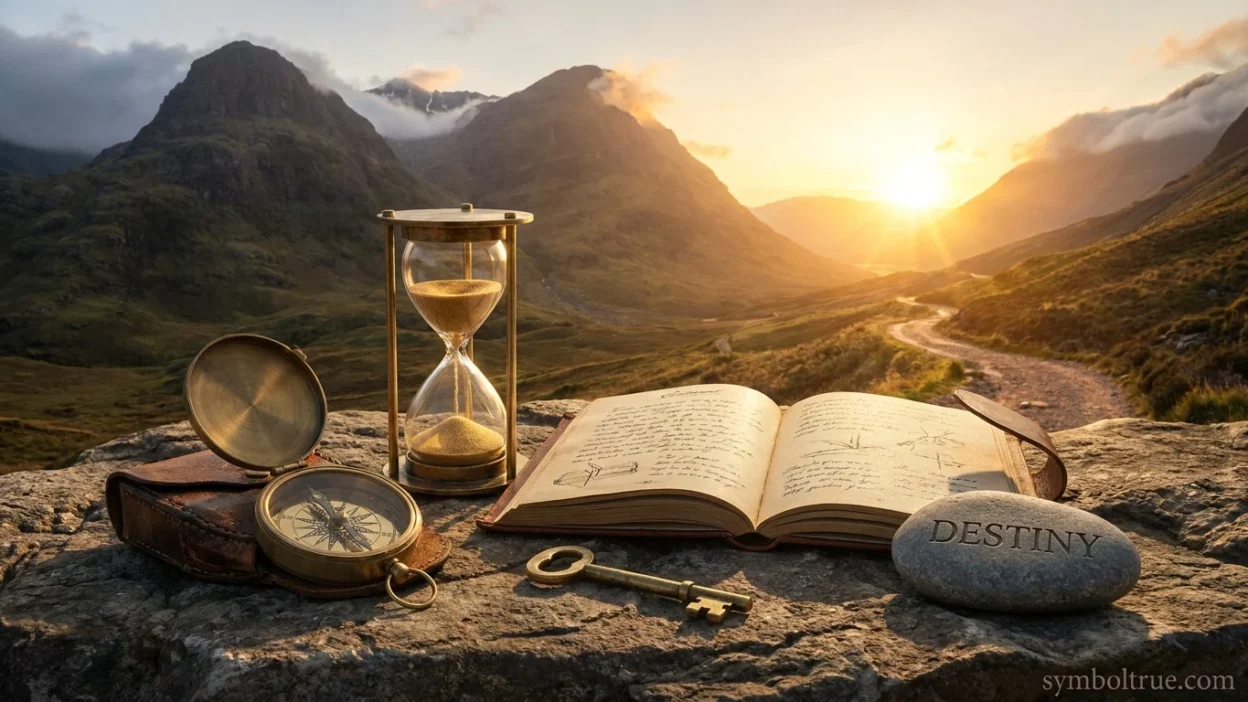
A road can symbolize the journey toward an unknown future. A doorway can represent a new chapter. A compass may symbolize direction, while a clock can suggest that important moments arrive at particular times.
Destiny may also represent acceptance. When people encounter situations they cannot control, the idea of destiny can provide a framework for understanding those experiences.
At the same time, destiny does not necessarily mean complete helplessness. Many philosophical and cultural traditions have explored the tension between fate and free will.
Common Symbols Connected With Destiny
Several familiar images are often associated with destiny:
Road: A life journey with different possible directions.
Stars: A traditional symbol of guidance, cosmic order, or a future influenced by forces beyond ordinary human control.
Thread: In some mythological traditions, a thread can symbolize the course or length of human life.
Door: A transition, opportunity, or entry into a new stage.
Compass: Direction and the search for one’s proper path.
Clock: Time, important moments, and the movement toward an unknown future.
Crossroads: A decision point where different paths become possible.
Spiritual Meaning of Destiny Symbolism
Spiritually, destiny symbolism can represent purpose, divine guidance, personal growth, and trust in life’s journey.
Some spiritual traditions view life as having a meaningful direction, even when that direction is not immediately clear. In this interpretation, difficult experiences may become opportunities for learning rather than simply unfortunate events.
Destiny can also symbolize surrender. This does not necessarily mean giving up. Instead, it can mean recognizing that some circumstances are outside personal control while focusing on how one responds to them.
For some people, destiny represents a connection between individual life and something larger, such as God, the universe, spiritual order, or a higher purpose.
These are matters of belief rather than scientifically established facts. The spiritual meaning of destiny depends heavily on the tradition and personal worldview involved.
Biblical / Religious Meaning of Destiny Symbolism
The Bible does not present one simple symbolic definition of the modern concept of “destiny.” Religious interpretations often involve related ideas such as God’s will, providence, calling, purpose, and human responsibility.
Some Christian interpretations emphasize that God has purposes for human beings while also recognizing the importance of faith, moral decisions, and individual responsibility.
Other religious traditions similarly explore relationships between divine knowledge, human actions, fate, and purpose. Islamic thought, for example, includes the concept of divine decree while also addressing human responsibility and choice.
Hindu and Buddhist traditions approach the subject differently, with concepts such as karma, dharma, rebirth, and causation offering frameworks for understanding why events and life circumstances unfold.
It is important not to treat these traditions as identical. Their ideas about fate, purpose, responsibility, and spiritual development have distinct histories and meanings.
Destiny Symbolism in History and Culture
The idea of destiny appears throughout human history.
Ancient societies often looked to the heavens, omens, prophecies, and divination when trying to understand future events. Astrology, for example, developed in several historical cultures as a system for interpreting relationships between celestial movements and earthly life.
Greek mythology contains powerful examples of fate. The Moirai, commonly known as the Fates, were traditionally associated with the course of human life. Their imagery helped express the idea that certain aspects of life could lie beyond individual control.
In Norse mythology, the Norns were associated with fate and the shaping of events.
These examples show that destiny has frequently been represented through figures, threads, records, prophecies, or cosmic forces.
Yet cultural ideas about destiny have never been completely uniform. Some traditions place stronger emphasis on predetermined outcomes, while others give greater importance to action, character, or spiritual development.
Destiny Symbolism in Literature and Art
Destiny is a major theme in literature because it creates tension between what characters want and what may happen to them.
Stories about prophecy often ask whether people can escape a predicted future. Tragedies may explore characters who unknowingly move toward outcomes they desperately want to avoid.
Roads, storms, clocks, mirrors, doors, stars, and crossroads are frequently useful artistic images for expressing these ideas.
In visual art, destiny may be represented through a person standing before two paths, looking toward distant mountains, reaching for a star, or facing a mysterious doorway.
These images work because they transform an abstract question about the future into something viewers can immediately understand.
Destiny Symbolism in Dreams
Dreams involving destiny can feel especially meaningful because they often involve strong emotions about the future.
A road in a dream may symbolize direction or uncertainty.
A crossroads may reflect an important decision or competing possibilities.
A door may represent a new opportunity or a transition.
A star-filled sky may symbolize hope, guidance, ambition, or a desire to understand one’s future.
A broken clock could represent anxiety about time, missed opportunities, or uncertainty about when something will happen.
Dream symbolism is highly personal. There is no scientifically established dictionary that gives one fixed meaning to every destiny-related dream.
Instead, consider the emotions, circumstances, people, and events surrounding the dream.
Positive Symbolism of Destiny
Destiny can carry many hopeful symbolic meanings.
Purpose
Destiny can represent the feeling that life has direction and meaning.
Hope
Thinking about the future can encourage people to believe that new possibilities remain ahead.
Guidance
Symbols such as stars and compasses can represent a search for direction during uncertain periods.
Transformation
Destiny may symbolize moving from one stage of life into another.
Trust
For people with spiritual beliefs, destiny can represent trust in a larger plan.
Courage
Facing an uncertain future can symbolize bravery and willingness to move forward despite fear.
Negative or Hidden Symbolism of Destiny
Destiny also has darker interpretations.
It can represent helplessness, inevitability, uncertainty, or fear of losing control.
Someone who feels trapped by circumstances may interpret destiny as a force that prevents change. In stories, destiny can sometimes symbolize an unavoidable tragedy or a future that a character cannot escape.
Destiny symbolism may also reveal a conflict between free will and predetermined outcomes.
A person may wonder:
- Do I control my future?
- Are some events unavoidable?
- Am I following my own path?
- Am I making choices because I want them or because I expect them?
- Can circumstances change my direction?
These questions make destiny a complex symbol rather than simply a positive or negative one.
Common Interpretations of Destiny Symbolism
The meaning of destiny symbolism can vary depending on context.
| Symbolic Context | Possible Meaning |
| Road | Life journey and direction |
| Crossroads | Choice or major decision |
| Stars | Guidance, fate, or higher purpose |
| Thread | Connection to life’s course |
| Compass | Direction and purpose |
| Door | New opportunity or transition |
| Clock | Time and important life moments |
| Prophecy | Expected or predicted future |
| Circle | Cycles, completion, or recurring patterns |
| Mountain | Challenge, growth, or long-term purpose |
These interpretations are symbolic possibilities rather than universal rules.
Why Does Destiny Symbolism Matter Today?
Destiny remains relevant because people still face uncertainty about relationships, careers, family, personal goals, and major life changes.
Modern life provides countless choices, but having many choices can also create uncertainty. Destiny symbolism offers a language for thinking about direction and purpose.
For some people, destiny encourages patience and trust. For others, it becomes a reminder to take responsibility for their choices rather than waiting for life to decide everything.
The most useful interpretation may be a balanced one: recognize what you cannot control while taking meaningful action where you can.
Destiny symbolism can therefore encourage reflection without requiring a person to believe that every event is predetermined.
FAQs;
What is the main meaning of destiny symbolism?
Destiny symbolism commonly represents fate, life purpose, future possibilities, direction, major transitions, and the tension between choice and inevitability.
What does destiny symbolize spiritually?
Spiritually, destiny may symbolize divine guidance, purpose, personal growth, trust, or a meaningful life journey. Interpretations differ between religious and spiritual traditions.
What object symbolizes destiny?
There is no single universal object representing destiny. Roads, stars, threads, compasses, clocks, doors, and crossroads are commonly used to express ideas connected with destiny.
What does a road symbolize in relation to destiny?
A road can represent the journey of life, direction, progress, uncertainty, or the choices that shape a person’s future.
What does a crossroads symbolize?
A crossroads commonly symbolizes an important decision. It can represent a moment when a person must choose between different directions or possibilities.
Is destiny the same as fate?
The words are often used similarly, but their meanings can differ. Fate is frequently associated with events that are considered unavoidable, while destiny can sometimes imply a meaningful purpose or future direction.
What does destiny mean in dreams?
Destiny-related dreams may reflect thoughts about the future, important choices, uncertainty, personal goals, or major transitions. Their meaning depends on the dreamer’s circumstances and emotions.
Is destiny always positive symbolism?
No. Destiny can symbolize hope and purpose, but it can also represent fear, helplessness, inevitability, or uncertainty about the future.
Can destiny symbolism represent free will?
Yes. Destiny symbolism often explores the relationship between circumstances and personal choice. It can represent the question of how much control people have over their lives.
Conclusion
Destiny symbolism represents one of humanity’s enduring questions: whether life follows a predetermined path or develops through choices, circumstances, and opportunities.
Its symbols include roads, stars, threads, crossroads, doors, clocks, and compasses, each offering a different way to think about the future.
Spiritually and culturally, destiny can suggest purpose, guidance, fate, transformation, or acceptance. In everyday life, it can simply remind us that the future is uncertain and that our choices still matter.
Ultimately, destiny symbolism is less about predicting exactly what will happen and more about understanding direction, possibility, purpose, and the meaning we give to life’s journey.
Henry Jack is the Administrator of SymbolTrue, ensuring the website runs smoothly while overseeing content quality, user experience, and daily operations. He is passionate about helping readers explore symbols, meanings, and cultural insights.