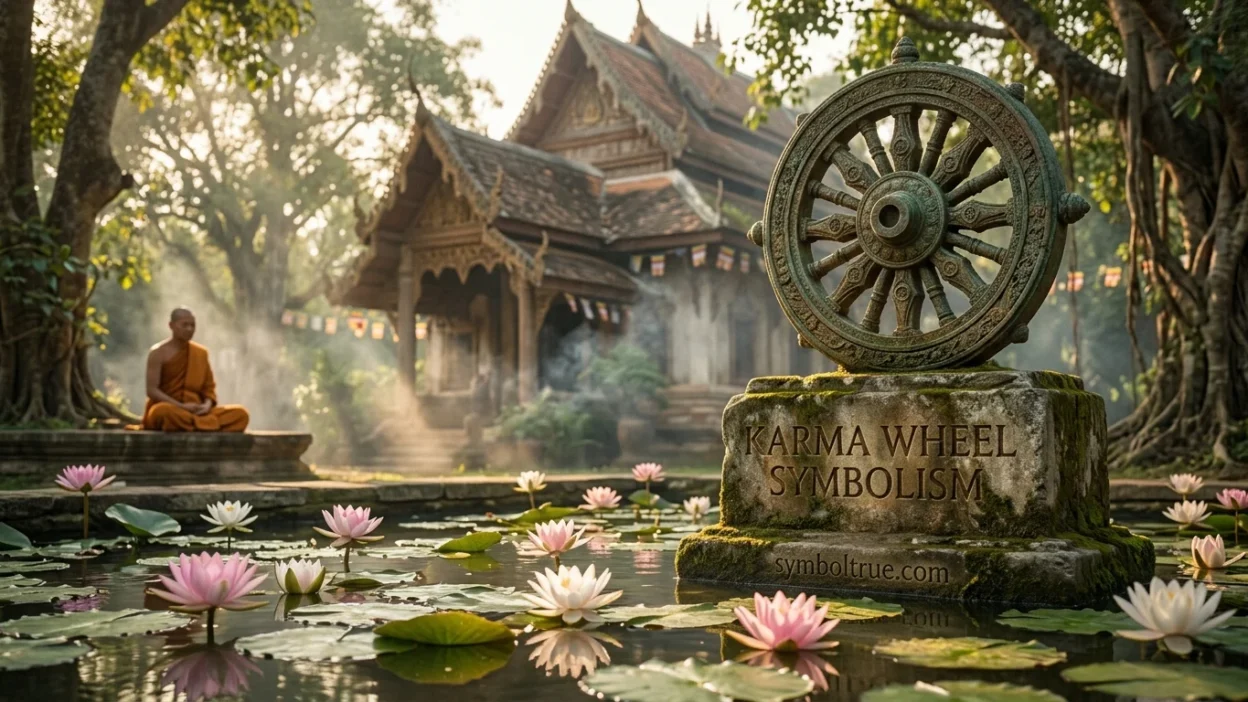
The karma wheel symbolism is closely connected with the Buddhist idea of the Wheel of Life, also called the Wheel of Becoming or bhavachakra. It represents the repeating cycle of actions, consequences, birth, death, and rebirth known as samsara.
Rather than simply meaning “what goes around comes around,” the karma wheel presents a deeper idea: our actions, intentions, attachments, and mental habits can influence the conditions we experience.
The exact imagery varies across Buddhist traditions, especially in Tibetan and Himalayan art. However, the central message is often connected with cause and effect, impermanence, suffering, attachment, awareness, and the possibility of spiritual freedom.
Karma Wheel Symbolism Meaning (Clear Definition)
At its simplest, karma wheel symbolism represents the continuing cycle of cause and effect.
The word karma comes from Sanskrit and broadly refers to action. In Buddhist teachings, karma is not simply a system of rewards and punishments. Actions involving the body, speech, and mind are understood to have consequences that can unfold over time.
The wheel represents movement and repetition. It has no obvious beginning or end, making it a powerful visual metaphor for cyclical existence.
In traditional Buddhist Wheel of Life paintings, the wheel usually illustrates samsara—the cycle of birth, death, and rebirth. Beings may be depicted moving through different realms according to karmic conditions, while the entire cycle remains influenced by ignorance, attachment, and other causes.
So, the karma wheel can symbolize:
- Cause and effect
- Rebirth and recurring patterns
- Actions and their consequences
- Attachment and desire
- Ignorance and awareness
- Impermanence
- Suffering and dissatisfaction
- Spiritual learning
- Personal responsibility
- The possibility of liberation
It is important to remember that “karma wheel” is a modern descriptive phrase. In Buddhist art and scholarship, related traditional terms include bhavachakra, samsara wheel, and Wheel of Becoming.
What Does Karma Wheel Symbolism Represent?
The karma wheel can represent several connected ideas rather than one fixed meaning.
1. The Cycle of Cause and Effect
One of its strongest meanings is that actions have consequences.
A person’s choices can create habits, relationships, emotional patterns, and circumstances that influence what happens next. In Buddhist thought, karma is understood in a much broader and more religious sense than the everyday phrase “you get what you deserve.”
2. Repetition
A wheel continually turns. This makes it an effective symbol for repeated experiences.
Someone may repeatedly encounter the same emotional pattern, conflict, attachment, or desire. In a spiritual interpretation, the wheel can encourage a person to notice what keeps repeating.
3. Impermanence
Everything on the wheel is moving. Nothing remains permanently fixed.
This reflects the Buddhist emphasis on impermanence. Pleasure changes, suffering changes, relationships change, bodies change, and circumstances change.
4. Responsibility
The wheel can also encourage reflection on personal actions.
Instead of asking only, “Why is this happening to me?” its symbolism can inspire another question:
“What am I creating through my choices, habits, and intentions?”
This does not mean every painful event is someone’s fault. Buddhist teachings about karma should not be simplified into blaming people for illness, tragedy, poverty, or other hardships.
Spiritual Meaning of Karma Wheel Symbolism
Spiritually, the karma wheel can represent a journey from unconscious repetition toward greater awareness.
Traditional Buddhist Wheel of Life imagery presents samsara as a cycle from which liberation is possible. The goal is not simply to move into a more comfortable position within the wheel but ultimately to understand the causes of suffering and move beyond the cycle.
This gives the wheel a powerful spiritual message:
Awareness can interrupt unconscious patterns.
The symbol may therefore suggest:
- Learning from repeated experiences
- Becoming aware of harmful attachments
- Developing compassion
- Practicing mindful action
- Understanding impermanence
- Releasing excessive desire
- Seeking wisdom
- Moving toward inner freedom
In traditional Buddhist interpretation, however, liberation is a much deeper religious concept than simply “changing your mindset.” It is associated with the Buddhist path toward awakening and nirvana.
The Three Poisons at the Center
One of the most important details in traditional Wheel of Life imagery is the center.
The central section commonly contains three animals representing the three poisons or destructive mental tendencies: attachment or desire, anger or aversion, and ignorance. The exact animals and artistic details can vary by tradition, but Tibetan Wheel of Existence paintings commonly use a rooster, snake, and pig.
These three forces help explain why the wheel continues turning.
Desire
Desire can represent grasping, craving, and attachment.
Anger
Anger or aversion represents resistance, hostility, and rejection.
Ignorance
Ignorance refers to a failure to see reality clearly, especially the nature of impermanence, suffering, and interdependence.
Together, they symbolize mental patterns that can keep beings caught in samsara.
Biblical / Religious Meaning of Karma Wheel Symbolism
There is no specific biblical symbol called the karma wheel.
Karma is primarily associated with Indian religious traditions, including Hinduism and Buddhism, although the concept is understood differently across those traditions.
Buddhist Wheel of Life imagery is particularly associated with teachings about samsara, karma, dependent origination, and the path toward liberation. The Rubin Museum describes the traditional Wheel of Existence as a visual explanation of life, death, rebirth, causes, conditions, and the possibility of resolving the problems of samsara.
Christianity does contain ideas about moral action, consequences, judgment, repentance, and spiritual transformation, but these should not automatically be equated with Buddhist karma.
Likewise, the karma wheel should not be presented as a biblical symbol.
The safest interpretation is to understand it within its original religious and cultural context before making comparisons with other faiths.
Karma Wheel Symbolism in History and Culture
The wheel has an especially important place in Buddhist visual culture.
The broader Buddhist wheel, known as the chakra, has several meanings. The dharmachakra, or Wheel of the Dharma, represents Buddhist teaching and is associated with the Buddha setting the teachings into motion. The Met notes that the wheel became a major symbol of Buddhist teaching across Buddhist traditions.
The Wheel of Life is related to this larger tradition of wheel imagery but has a more specific purpose.
Traditional Wheel of Existence paintings can contain several concentric sections. These may show the realms of existence, karmic movement, the three poisons, and the twelve links of dependent origination.
In Himalayan Buddhist art, the wheel is often shown being held by Yama, the Lord of Death. This visual arrangement emphasizes mortality and the fact that beings remain within conditioned existence until liberation.
The symbol therefore functions almost like a visual teaching tool. A viewer can study the wheel and contemplate why beings remain trapped in recurring patterns.
The Six Realms and Karma Wheel Symbolism
Traditional Buddhist Wheels of Life commonly depict six realms of existence.
These are generally described as:
- Gods
- Demigods or asuras
- Humans
- Animals
- Hungry ghosts
- Hell beings
The precise presentation can vary among Buddhist traditions and artistic traditions. The Rubin Museum identifies these six realms as part of the traditional depiction of samsara.
The realms should not necessarily be reduced to simple personality types. Within traditional Buddhist contexts, they have religious and cosmological meanings.
At the same time, modern readers may use them symbolically to think about different psychological states—for example, extreme desire, jealousy, fear, ignorance, or pride. That psychological reading can be useful, but it should be distinguished from the traditional religious interpretation.
Karma Wheel Symbolism in Literature and Art
Circular imagery appears frequently in religious art because a circle naturally communicates ideas such as repetition, eternity, movement, and continuity.
The Buddhist Wheel of Life is especially significant because it combines those visual qualities with a detailed teaching system.
Artists may use the wheel to show:
- Life and death
- Rebirth
- Human suffering
- Desire
- Moral action
- Spiritual awakening
- The relationship between inner states and outer existence
The broader Buddhist wheel also became a major artistic symbol for the Dharma. Historical Buddhist art used the wheel to represent the Buddha’s teaching and the “turning” of the Dharma.
Contemporary artists continue to reinterpret Wheel of Life imagery. Modern works may preserve traditional figures and structures while using them to explore identity, suffering, society, time, and human experience.
Karma Wheel Symbolism in Dreams
Seeing a karma wheel in a dream does not have one universally accepted meaning.
Dream interpretation is personal, and Buddhist teachings should not automatically be treated as a dream dictionary.
However, from a symbolic perspective, a wheel appearing in a dream may encourage reflection on cycles and repetition.
For example, it could represent:
Repeating Life Patterns
You may be thinking about something that repeatedly happens in your relationships, work, emotions, or decisions.
Consequences
The dream may symbolize awareness that an earlier choice is influencing a current situation.
Change
A rotating wheel can suggest movement, transition, or a new stage of life.
Feeling Stuck
If the wheel appears to spin endlessly without progress, it may symbolize a feeling of being trapped in repetition.
Spiritual Reflection
For someone familiar with Buddhist symbolism, the image may inspire thoughts about attachment, impermanence, awareness, or personal growth.
These are interpretive possibilities, not predictions or guaranteed spiritual messages.
Positive Symbolism of the Karma Wheel
Although the Wheel of Life is strongly associated with samsara and suffering, its symbolism is not necessarily negative.
The wheel can represent learning, awareness, responsibility, and transformation.
Positive interpretations include:
- Personal growth
- Wisdom gained through experience
- Learning from consequences
- Breaking unhealthy patterns
- Mindfulness
- Compassion
- Self-awareness
- Spiritual development
- Acceptance of change
- Freedom through understanding
The most hopeful aspect of the symbolism is that the wheel teaches that patterns can be understood.
In Buddhist tradition, the purpose of understanding samsara is not to become frightened by the cycle but to recognize its causes and follow a path toward liberation.
Negative or Hidden Symbolism of the Karma Wheel
The darker side of karma wheel symbolism concerns repetition without awareness.
It may symbolize:
- Attachment
- Craving
- Anger
- Ignorance
- Repeated mistakes
- Emotional cycles
- Suffering
- Fear of change
- Feeling trapped
- Consequences of harmful actions
- The temporary nature of worldly pleasure
Traditional imagery makes this especially clear by placing the entire wheel within the grip of Yama, symbolizing mortality and the conditioned nature of existence.
However, calling the wheel simply a “bad luck symbol” would miss its deeper meaning. Its purpose is more instructional than superstitious.
Common Interpretations of Karma Wheel Symbolism
Different people may understand the symbol in different ways.
| Interpretation | Symbolic Meaning |
| Karma | Actions have consequences |
| Wheel | Cycles, repetition, movement |
| Samsara | Birth, death, and rebirth |
| Center | Desire, anger, and ignorance |
| Six realms | Different states or conditions of existence |
| Yama | Mortality and the power of conditioned existence |
| Buddha outside the wheel | The possibility of liberation |
| Turning motion | Continuous change |
| Broken pattern | Awakening or transformation |
| Circular form | Continuity and recurring experience |
A modern personal interpretation might focus on breaking negative habits, while a traditional Buddhist interpretation places the symbol within a much larger religious framework.
Both can be discussed, but they should not be presented as identical.
Karma Wheel Symbolism and Personal Growth
One reason the karma wheel remains meaningful today is that its central image is easy to relate to.
People often notice cycles in everyday life.
Someone may repeatedly choose similar relationships. Another person may respond to criticism with the same anger each time. Someone else may continually chase achievements expecting the next success to provide permanent satisfaction.
The wheel can become a visual reminder to pause and ask:
What pattern am I repeating?
This question does not require believing in reincarnation to be useful.
The symbol can encourage:
- Awareness of your actions.
- Reflection on their consequences.
- Recognition of recurring habits.
- Greater compassion toward yourself and others.
- More deliberate choices.
- Openness to change.
This modern reflective use should be understood as a personal interpretation rather than a replacement for traditional Buddhist doctrine.
Why Does Karma Wheel Symbolism Matter Today?
The karma wheel remains relevant because modern life still involves cycles.
People experience cycles of success and failure, attachment and separation, conflict and reconciliation, desire and disappointment.
The wheel provides a visual language for thinking about these experiences.
Its deeper lesson is not simply “karma will punish you.”
A more thoughtful interpretation is:
Our actions matter, our habits can shape our experience, and awareness can create the possibility of change.
In traditional Buddhism, the teaching goes beyond personal improvement toward liberation from samsara. In a modern symbolic context, people may use the wheel as a reminder to examine their choices and recognize patterns that no longer serve them.
That distinction matters because it keeps the symbol meaningful without turning a complex religious teaching into a simple slogan.
FAQs;
What does the karma wheel symbolize?
The karma wheel commonly symbolizes karma, samsara, cause and effect, repeated existence, attachment, suffering, and the possibility of liberation. In Buddhist art, it is closely associated with the Wheel of Life or Wheel of Becoming.
Is the karma wheel a Buddhist symbol?
The phrase “karma wheel” is not necessarily the formal name of one Buddhist symbol. It is often used to describe the Buddhist Wheel of Life or Wheel of Becoming, known as bhavachakra. The Buddhist wheel more broadly also symbolizes the Dharma and the Buddha’s teachings.
What is the Buddhist Wheel of Life?
The Buddhist Wheel of Life is a visual representation of samsara, the cycle of birth, death, and rebirth. Traditional versions depict karmic existence, the six realms, the three poisons, and other teachings.
What do the animals in the center of the karma wheel mean?
In traditional Tibetan Wheel of Life imagery, the three central animals represent mental poisons such as desire or attachment, anger or aversion, and ignorance. The exact artistic presentation can vary.
Is karma the same as punishment?
Not exactly. In Buddhist contexts, karma concerns actions and their consequences rather than a simple system in which an external judge gives rewards or punishments. Karma is connected with intentional physical, verbal, and mental actions and their results.
What does a karma wheel mean spiritually?
Spiritually, it can represent awareness of recurring patterns, the consequences of actions, impermanence, and the possibility of moving toward greater wisdom and freedom. Traditional Buddhist meaning connects it with the larger goal of liberation from samsara.
What does a karma wheel mean in a dream?
A karma wheel in a dream may personally symbolize repetition, consequences, change, or feeling caught in a cycle. There is no universally accepted dream meaning, so the dreamer’s circumstances and emotions are important.
Is the karma wheel a symbol of good luck?
Not traditionally. The Wheel of Life is better understood as a teaching symbol concerning samsara, karma, suffering, and liberation. Treating it simply as a good-luck charm overlooks its religious context.
What does a wheel symbolize spiritually?
Across different traditions, wheels can symbolize movement, cycles, continuity, time, law, and transformation. In Buddhism, specific wheel symbols have distinct meanings, including the Wheel of Dharma and Wheel of Life.
Does the karma wheel mean everything happens for a reason?
That statement is an oversimplification. Buddhist teachings about karma are more complex than saying every event has a simple personal explanation. Karma concerns actions and consequences within a broader framework of causation and dependent arising.
Conclusion
Karma wheel symbolism is a powerful representation of cycles, cause and effect, karma, samsara, attachment, impermanence, and spiritual transformation.
Its deepest traditional meaning comes from Buddhist teachings about the Wheel of Life, where beings remain within cycles of conditioned existence while influenced by mental poisons and karmic actions. Yet the wheel also points toward the possibility of awakening and liberation.
For modern readers, it can serve as a thoughtful reminder to recognize repeating patterns, consider the consequences of actions, and approach change with greater awareness.
The wheel keeps turning—but understanding why it turns can be the beginning of seeing life differently.

Henry Jack is a passionate writer at SymbolTrue, dedicated to exploring the meanings, history, and cultural significance of symbols. He creates clear, engaging, and well-researched content that helps readers understand symbols from around the world.