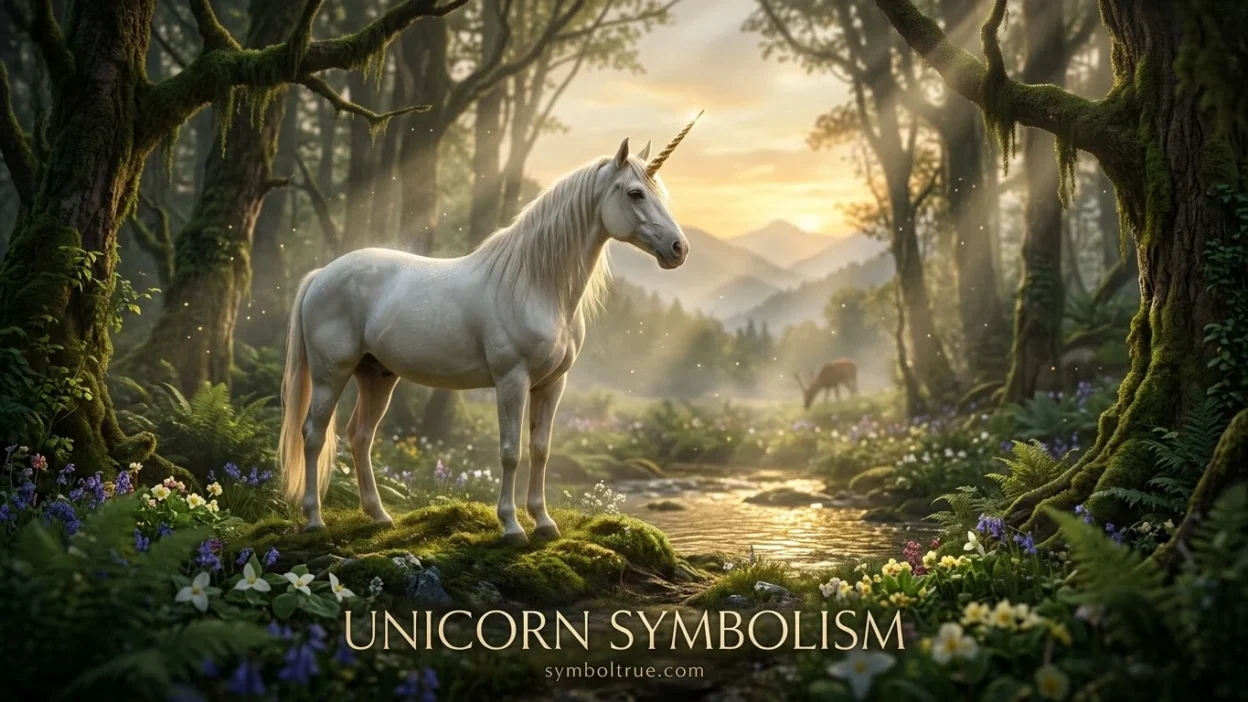
Unicorn symbolism refers to the meanings and ideas traditionally associated with the unicorn, a legendary creature usually portrayed as a horse with a single horn. Across different cultures and periods, the unicorn has been connected with purity, innocence, rarity, magic, protection, freedom, and hope.
The unicorn is not a real animal but a mythical figure with a long cultural history. Its meaning has changed over time, so there is no single interpretation that applies to everyone.
In modern symbolism, the unicorn often represents something extraordinary or difficult to find. People may use it as a symbol of individuality, imagination, personal freedom, and the belief that unusual possibilities can become meaningful realities.
What Does Unicorn Symbolism Represent?
The unicorn can represent several powerful ideas:
- Purity: Its white appearance in many traditions is associated with innocence and cleanliness.
- Rarity: A unicorn is often used to describe something exceptionally uncommon.
- Magic: It represents wonder, imagination, and possibilities beyond ordinary experience.
- Freedom: As a wild mythical creature, it can symbolize independence and a refusal to be controlled.
- Protection: Some traditional stories connect the unicorn’s horn with healing or protective qualities.
- Hope: The creature can represent optimism during difficult periods.
- Individuality: A unicorn stands apart from ordinary creatures, making it a symbol of being different.
- Transformation: Its appearance in stories can represent extraordinary change or discovery.
The exact meaning depends heavily on the context in which the unicorn appears.
Spiritual Meaning of Unicorn Symbolism
Spiritually, unicorn symbolism is often interpreted as a reminder to protect what is pure, meaningful, and authentic within yourself.
Some modern spiritual traditions view the unicorn as a symbol of intuition, inner wisdom, emotional healing, and connection with something greater than everyday life. These interpretations are spiritual beliefs rather than established historical facts.
The unicorn may also symbolize trusting your inner voice. Because the creature exists outside the ordinary physical world, it can represent imagination and the willingness to consider possibilities that are not immediately visible.
Another common interpretation is spiritual protection. In this view, the unicorn’s horn represents strength directed toward healing rather than destruction.
Unicorn as a Symbol of Inner Purity
The unicorn’s association with purity can encourage people to think about honesty, kindness, and staying connected to their deeper values.
Rather than suggesting literal perfection, this symbolism can be understood as an invitation to preserve your sense of integrity even when circumstances become difficult.
Biblical / Religious Meaning of Unicorn Symbolism
The unicorn has an interesting place in religious history, particularly in discussions surrounding older translations of the Bible.
In some historical English Bible translations, the Hebrew word re’em was translated as “unicorn.” Modern biblical scholarship generally understands re’em as referring to a powerful wild animal, often identified with the wild ox or aurochs, rather than the legendary one-horned creature familiar today.
Therefore, it would be misleading to claim that the Bible clearly teaches the modern unicorn as a spiritual creature.
Nevertheless, medieval Christian art and literature later gave the unicorn religious symbolism. In some medieval interpretations, the unicorn became associated with purity, innocence, and Christ, although these associations developed through later tradition and allegorical interpretation.
This distinction matters: the modern symbolic meaning of the unicorn should not automatically be presented as a direct biblical teaching.
Unicorn Symbolism in History and Culture
The unicorn has appeared in legends, artwork, heraldry, literature, and folklore for centuries.
Ancient descriptions of one-horned animals may have been influenced by travelers’ reports, artistic imagination, or misunderstandings of real animals. Over time, these ideas developed into the recognizable unicorn of European folklore.
During the medieval period in Europe, the unicorn became especially prominent in religious and courtly art. Stories sometimes portrayed it as a rare and difficult creature to capture.
Unicorn imagery also appeared in royal and heraldic settings. The creature eventually became associated with qualities such as strength, nobility, purity, and mystery.
The Unicorn in Scottish Heraldry
The unicorn has a particularly strong connection with Scotland. It appears as a supporter of the Scottish royal arms, where it represents strength and independence.
Historically, the unicorn’s association with Scotland demonstrates how mythical creatures can become symbols of national identity rather than simply characters in fantasy stories.
The Unicorn in Modern Culture
Today, unicorns appear widely in children’s books, films, toys, fashion, illustrations, and internet culture.
The modern unicorn is often more colorful and playful than its medieval counterpart. Pink, rainbow, and sparkling unicorn imagery commonly represents joy, creativity, fantasy, and self-expression.
The word “unicorn” is also used metaphorically for something extremely rare or exceptional, such as an unusual business success or an exceptionally talented person.
Unicorn Symbolism in Literature and Art
Unicorns have played an important role in European literature and visual art.
Medieval and Renaissance artists frequently used the creature to explore themes of purity, temptation, innocence, mystery, and spirituality. Unicorn stories often worked as allegories, meaning that the creature represented ideas beyond its literal role in the story.
In later fantasy literature, the unicorn became increasingly associated with enchantment, goodness, imagination, and otherworldly beauty.
Modern artists often reinterpret the unicorn according to their own themes. A realistic unicorn might represent mystery, while a colorful cartoon unicorn may communicate playfulness and childhood imagination.
This flexibility is one reason the symbol remains popular.
Unicorn Symbolism in Dreams
Dream interpretation is subjective, and there is no scientifically established universal meaning for dreaming about a unicorn.
However, within traditional and modern symbolic interpretations, a unicorn dream may represent hope, imagination, individuality, or the desire for something extraordinary.
Seeing a Unicorn
Seeing a unicorn in a dream may be interpreted as a symbol of wonder or an unusual opportunity.
If the dream feels peaceful, it may reflect positive emotions, creativity, or optimism.
Riding a Unicorn
Riding a unicorn could symbolize freedom, confidence, or a desire to escape ordinary limitations.
It may also represent taking control of your imagination and using it to move toward a personal goal.
A White Unicorn
A white unicorn may emphasize traditional associations with purity, innocence, peace, and spiritual ideals.
An Injured Unicorn
An injured unicorn could symbolically represent disappointment, lost innocence, emotional vulnerability, or something precious that feels threatened.
The personal emotions experienced during the dream are usually more important than any fixed dream dictionary definition.
Positive Symbolism of Unicorns
The unicorn is generally viewed as a highly positive symbolic figure.
Its most common positive meanings include:
Purity and Innocence
The traditional white unicorn can represent sincerity, innocence, and a clean intention.
Hope and Wonder
The creature reminds people that life can contain unexpected possibilities. It can symbolize hope when ordinary solutions seem limited.
Individuality
Because the unicorn is unique, it can encourage people to embrace qualities that make them different from others.
Freedom
The mythical creature’s wild nature can symbolize independence and the desire to live according to your own values.
Creativity
Unicorns are strongly connected with fantasy and imagination, making them useful symbols of creative thinking.
Protection
In some traditional stories, the unicorn’s horn is given protective or healing qualities. Modern interpretations may use this idea symbolically rather than literally.
Negative or Hidden Symbolism of Unicorns
Although unicorn symbolism is usually positive, the creature can have more complicated meanings.
Unrealistic Expectations
Because unicorns represent extraordinary possibilities, they can sometimes symbolize expectations that are difficult or impossible to meet.
Escapism
A strong attachment to fantasy may represent a desire to avoid difficult realities. In this interpretation, the unicorn becomes a reminder to balance imagination with practical action.
Fragile Innocence
The unicorn’s association with purity can also suggest vulnerability. Something beautiful or innocent may need protection from harmful influences.
Rarity and Isolation
Being unique can be empowering, but it can also create feelings of being different or alone. The unicorn may therefore symbolize the complicated side of individuality.
Common Interpretations of Unicorn Symbolism
Different situations can produce different meanings.
| Context | Possible Symbolic Meaning |
| White unicorn | Purity, innocence, peace |
| Wild unicorn | Freedom, independence |
| Unicorn horn | Strength, healing, protection |
| Colorful unicorn | Joy, creativity, imagination |
| Unicorn in a forest | Mystery, discovery, natural wonder |
| Flying unicorn | Freedom, ambition, limitless imagination |
| Baby unicorn | Innocence, new beginnings |
| Injured unicorn | Vulnerability, disappointment, lost innocence |
| Unicorn in dreams | Hope, individuality, imagination |
| Unicorn in art | Fantasy, beauty, spirituality, mystery |
These interpretations are symbolic possibilities rather than universal rules.
Why Does Unicorn Symbolism Matter Today?
Unicorn symbolism remains popular because it speaks to ideas that are still meaningful in modern life.
People often feel pressure to fit in, follow expectations, or behave like everyone else. The unicorn offers an opposite image: being rare, distinctive, imaginative, and authentic.
It can also represent hope. When people describe something as a “unicorn,” they often mean something exceptionally unusual or valuable.
The symbol therefore works in both fantasy and everyday language.
For children, unicorns can represent imagination and wonder. For adults, they may represent individuality, creativity, ambition, or the search for something extraordinary.
The most useful modern interpretation is not that a unicorn guarantees magical outcomes, but that it can remind us to value imagination while remaining grounded in reality.
FAQs;
What does a unicorn symbolize?
A unicorn commonly symbolizes purity, rarity, freedom, magic, hope, individuality, creativity, and wonder. Its meaning changes depending on cultural and personal context.
What is the spiritual meaning of a unicorn?
In modern spiritual interpretations, a unicorn may symbolize inner purity, intuition, protection, healing, hope, and connection with one’s authentic self. These are spiritual interpretations rather than universally established facts.
What does a unicorn represent in dreams?
A unicorn in a dream may represent hope, imagination, individuality, freedom, or a desire for something extraordinary. Personal feelings and the details of the dream can change the interpretation.
Is the unicorn mentioned in the Bible?
Some older English Bible translations used the word “unicorn” for the Hebrew term re’em. Modern scholarship generally does not identify re’em with the legendary unicorn. Later Christian traditions nevertheless gave unicorn imagery various symbolic meanings.
What does a white unicorn symbolize?
A white unicorn is commonly associated with purity, innocence, peace, goodness, and spiritual ideals, particularly in European artistic and literary traditions.
What does a unicorn horn symbolize?
The horn can symbolize strength, protection, healing, and magical power in different stories and traditions. These meanings are part of mythology rather than evidence of literal supernatural abilities.
Why are unicorns associated with magic?
Unicorns are mythical creatures that exist outside ordinary experience, so stories naturally connect them with wonder, enchantment, mystery, and imagination.
What does a unicorn symbolize in modern culture?
Today, unicorns commonly represent uniqueness, creativity, positivity, self-expression, imagination, and something exceptionally rare.
Conclusion
Unicorn symbolism has developed across folklore, religion, literature, art, and modern popular culture. Its strongest recurring meanings include purity, rarity, freedom, imagination, hope, protection, and individuality.
Historically, the unicorn has carried different meanings in different contexts, so no single interpretation explains every appearance of the creature. Modern audiences often see it as a reminder to embrace uniqueness and imagination while staying connected to reality.
Ultimately, the unicorn remains powerful because it represents something rare and extraordinary: the possibility of seeing the world with wonder, courage, and an open mind.

Ryan Thomas is a passionate writer at SymbolTrue, dedicated to exploring the meanings, history, and cultural significance of symbols worldwide. He creates engaging, well-researched content that helps readers discover the stories and symbolism behind everyday signs, icons, and traditions.