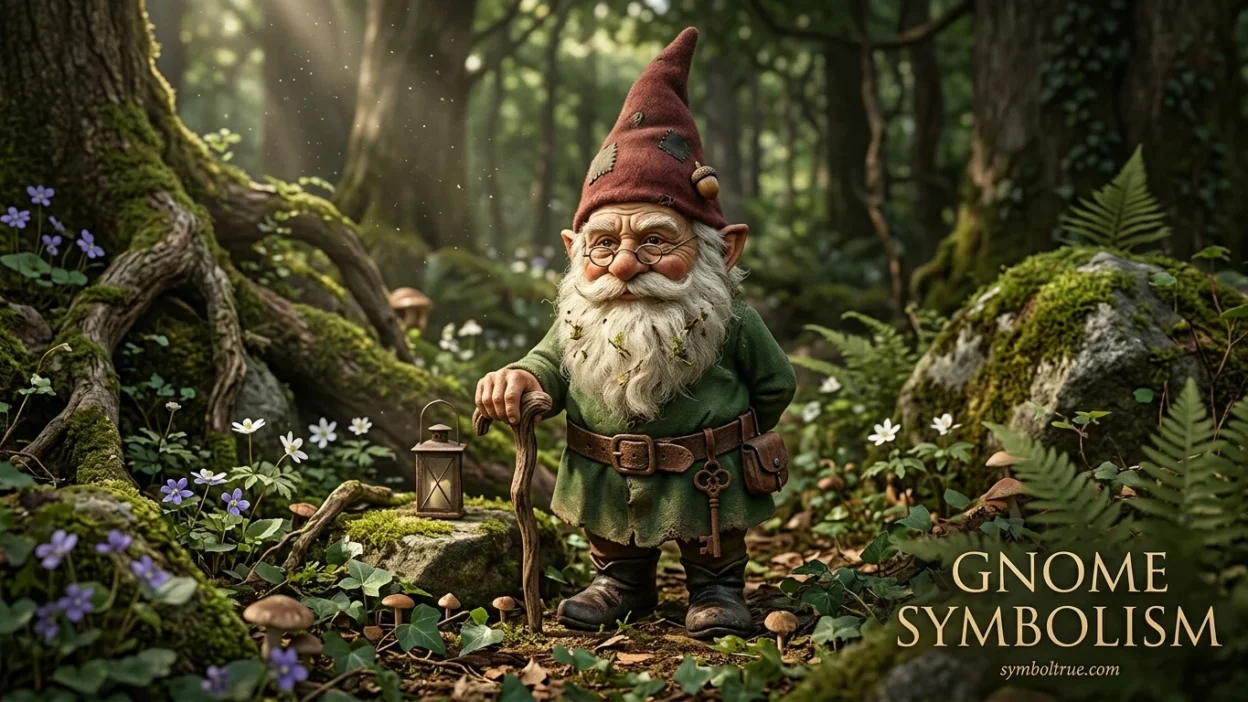
Gnome symbolism often centers on protection, hidden wisdom, nature, good fortune, hard work, and the mysteries of the unseen world. These small, human-like figures have appeared in European folklore and later became popular garden decorations, where their meanings have developed beyond their original traditions.
Gnome Symbolism Meaning (Clear Definition)
Gnome symbolism refers to the meanings and ideas associated with gnomes in folklore, popular culture, art, gardens, stories, and personal interpretation.
Historically, gnomes have been connected with beings believed to live close to the earth. They are often imagined as guardians of underground places, natural treasures, forests, gardens, or hidden knowledge.
Today, a garden gnome may simply represent humor or decoration. However, symbolic interpretations often connect the figure with:
- Protection
- Good fortune
- Wisdom
- Nature
- Grounding
- Hard work
- Hidden knowledge
- Abundance
- Playfulness
- A connection with the earth
The meaning depends heavily on context. A gnome appearing in a fairy tale does not necessarily carry the same meaning as a decorative gnome placed in someone’s garden.
What Does Gnome Symbolism Represent?
Gnomes are commonly interpreted through several important symbolic themes.
Protection
One of the strongest modern associations with garden gnomes is protection. A gnome standing outside a home or among plants can be viewed as a symbolic guardian.
This interpretation fits the traditional image of small supernatural beings watching over particular places or natural environments.
Connection With Nature
Gnomes are strongly associated with the earth, forests, gardens, rocks, roots, and underground spaces.
Because of this, they can symbolize respect for nature and awareness of the natural world.
Hidden Wisdom
Gnomes are often portrayed as mysterious beings who know things that humans cannot easily see. This makes them a useful symbol for hidden knowledge, experience, and wisdom.
Good Fortune
Modern garden traditions frequently associate gnomes with luck and prosperity. A gnome placed in a garden may therefore represent a wish for a household to experience happiness, abundance, or good fortune.
Grounding
Because gnomes are associated with the earth, they can also symbolize stability and staying grounded.
In a personal or spiritual interpretation, seeing a gnome may be understood as a reminder to slow down, reconnect with ordinary life, and remain steady during uncertain times.
Spiritual Meaning of Gnome Symbolism
There is no single universal spiritual meaning of gnomes. Their spiritual interpretation depends on the tradition, story, or personal belief involved.
In contemporary symbolic thinking, gnomes may represent earth energy, protection, patience, practical wisdom, and awareness of things hidden beneath the surface.
Their small size can also carry an interesting symbolic message. Something does not need to be large or powerful to have value.
A gnome can therefore represent the idea that quiet strength and careful attention can matter more than outward appearance.
For some people, gnomes symbolize the importance of caring for one’s surroundings. Their association with gardens makes them especially suitable as symbols of patience because plants require consistent care before their growth becomes visible.
It is important to distinguish these modern spiritual interpretations from documented historical beliefs. Not every spiritual meaning attributed to gnomes today was part of older European folklore.
Biblical / Religious Meaning of Gnome Symbolism
Gnomes do not have a specific biblical meaning, and they are not figures established in the Bible as spiritual beings.
Some modern discussions may connect gnome symbolism with general ideas such as stewardship of nature, humility, wisdom, or protection. However, these are interpretations rather than direct biblical teachings about gnomes.
The same distinction applies to broader religious symbolism. Different traditions may have stories about supernatural beings associated with nature, but that does not mean those beings are historically equivalent to gnomes.
Therefore, it is better to describe gnome symbolism in religious contexts cautiously rather than claiming that gnomes have a fixed religious meaning.
Gnome Symbolism in History and Culture
The history of gnome symbolism is closely connected with European folklore and changing ideas about nature spirits.
The word gnome became associated with a legendary earth-dwelling being in early modern European literature. The term is particularly associated with the Swiss alchemist and physician Paracelsus, whose writings described small elemental beings connected with the earth.
Over time, folklore, literature, fairy tales, illustrations, and popular culture helped develop the familiar image of the gnome.
The modern garden gnome became especially recognizable in Europe during the nineteenth century. Decorative gnomes eventually spread internationally and became associated with gardens, lawns, humor, and good luck.
This history shows why today’s gnome symbolism is layered. Some meanings come from folklore, while others developed through literature, commercial decoration, popular culture, and personal belief.
Gnome Symbolism in Literature and Art
Gnomes have played an important role in fantasy literature and visual storytelling.
Artists and writers often use gnomes to create a sense of mystery, hidden worlds, magical nature, and life beyond ordinary human perception.
Their small stature makes them particularly effective characters in fantasy because they can inhabit spaces that humans overlook, such as underground tunnels, tree roots, caves, gardens, and forests.
In art, a gnome may also be used to create a playful contrast between the ordinary and the magical. A familiar garden can suddenly feel mysterious when a small mythical figure appears within it.
Modern fantasy has expanded the image even further, portraying gnome-like characters as inventors, craftsmen, guardians, miners, gardeners, or magical creatures.
Gnome Symbolism in Dreams
Dream symbolism is personal, so seeing a gnome in a dream does not have one guaranteed interpretation.
The meaning may depend on what the gnome was doing, where it appeared, and how you felt during the dream.
Seeing a Friendly Gnome
A friendly gnome may symbolize comfort, protection, good fortune, or support.
It could reflect a desire to feel safe or cared for in your everyday surroundings.
Seeing a Gnome in a Garden
A garden gnome may suggest themes of growth, patience, home, nature, and personal stability.
The garden itself may be as important as the gnome.
Seeing a Hidden Gnome
A hidden gnome might represent something that has been overlooked.
Symbolically, it could encourage you to pay attention to a small detail, quiet opportunity, or piece of knowledge that you previously ignored.
A Frightening Gnome
If the gnome feels threatening, the dream may reflect your personal associations with unfamiliar or mysterious things.
It does not necessarily predict anything negative.
Positive Symbolism of Gnomes
Gnomes can carry many positive symbolic meanings, especially in contemporary culture.
Protection: A gnome may symbolize a guardian watching over a home or garden.
Luck: Garden gnomes are often associated with good fortune.
Wisdom: Their connection with folklore and hidden worlds can suggest knowledge gained through experience.
Nature: Gnomes can represent closeness to the earth and natural environments.
Patience: Their association with gardening can symbolize steady effort and gradual growth.
Stability: Their earth-related imagery can represent grounding and reliability.
Playfulness: Their unusual appearance can add humor and lightness to everyday life.
Together, these meanings create an image of a small but meaningful guardian who combines practicality with mystery.
Negative or Hidden Symbolism of Gnomes
Gnome symbolism is not always positive.
Because gnomes belong to the world of folklore and supernatural storytelling, they can sometimes represent the unknown, secrecy, deception, or hidden forces.
Their underground associations may symbolize things kept out of sight. In a story, a gnome could therefore represent secrets, unexplored parts of the self, or knowledge that has not yet been discovered.
Some people may also associate garden gnomes with artificiality or excessive decoration. In this interpretation, the gnome can symbolize the difference between authentic nature and a manufactured image of nature.
These interpretations are contextual rather than universal.
Common Interpretations of Gnome Symbolism
Here are some of the most common symbolic associations:
| Gnome Symbolism | Possible Meaning |
| Garden gnome | Home, protection, luck |
| Gnome in a forest | Nature, mystery, hidden wisdom |
| Underground gnome | Secrets, earth, unseen knowledge |
| Friendly gnome | Support, comfort, good fortune |
| Working gnome | Patience, craftsmanship, effort |
| Colorful gnome | Joy, creativity, playfulness |
| Old gnome | Experience, wisdom, tradition |
| Hidden gnome | Discovery, overlooked details |
| Gnome with plants | Growth, nature, patience |
| Gnome near a home | Protection, security, belonging |
These meanings should be treated as symbolic possibilities rather than fixed rules.
Why Does Gnome Symbolism Matter Today?
Gnome symbolism remains popular because it combines ordinary life with imagination.
A garden gnome can transform a simple outdoor space into something playful and mysterious. For some people, it is merely decoration. For others, it represents luck, protection, nature, or a connection with folklore.
Gnomes are also useful symbols because they challenge the idea that importance depends on size or appearance.
A small figure can represent quiet strength, careful work, hidden knowledge, and steady protection.
In modern storytelling, gnomes continue to appear in books, games, films, artwork, decorations, and fantasy worlds. Their flexible symbolism allows different people to give them different meanings.
FAQs;
What is the main meaning of gnome symbolism?
Gnome symbolism is commonly associated with protection, luck, nature, wisdom, grounding, hard work, and hidden knowledge.
Are gnomes symbols of good luck?
In modern garden traditions, gnomes are often associated with good luck and prosperity. This is a cultural and folkloric association rather than a universal belief.
What does a gnome represent spiritually?
In contemporary spiritual interpretation, a gnome may symbolize grounding, protection, patience, connection with nature, and awareness of hidden wisdom.
Do gnomes have a biblical meaning?
No specific biblical meaning of gnomes exists. Gnomes are not biblical figures, so claims about their religious symbolism should be treated as later interpretations rather than biblical teachings.
What does a garden gnome symbolize?
A garden gnome can symbolize protection, good fortune, home, nature, playfulness, and care for one’s surroundings.
What does seeing a gnome in a dream mean?
A gnome in a dream may represent protection, hidden knowledge, nature, stability, or something overlooked. The meaning depends on the dream’s context and your personal associations.
Are gnomes connected to nature?
Yes. Gnomes have long been portrayed in folklore and fantasy as beings associated with the earth, underground places, forests, gardens, and natural environments.
What does a gnome symbolize in a garden?
In a garden, a gnome commonly represents good luck, protection, playfulness, and a symbolic connection with nature.
Conclusion
Gnome symbolism brings together ideas of protection, good fortune, nature, hidden wisdom, patience, stability, and playfulness. Its meanings have developed through folklore, literature, art, garden traditions, and modern popular culture.
While some interpretations have historical roots, others are contemporary symbolic ideas. Understanding that distinction makes gnome symbolism more interesting and prevents folklore from being presented as established religious or spiritual fact.
Ultimately, the humble gnome can represent a simple but meaningful idea: small things can carry great significance when we take the time to notice them.

Ryan Thomas is a passionate writer at SymbolTrue, dedicated to exploring the meanings, history, and cultural significance of symbols worldwide. He creates engaging, well-researched content that helps readers discover the stories and symbolism behind everyday signs, icons, and traditions.