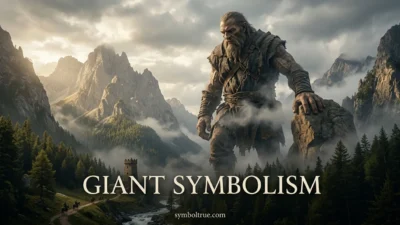
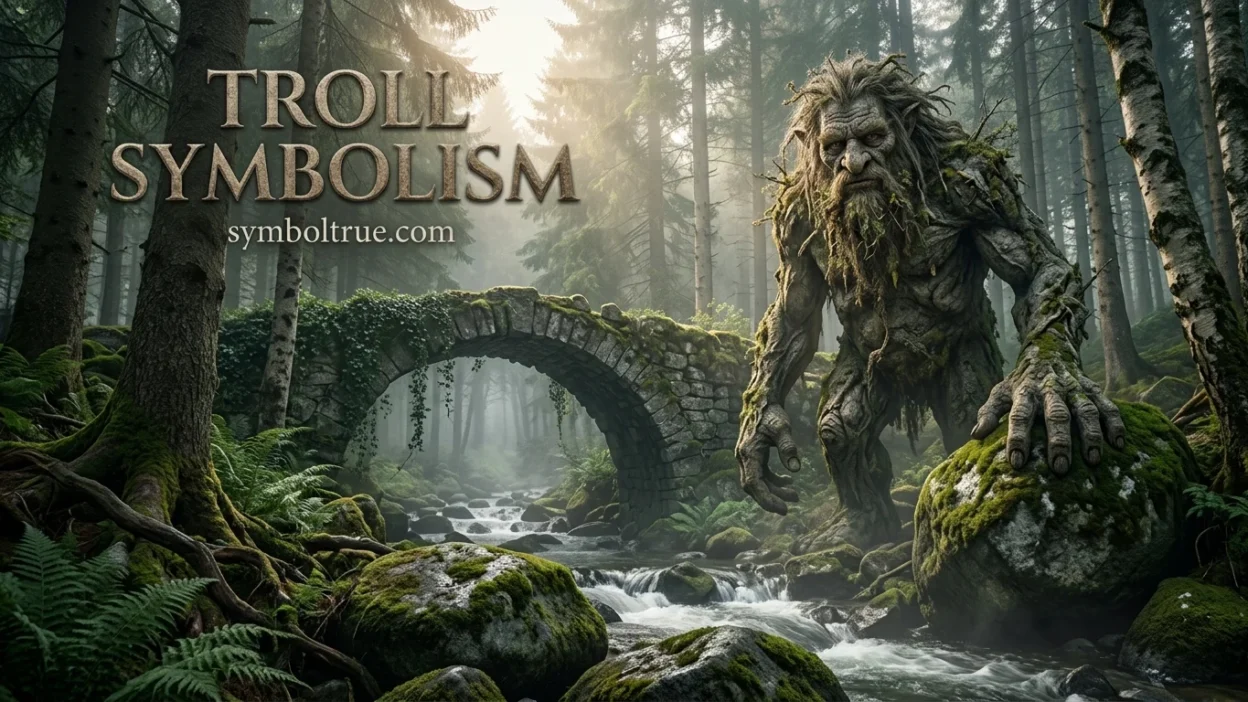
Trolls are mysterious figures that have appeared in Scandinavian folklore for centuries. Often described as powerful, strange, solitary, or dangerous beings, they are strongly connected with mountains, caves, forests, darkness, and places beyond ordinary human society.
Because of these associations, troll symbolism can represent many ideas, including hidden fears, protection, isolation, strength, obstacles, and the unknown.
The meaning of a troll depends greatly on the story, culture, and situation in which it appears. In traditional folklore, trolls were not simply monsters. They could represent forces of nature, dangers outside the safety of human communities, or beings that challenged people to use courage and intelligence.
Today, trolls also appear in books, movies, games, dreams, artwork, and popular culture. Their symbolic meaning has therefore expanded beyond traditional folklore.
Troll Symbolism Meaning (Clear Definition)
Troll symbolism generally represents the unknown, hidden dangers, obstacles, raw strength, isolation, and the mysterious side of nature.
In traditional Scandinavian stories, trolls were often connected with places that were difficult or dangerous for humans to enter. Mountains, forests, caves, and remote landscapes became natural settings for encounters with these creatures.
Symbolically, a troll can therefore represent something that stands between a person and a desired goal.
For example, if a hero encounters a troll while crossing a bridge, the troll may symbolize a barrier or test. The hero must find courage, intelligence, or another solution to continue the journey.
Common symbolic meanings include:
- Strength and physical power
- Obstacles and challenges
- Hidden fears
- Isolation and loneliness
- Protection of boundaries
- Nature and wilderness
- The unknown
- Transformation through difficulty
- Uncontrolled or rudimentary forces
- Wisdom gained through experience
Not every troll represents something negative. In some modern interpretations, trolls can symbolize resilience, individuality, protection, and the ability to survive difficult circumstances.
What Does Troll Symbolism Represent?
Troll symbolism can represent different ideas depending on the context.
Obstacles and Challenges
One of the strongest symbolic interpretations of a troll is an obstacle.
A troll standing in someone’s path can represent a problem that appears difficult to overcome. The obstacle might be fear, uncertainty, conflict, or an important decision.
The symbolism encourages the idea that challenges must be faced rather than avoided.
The Unknown
Trolls are often associated with dark forests, caves, mountains, and remote locations. These settings naturally connect them with mystery and uncertainty.
Because of this, a troll may symbolize something a person does not yet understand.
Strength and Power
Traditional troll stories often describe creatures with unusual physical strength. Symbolically, this can represent raw power, endurance, or the ability to withstand hardship.
The meaning can be positive when strength is controlled wisely, but negative when power becomes destructive.
Isolation
Trolls are frequently portrayed as living away from ordinary human communities. This makes them a useful symbol of isolation, separation, or feeling different from others.
A troll can therefore represent someone who feels misunderstood or disconnected.
Boundaries and Protection
In some stories, trolls guard specific places or territories. From a symbolic perspective, this can represent boundaries.
The troll may symbolize the need to protect personal space, values, resources, or something important.
Spiritual Meaning of Troll Symbolism
There is no single universal spiritual meaning of trolls. Their spiritual interpretation depends on the tradition, personal beliefs, and story involved.
Symbolically, a troll can represent a spiritual challenge or an inner obstacle.
Seeing a troll in a symbolic or spiritual context may encourage someone to examine what they fear or avoid.
A troll can also represent the parts of ourselves that we find uncomfortable. Anger, insecurity, jealousy, loneliness, or fear may be imagined as a frightening creature that needs to be understood rather than simply rejected.
From this perspective, troll symbolism may suggest:
- Facing hidden fears
- Developing inner strength
- Accepting difficult emotions
- Protecting personal boundaries
- Learning from difficult experiences
- Exploring the unknown
- Becoming more courageous
These interpretations are symbolic rather than established spiritual facts.
Biblical / Religious Meaning of Troll Symbolism
Trolls do not have a specific established meaning in the Bible.
The concept of the Scandinavian troll belongs primarily to European folklore, especially traditions associated with Scandinavia. Therefore, it would be misleading to claim that the Bible directly identifies trolls or gives them a particular symbolic meaning.
Some modern readers may compare trolls with broader religious themes such as temptation, fear, evil, wilderness, or spiritual trials. However, these are interpretations rather than biblical definitions.
The safest distinction is:
Biblical meaning: There is no specific biblical symbolism for trolls.
Symbolic comparison: A troll may be used in modern storytelling to represent temptation, danger, fear, or a difficult spiritual test.
These ideas should not be presented as direct biblical teachings.
Troll Symbolism in History and Culture
Trolls have deep roots in Scandinavian folklore.
The word and concept developed within Northern European traditions, particularly in Norway, Sweden, Denmark, and Iceland, although descriptions and stories varied across regions and periods.
Traditional stories portray trolls in different ways. Some are huge and frightening, while others are smaller, clever, foolish, or supernatural. They may live in mountains, caves, forests, or other remote places.
Some famous Scandinavian folk traditions describe trolls as creatures that could be dangerous to humans. Certain stories also associate trolls with daylight, with some tales saying that trolls could be turned to stone when exposed to sunlight.
It is important to recognize that folklore is not a single fixed system. Stories were passed through different communities and changed over time.
Trolls and the Natural World
One important cultural interpretation connects trolls with the power and mystery of nature.
Mountains, cliffs, forests, and caves can be beautiful but dangerous. Before modern transportation, mapping, and technology, remote landscapes could seem mysterious and frightening.
Troll stories gave imaginative form to those dangers.
In this sense, a troll can symbolize nature that humans cannot completely control.
Troll Symbolism in Literature and Art
Trolls became especially influential in literature and visual art.
Scandinavian fairy tales and folklore collections helped introduce troll stories to wider audiences. Writers and artists transformed trolls from local folklore figures into recognizable characters in international popular culture.
One important example is Norwegian author and playwright Henrik Ibsen, whose play Peer Gynt includes supernatural figures associated with the troll world.
Later children’s literature, fantasy novels, illustrations, films, television shows, and video games gave trolls many new personalities.
Modern portrayals may show trolls as:
- Terrifying monsters
- Comic characters
- Ancient guardians
- Lonely creatures
- Powerful warriors
- Misunderstood outsiders
- Magical beings
- Symbols of nature
This demonstrates how symbolism changes as stories move between cultures and generations.
Troll Symbolism in Dreams
Dream interpretation is personal, so a troll does not have one fixed meaning in every dream.
A troll in a dream may represent something that feels large, threatening, difficult, or emotionally overwhelming.
For example, dreaming about being chased by a troll might reflect a situation you are trying to avoid. A troll blocking a road could symbolize an obstacle standing between you and an important goal.
A friendly troll may have a different meaning. It could represent an unexpected source of strength, an unusual friendship, or a part of yourself that you once considered frightening but are beginning to understand.
Common dream interpretations include:
Seeing a Troll
This may symbolize an obstacle, fear, or unfamiliar situation.
Fighting a Troll
This can represent confronting a difficult problem or standing up for yourself.
Running Away From a Troll
This may reflect avoidance or anxiety about something challenging.
Defeating a Troll
This can symbolize overcoming fear, difficulty, or a personal limitation.
Talking to a Troll
This may suggest that you are trying to understand something unfamiliar or uncomfortable.
A Friendly Troll
A friendly troll may symbolize unexpected help, hidden strength, acceptance, or a misunderstood part of yourself.
Dream symbolism should be treated as a personal reflection rather than a prediction of future events.
Positive Symbolism of Trolls
Although trolls are often portrayed as frightening, they can carry positive symbolic meanings.
Resilience
A troll can represent the ability to survive difficult conditions.
Protection
A troll guarding a place can symbolize strong boundaries and protection.
Inner Strength
The physical power associated with trolls can represent emotional or psychological strength.
Individuality
Because trolls are often portrayed as outsiders, they can symbolize being comfortable with being different.
Courage
Facing a troll can represent the courage required to confront something intimidating.
Hidden Wisdom
Some modern interpretations portray the frightening creature as something that teaches an important lesson. The difficult experience itself may contain wisdom.
Negative or Hidden Symbolism of Trolls
Troll symbolism can also point toward darker themes.
A troll may represent:
- Fear
- Anger
- Aggression
- Isolation
- Stubbornness
- Destructive behavior
- Hidden insecurity
- Uncontrolled power
- Resistance to change
- Emotional barriers
The symbolic meaning often depends on how the troll behaves.
A peaceful troll may represent protection or strength, while an aggressive troll may represent conflict or uncontrolled emotions.
The setting matters too. A troll peacefully living in a forest creates a different symbolic impression from a troll attacking travelers.
Common Interpretations of Troll Symbolism
Here are some of the most common symbolic interpretations:
| Troll Symbolism | Possible Meaning |
| Troll under a bridge | Obstacle or difficult transition |
| Mountain troll | Endurance, isolation, or powerful challenges |
| Forest troll | Mystery, nature, and the unknown |
| Friendly troll | Hidden support or unexpected wisdom |
| Angry troll | Conflict, fear, or uncontrolled emotion |
| Giant troll | A problem that feels overwhelming |
| Troll guarding something | Boundaries and protection |
| Defeating a troll | Overcoming an obstacle |
| Hiding from a troll | Avoidance or fear |
| Talking to a troll | Understanding the unfamiliar |
These meanings are interpretive rather than universal rules.
Why Does Troll Symbolism Matter Today?
Trolls remain relevant because they provide a powerful way to describe challenges and uncomfortable parts of human experience.
In fantasy stories, the troll often stands between the hero and a destination. This makes the creature a natural symbol of personal challenges.
The idea also works outside fantasy.
Someone might describe a difficult problem as a “troll” metaphorically because it blocks progress. A person dealing with fear may imagine that fear as a creature standing in their way.
Modern internet culture has also given the word troll another meaning. An online troll is generally someone who deliberately provokes or disrupts others, often through online comments.
This modern usage is related to the older image of a troublesome creature but should not be confused with the original Scandinavian folklore tradition.
As a result, the word has developed multiple layers of meaning: folklore, fantasy, metaphor, and modern internet culture.
FAQs:
What is the main meaning of troll symbolism?
Troll symbolism commonly represents obstacles, hidden fears, strength, isolation, boundaries, nature, and the unknown.
Are trolls evil?
Not necessarily. Traditional stories portray trolls in different ways, and modern fiction has expanded their personalities. Some are dangerous, while others are humorous, protective, or misunderstood.
What does a troll symbolize spiritually?
In symbolic spiritual interpretations, a troll may represent an inner obstacle, hidden fear, personal boundaries, or a challenge that encourages growth. These interpretations are not universal religious teachings.
What does seeing a troll in a dream mean?
A troll in a dream may symbolize a difficult situation, fear, emotional barrier, or challenge. The meaning depends on the dream’s details and your personal circumstances.
What does a troll under a bridge symbolize?
A troll under a bridge commonly symbolizes a barrier or challenge that must be faced before moving from one stage of life to another.
What do trolls symbolize in Scandinavian folklore?
In Scandinavian folklore, trolls are supernatural beings associated with remote landscapes and various traditional beliefs. Their characteristics differ between stories and regions.
Do trolls have a biblical meaning?
There is no specific biblical meaning of trolls. Trolls come from European folklore rather than biblical tradition.
Can troll symbolism be positive?
Yes. Trolls can symbolize resilience, protection, strength, individuality, courage, and the ability to overcome difficult situations.
Conclusion
Troll symbolism is rich because trolls can represent both danger and strength. In traditional folklore, they are closely connected with mystery, wilderness, remote places, and the supernatural. Symbolically, they can represent obstacles, hidden fears, isolation, boundaries, resilience, and the unknown.
Their meaning changes depending on the story or situation. A frightening troll may represent a challenge, while a protective or friendly troll may symbolize strength and unexpected wisdom.
Rather than having one fixed interpretation, trolls are best understood as flexible symbols that reflect how people think about fear, nature, difference, challenges, and the mysterious parts of life.

Henry Jack is a passionate writer at SymbolTrue, dedicated to exploring the meanings, history, and cultural significance of symbols. He creates clear, engaging, and well-researched content that helps readers understand symbols from around the world.