Phoenix Symbolism Meaning (Clear Definition)
Phoenix symbolism is strongly connected with rebirth, renewal, transformation, resilience, and hope. The phoenix is a legendary bird found in ancient traditions, especially those associated with the Mediterranean and later European literature.
In the familiar modern version of the story, the phoenix lives for a long period before being consumed by fire and rising again from its remains. Because of this powerful cycle, phoenix symbolism often represents the idea that an ending can become the beginning of something new.
The phoenix is not a real historical animal. It is a mythological creature, and its meaning has changed across different cultures, periods, and literary traditions.
What Does Phoenix Symbolism Represent?
The phoenix can represent several important ideas:
- Rebirth: Starting again after an ending or major change.
- Transformation: Becoming different through an important life experience.
- Resilience: Continuing forward after hardship.
- Renewal: Recovering energy, purpose, or hope.
- Hope: Believing that something positive can emerge from difficulty.
- Immortality: In some traditions, the phoenix’s repeated return suggests life beyond ordinary limits.
- Strength: Facing destruction or difficulty without remaining defeated.
- New beginnings: Leaving an old chapter behind and moving toward another.
The strongest theme is usually renewal after destruction or loss.
For example, someone rebuilding their life after failure may describe their experience as being like a phoenix rising again.
Spiritual Meaning of Phoenix Symbolism
Spiritually, phoenix symbolism is often interpreted as a reminder of inner transformation and renewal.
The image of fire can represent an intense period of change. The phoenix emerging afterward can symbolize a renewed sense of identity, strength, or purpose.
Some people interpret the phoenix as representing:
Spiritual Rebirth
A person may feel spiritually changed after an important life experience. The phoenix can symbolize leaving an old version of oneself behind.
Transformation Through Difficulty
The phoenix story suggests that difficult experiences can become part of a larger transformation. This does not mean suffering is automatically beneficial, but it can provide a symbolic framework for personal growth.
Hope After Darkness
Because the phoenix returns after destruction, it is often used as an image of hope. Its symbolism can encourage people to remember that difficult periods are not necessarily permanent.
Letting Go
The phoenix may also represent releasing old habits, identities, relationships, or patterns that no longer fit.
These are symbolic and spiritual interpretations, rather than universal religious facts.
Biblical / Religious Meaning of Phoenix Symbolism
The phoenix does not have one universally accepted biblical meaning.
Some Christian traditions and later religious writings have associated the phoenix with resurrection, renewal, and life after death. However, interpretations differ, and the phoenix should not be treated as a central biblical symbol.
The most famous phoenix traditions developed outside the Bible. Later Christian writers sometimes used the legendary bird as an illustrative symbol because its death-and-return story could be compared with ideas of resurrection.
This distinction is important: the phoenix is primarily a mythological symbol, while its religious interpretations developed through later cultural and literary traditions.
In other religious and cultural contexts, similar fire-bird or renewal motifs may appear without having exactly the same origin or meaning.
Phoenix Symbolism in History and Culture
The phoenix has a long and complicated cultural history.
Ancient Greek and Roman writers described a remarkable bird associated with long life and renewal. One well-known ancient tradition connected the phoenix with Egypt and the sacred Bennu bird, although scholars generally caution against treating the two as simply identical.
Over time, the phoenix became increasingly associated in European literature with death, renewal, resurrection, and immortality.
The symbol continued to appear in medieval religious writing, Renaissance art, heraldry, poetry, and later popular culture.
It is also important to distinguish the classical phoenix from other legendary fire birds. For example, the Chinese fenghuang is a different cultural figure with its own history and symbolism. Although both are sometimes called phoenixes in English, their meanings and traditions are not identical.
Phoenix Symbolism in Literature and Art
The phoenix has been especially powerful in literature because its story provides a natural metaphor for transformation.
Writers have used the phoenix to represent:
- A person rebuilding their identity
- A civilization recovering from destruction
- Love returning after loss
- Hope following tragedy
- Artistic or creative renewal
- Political or cultural revival
- The repeating cycles of life
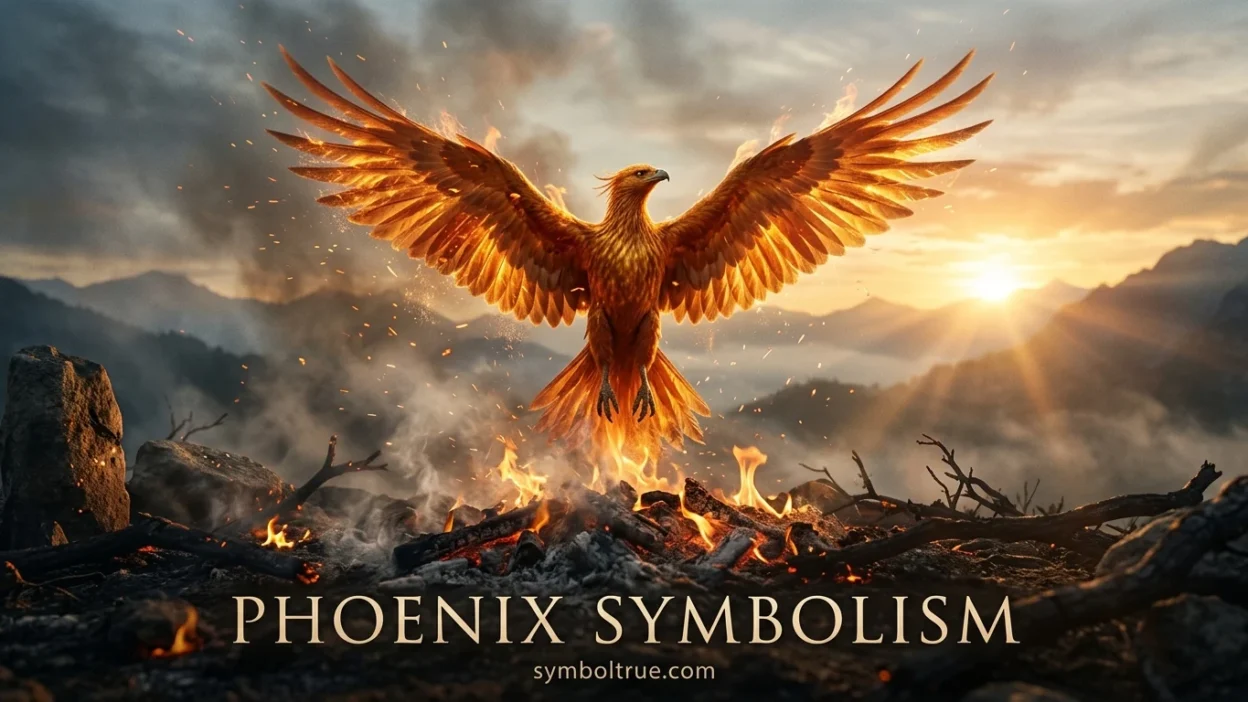
In visual art, the phoenix is often shown with fire, glowing feathers, wings, ashes, sunlight, or flames.
Artists may emphasize different aspects of its symbolism. A phoenix surrounded by flames can suggest destruction and transformation, while a phoenix flying upward may emphasize freedom, hope, and renewal.
Phoenix Symbolism in Dreams
Dream interpretations are personal, so there is no single meaning that applies to everyone.
If a phoenix appears in a dream, common symbolic interpretations may include change, recovery, personal transformation, or a new beginning.
The context of the dream matters.
Seeing a Phoenix
This may symbolize hope, renewal, or the possibility of beginning again.
A Phoenix Rising From Fire
This is one of the clearest symbolic images of overcoming a difficult period and moving into a new stage.
A Flying Phoenix
A flying phoenix may represent freedom, ambition, confidence, or moving beyond the past.
A Phoenix in Flames
This could symbolize intense transformation. It may also reflect a period in which something familiar is changing dramatically.
A Dead or Fallen Phoenix
This does not necessarily mean something negative. Symbolically, it could represent the end of one stage before another begins.
Dream symbolism should be viewed as a personal reflection rather than a prediction of future events.
Positive Symbolism of Phoenix
The phoenix is one of the strongest symbols of positive transformation.
Its positive meanings can include:
Resilience: The ability to continue after setbacks.
Renewal: The opportunity to start fresh.
Hope: Confidence that circumstances can change.
Courage: Facing difficult transformation rather than avoiding it.
Growth: Becoming wiser or stronger through experience.
Freedom: Moving beyond an old identity or limiting situation.
New beginnings: Opening the door to another chapter of life.
For this reason, phoenix imagery is often meaningful to people who have experienced major changes and want a visual reminder of their ability to move forward.
Negative or Hidden Symbolism of Phoenix
Phoenix symbolism is not always completely positive.
Because the phoenix story involves fire, destruction, and death before renewal, it can also symbolize loss, painful endings, sacrifice, and the difficult cost of transformation.
Its hidden meanings may include:
- Destruction before rebuilding
- The pain of leaving the past behind
- Repeated cycles of collapse and renewal
- The loss of an old identity
- Emotional exhaustion
- Fear of major change
- The realization that some things cannot return exactly as they were
This darker interpretation makes the phoenix more complex. Renewal does not necessarily mean returning to the old life. Sometimes it means becoming something different.
Common Interpretations of Phoenix Symbolism
Here are some of the most common ways people understand the phoenix:
| Phoenix Symbolism | Common Interpretation |
| Fire | Transformation and purification |
| Ashes | What remains after an ending |
| Rising | Renewal and recovery |
| Wings | Freedom and possibility |
| Rebirth | Starting again |
| Long life | Endurance and continuity |
| Golden or red feathers | Power, vitality, and energy |
| Flight | Moving beyond the past |
| Death and return | Cycles of ending and beginning |
These interpretations are symbolic rather than fixed rules. A person’s culture, beliefs, and circumstances can change how they understand the image.
Why Does Phoenix Symbolism Matter Today?
Phoenix symbolism remains popular because its central message is easy to understand: a difficult ending does not always have to be the end of the story.
People use phoenix imagery in tattoos, artwork, jewelry, stories, personal symbols, and creative projects. It can represent recovery from failure, a fresh start, personal development, or a major life transition.
The phoenix also fits modern conversations about resilience. Whether someone is rebuilding a career, changing their identity, recovering from a setback, or simply entering a new stage of life, the image provides a memorable metaphor for starting again.
Its popularity also comes from its visual power. Fire, ashes, wings, and rebirth create an image that can communicate transformation without requiring many words.
FAQs;
What is the main meaning of phoenix symbolism?
The main meaning is rebirth and renewal after destruction or difficulty. It is commonly associated with transformation, resilience, hope, and new beginnings.
What does a phoenix symbolize spiritually?
Spiritually, a phoenix may symbolize inner transformation, renewal, releasing the past, and finding hope after a difficult period. These interpretations vary between individuals and traditions.
Is the phoenix a religious symbol?
The phoenix is primarily a mythological symbol rather than a uniquely religious one. Some later religious traditions, particularly Christian writers, connected its story with resurrection and renewal.
What does a phoenix represent in a tattoo?
A phoenix tattoo often represents rebirth, strength, recovery, transformation, or overcoming a difficult chapter. The personal meaning depends on the person wearing it.
What does a phoenix mean in dreams?
A phoenix in a dream may symbolize transformation, recovery, hope, or a new beginning. The meaning depends heavily on the dreamer’s personal experiences and the surrounding details.
Why is the phoenix associated with fire?
Fire is central to the traditional image of the phoenix because the bird’s destruction and subsequent renewal create a powerful metaphor for transformation.
Does the phoenix symbolize immortality?
In some traditions and interpretations, yes. Its repeated return can represent continuity, long life, or immortality. However, this is a symbolic interpretation rather than a literal claim.
What does a phoenix rising from ashes mean?
A phoenix rising from ashes commonly represents recovering after loss, overcoming hardship, and beginning a new chapter.
Conclusion
Phoenix symbolism centers on rebirth, transformation, resilience, renewal, and hope. Its legendary cycle of destruction and return has made it one of the world’s most recognizable symbols of starting again.
Although interpretations differ across history, religion, literature, and personal belief, the phoenix continues to carry a powerful message: an ending can sometimes become the foundation for a new beginning.

Ryan Thomas is a passionate writer at SymbolTrue, dedicated to exploring the meanings, history, and cultural significance of symbols worldwide. He creates engaging, well-researched content that helps readers discover the stories and symbolism behind everyday signs, icons, and traditions.