Reincarnation is one of humanity’s oldest ideas about life, death, and what may come afterward. Reincarnation symbolism often represents renewal, transformation, continuity, spiritual growth, and the possibility of beginning again.
Across different cultures and religious traditions, reincarnation has been understood in different ways. Some traditions describe repeated births as part of a spiritual journey, while others focus on cycles of existence, moral development, or liberation from those cycles.
It is important to remember that reincarnation is a matter of religious and philosophical belief rather than an established scientific fact. Its symbolism can still offer meaningful ways to think about change, identity, loss, personal growth, and new beginnings.
Reincarnation Symbolism Meaning (Clear Definition)
Reincarnation symbolism refers to the symbolic meanings connected with the belief that life, consciousness, or a person’s spiritual essence may continue through another existence after death.
At its simplest level, reincarnation symbolizes a cycle rather than an ending.
Death may be viewed not only as a conclusion but as one stage in a larger process. Because of this, reincarnation is commonly associated with ideas such as:
- Renewal and rebirth
- Transformation
- Spiritual development
- Continuity
- Life cycles
- Personal lessons
- Karma and consequences
- Hope after loss
- Change and personal growth
- The mystery of existence
The exact meaning depends heavily on the religious or cultural tradition in which the idea appears.
What Does Reincarnation Represent?
Reincarnation can represent several powerful themes.
Rebirth
The most obvious symbolism is rebirth. Something appears to end, yet another form of existence begins.
This makes reincarnation a powerful metaphor for major life changes. Someone leaving an old career, recovering from a difficult experience, or starting a completely different chapter of life might describe the experience as a personal rebirth.
Transformation
Reincarnation is also associated with transformation because the individual is imagined as moving from one state of existence to another.
Symbolically, this can suggest that identity is not completely fixed. People change through experience, relationships, challenges, and personal choices.
Continuity
For believers in reincarnation, death does not necessarily represent complete disappearance. Instead, existence may continue in another form.
Symbolically, this can provide a way of understanding the connection between past, present, and future.
Spiritual Growth
In some traditions, repeated existence is connected with learning, ethical development, or spiritual progress.
This interpretation turns life into a journey in which experiences may have deeper significance.
Spiritual Meaning of Reincarnation Symbolism
The spiritual meaning of reincarnation varies significantly between traditions.
In Hindu traditions, concepts related to samsara, karma, and rebirth are important parts of religious thought. Samsara generally refers to the cycle of birth, death, and rebirth, while liberation from this cycle is associated with moksha.
Buddhist traditions also discuss rebirth and samsara, but Buddhist teachings do not generally describe an eternal, unchanging soul moving from body to body in the same way some popular explanations of reincarnation suggest. Instead, Buddhist philosophy emphasizes processes of causation, karma, and continuity without requiring a permanent self.
Certain Jain traditions also place strong emphasis on rebirth and karma, with spiritual liberation involving release from the cycle of rebirth.
These traditions should not be treated as interchangeable. Each has its own teachings, terminology, and philosophical framework.
From a broader spiritual perspective, reincarnation symbolism can represent the idea that existence has layers beyond a single lifetime. For some people, it inspires patience, reflection, responsibility, and hope.
Biblical / Religious Meaning of Reincarnation
The Bible does not present reincarnation as a central Christian doctrine. Mainstream Christianity traditionally teaches resurrection and an afterlife rather than repeated earthly lives.
This distinction is important because reincarnation and resurrection are not the same concept.
Reincarnation generally refers to repeated embodiment or rebirth, whereas resurrection refers to being raised from death, particularly in Christian theology.
Other religions and philosophical traditions have developed different understandings of what happens after death. Some emphasize resurrection, some rebirth, some an eternal afterlife, and others liberation from worldly existence.
Therefore, when discussing the religious meaning of reincarnation, it is better to identify the specific tradition instead of claiming that all religions interpret it in the same way.
Reincarnation Symbolism in History and Culture
Ideas resembling reincarnation or repeated existence have appeared in several historical and cultural contexts.
Ancient Indian religious traditions developed sophisticated teachings about rebirth, karma, and liberation. These ideas later became important within Hinduism, Buddhism, and Jainism, although each tradition developed its own interpretation.
Ancient Greek philosophy also contains discussions of the soul’s possible movement between lives. The philosopher Pythagoras and later Plato are associated with ideas concerning the soul and rebirth, although their views should be understood within their own philosophical contexts.
In various cultures, stories of people returning to life, ancestral continuation, or souls entering new forms have also appeared in folklore and mythology.
These examples do not prove reincarnation. They demonstrate that questions about death, continuity, and what may happen after life have appeared repeatedly throughout human history.
Reincarnation Symbolism in Literature and Art
Reincarnation has provided writers and artists with a powerful way to explore identity and transformation.
In literature, reincarnation can create questions such as:
- Who are we beneath our current identity?
- Can a person escape their past?
- Does experience continue beyond one lifetime?
- Can love survive death?
- Are people shaped by choices made before their current life?
- What does it mean to become someone new?
Authors may use reincarnation as a storytelling device without necessarily presenting it as a religious truth.
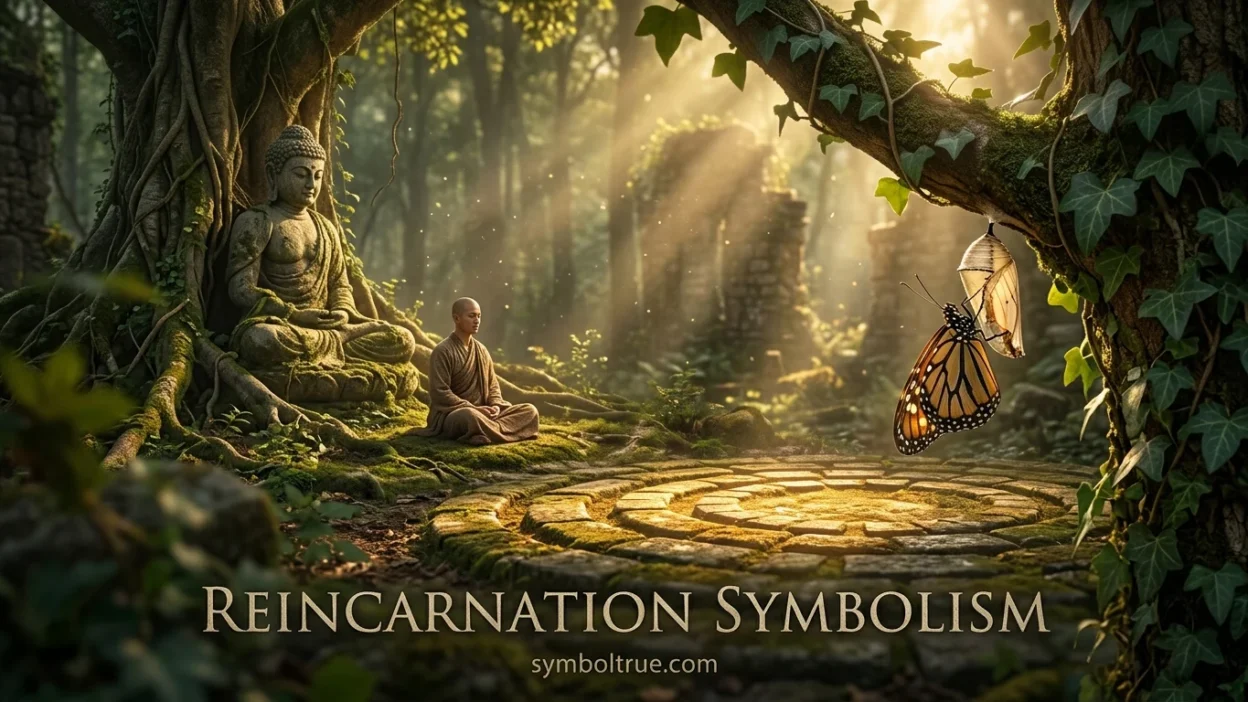
In visual art, circular imagery, repeated figures, changing bodies, butterflies, spirals, seasons, and rising forms can symbolically communicate ideas associated with rebirth and transformation.
The symbolism often depends on the artist’s intention and cultural background.
Reincarnation Symbolism in Dreams
Dreams involving reincarnation can feel especially meaningful because they often deal with identity, memory, change, and unfamiliar experiences.
Dreaming that you are living another life may symbolize a desire to understand yourself differently. It can also represent curiosity about the past or feelings that a current situation resembles something you have experienced before.
Dreaming about dying and being born again may symbolize personal transformation rather than a literal prediction about another life.
For example, someone going through a major career change might dream about becoming another person. Symbolically, this could reflect the psychological experience of leaving an old identity behind.
Dream interpretation is personal, so there is no universal meaning for every reincarnation-related dream.
Positive Symbolism of Reincarnation
Reincarnation can carry several positive symbolic meanings.
Hope
The concept can symbolize hope because an ending may be understood as the beginning of something else.
Renewal
Reincarnation naturally connects with renewal and the opportunity to start again.
Growth
For traditions that connect rebirth with karma and spiritual development, life can symbolize a process of learning and growth.
Resilience
The idea of returning after an ending can represent resilience and the ability to continue through change.
Connection
Reincarnation can symbolize a connection between different stages of existence, generations, or experiences.
Negative or Hidden Symbolism of Reincarnation
Reincarnation does not always carry a comforting meaning.
In some religious traditions, repeated rebirth can symbolize being caught in a difficult cycle. The goal may therefore be liberation from the cycle rather than endless continuation.
This creates an important symbolic contrast:
Rebirth can represent hope, but the cycle of rebirth can also represent attachment, suffering, or unfinished spiritual work.
In a psychological interpretation, reincarnation imagery may sometimes represent difficulty letting go of the past. A person may feel trapped in repeating patterns and wish to break free.
Thus, the symbolism can point either toward renewal or toward the need to escape repetition.
Common Interpretations of Reincarnation Symbolism
Different situations can produce different interpretations.
| Reincarnation Symbolism | Possible Meaning |
| Being born again | Renewal or a fresh beginning |
| Living another life | Exploring identity or transformation |
| Repeated lives | Cycles, lessons, or recurring patterns |
| Past-life imagery | Curiosity about identity and history |
| Dying and returning | Major personal change |
| Reincarnation of a loved one | Grief, continuity, or emotional connection |
| Repeating relationships | Patterns that seem difficult to escape |
| Spiritual rebirth | Inner development or awakening |
| Breaking the cycle | Freedom, liberation, or personal growth |
| Returning in a different form | Adaptation and transformation |
These interpretations are symbolic rather than universal rules. Personal circumstances always matter.
Why Does Reincarnation Symbolism Matter Today?
Reincarnation symbolism remains relevant because modern people continue to ask ancient questions about identity, death, purpose, and transformation.
Even people who do not believe in literal reincarnation may use the concept metaphorically.
Someone might describe recovering from a difficult period as being “reborn.” Another person might see a dramatic change in personality as the end of an old self and the beginning of a new one.
The symbolism can therefore help people think about second chances.
It also connects with a modern understanding of personal development. People frequently change careers, relationships, lifestyles, beliefs, and priorities. These changes can feel like different versions of the same person emerging over time.
Reincarnation symbolism provides a powerful language for describing that experience.
FAQs;
What is the main symbolism of reincarnation?
The main symbolism of reincarnation is rebirth, renewal, transformation, continuity, and spiritual development. Its exact meaning depends on the tradition or personal context.
Is reincarnation a religious belief?
Yes, reincarnation or related ideas of rebirth are important in several religious and philosophical traditions, including Hinduism, Buddhism, and Jainism. Their teachings differ significantly.
Does Christianity believe in reincarnation?
Mainstream Christianity generally does not teach reincarnation. Christian theology traditionally emphasizes resurrection and an afterlife instead.
What does reincarnation symbolize spiritually?
Spiritually, reincarnation may symbolize continued existence, personal development, karmic consequences, spiritual lessons, or movement through cycles of existence, depending on the tradition.
What does reincarnation mean in dreams?
A reincarnation dream may symbolize transformation, identity, recurring life patterns, curiosity about the past, or the beginning of a new chapter. It does not necessarily indicate a literal past life.
Is reincarnation scientifically proven?
Reincarnation is not established as a scientific fact. It remains primarily a religious, philosophical, and spiritual belief, although researchers have investigated reports sometimes interpreted as memories of previous lives.
What does being reborn symbolize?
Being reborn commonly symbolizes a fresh start, personal transformation, recovery, spiritual renewal, or leaving an old identity behind.
Does reincarnation always have a positive meaning?
No. In some traditions, repeated rebirth is viewed as a cycle from which a person seeks liberation. Symbolically, it can represent either renewal or being caught in repeating patterns.
Conclusion
Reincarnation symbolism centers on the powerful ideas of rebirth, transformation, continuity, spiritual growth, and cycles of existence. Different religions and cultures interpret these ideas in distinct ways, so no single meaning applies everywhere.
Whether understood as a religious belief, philosophical concept, literary theme, dream symbol, or metaphor for personal change, reincarnation encourages reflection on one enduring question: Can an ending also become a beginning?
Its symbolism ultimately reminds us that transformation can be understood in many forms, from spiritual renewal to the simple human experience of starting a new chapter in life.

Abigail Alice is a passionate writer at SymbolTrue, exploring the history, meanings, and cultural significance of symbols worldwide. She creates clear, engaging, and well-researched content that helps readers uncover the fascinating stories behind everyday and ancient symbols.