
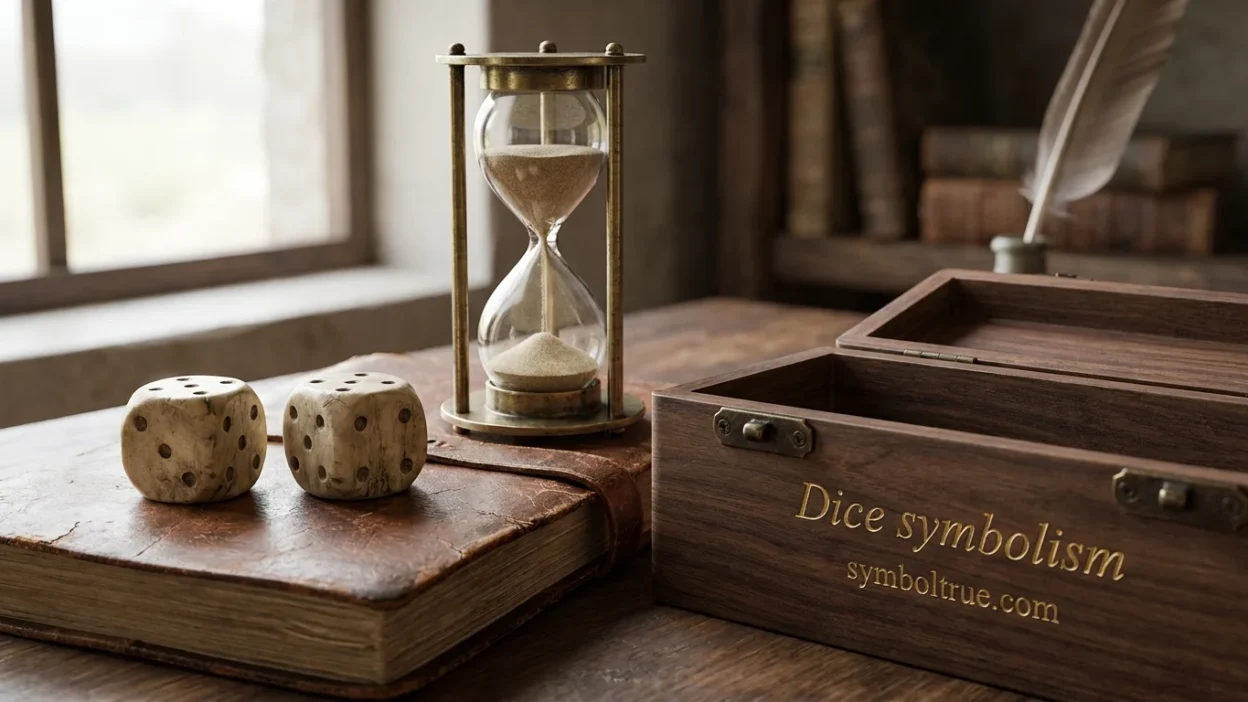
Dice symbolism explores the meanings people attach to chance, uncertainty, luck, risk, choice, and unpredictable outcomes. Although dice are commonly associated with games, their symbolism extends into mythology, literature, art, spirituality, and everyday language.
A simple roll of the dice can represent the idea that some outcomes remain outside human control. At the same time, dice can symbolize taking risks, making choices, accepting uncertainty, or trusting the possibilities ahead.
Dice Symbolism Meaning (Clear Definition)
Dice symbolism refers to the ideas and meanings associated with dice, especially concepts such as chance, luck, randomness, risk, and fate.
Because a dice roll produces an uncertain result, dice have naturally become symbols of unpredictability. People may use dice imagery to represent situations where preparation and decision-making meet circumstances that cannot be completely controlled.
The meaning can change according to context. A pair of dice in a casino may suggest gambling and risk, while dice in a board game may represent entertainment, competition, or strategy.
What Does Dice Symbolism Represent?
Dice commonly represent several interconnected ideas:
- Chance and randomness
- Luck and fortune
- Risk and uncertainty
- Choice and decision-making
- Fate and unpredictability
- Competition
- Opportunity
- Taking chances
- Rewards and consequences
- Lack of control
The symbolism often comes from the basic experience of rolling dice: a person makes an action, but cannot know the exact result beforehand.
Dice as a Symbol of Chance
Chance is perhaps the most recognizable meaning associated with dice. The unknown result of a roll makes dice a natural visual representation of uncertainty.
This symbolism appears in everyday expressions and storytelling, where “rolling the dice” can describe taking a risk or entering an uncertain situation.
Dice as a Symbol of Choice
Although dice involve randomness, deciding to roll them is still an intentional action. This creates an interesting symbolic contrast between personal choice and unpredictable outcomes.
Dice can therefore represent situations where people make decisions without knowing exactly what will happen next.
Spiritual Meaning of Dice Symbolism
Some spiritual and symbolic traditions interpret dice through ideas of fate, uncertainty, transformation, and surrender.
A person may view a dice roll as a reminder that not everything can be controlled. In this sense, dice can encourage acceptance of uncertainty and awareness of life’s unpredictable nature.
Other interpretations connect dice with intuition, possibility, or the idea of allowing circumstances to unfold.
These meanings depend on personal belief and cultural tradition. Dice do not have one universally accepted spiritual meaning.
Biblical / Religious Meaning of Dice Symbolism
Dice do not have a single established biblical symbolic meaning.
However, casting lots appears in several biblical narratives as a method used to make decisions or determine outcomes. Because of this historical association, some modern interpretations connect dice-like imagery with chance, selection, or uncertain outcomes.
It is important to distinguish biblical references to casting lots from modern dice symbolism. The two practices are not necessarily identical, and modern spiritual interpretations should not be presented as direct biblical teachings.
Dice Symbolism in History and Culture
Dice have a long history across different civilizations. Archaeological discoveries show that ancient societies used dice-like objects for games and other activities.
Historically, dice have been connected with entertainment, gambling, divination practices, and decision-making in different cultural settings.
Their widespread use helped establish a strong association between dice and chance. Over time, this association became part of popular language, visual culture, and storytelling.
Different societies have interpreted games of chance in different ways. Some have viewed them primarily as recreation, while others have connected gambling with moral, social, or religious concerns.
Dice Symbolism in Literature and Art
Dice frequently appear in literature and visual art as symbols of uncertainty and risk.
A character rolling dice can represent a turning point, especially when the result may change the direction of a story. Writers can use dice to explore questions about fate, free will, luck, and human control.
Artists may also use dice alongside money, cards, clocks, skulls, roads, or other symbolic objects to create themes involving mortality, opportunity, temptation, or uncertainty.
In popular culture, oversized or stylized dice can also communicate gaming, competition, strategy, and entertainment.
Dice Symbolism in Dreams
Dice can appear in dreams when themes of uncertainty, risk, competition, or decision-making are personally meaningful.
Dream interpretation does not have one scientifically established symbolic dictionary, so the meaning depends on the dreamer’s circumstances and associations.
Possible interpretations include:
- Rolling dice: Taking a risk or facing an uncertain decision.
- Winning with dice: Feeling hopeful about an opportunity or outcome.
- Losing a dice game: Fear of failure or concern about unpredictable circumstances.
- Broken dice: Feeling that expectations or plans have been disrupted.
- Many dice: Facing numerous possibilities or competing choices.
- A single die: Focusing on one important decision or uncertain outcome.
These interpretations are possibilities rather than fixed predictions.
Positive Symbolism of Dice Symbolism
Dice can carry several positive symbolic meanings.
Common examples include:
- Opportunity
- Adventure
- Courage
- Possibility
- Luck
- Excitement
- Freedom
- Adaptability
- New experiences
- Willingness to take chances
Dice can remind people that uncertainty sometimes creates opportunities that cannot be predicted in advance.
For someone beginning a new project or entering an unfamiliar situation, dice may symbolize openness to possibility.
Negative or Hidden Symbolism of Dice Symbolism
Dice can also have more difficult associations.
These may include:
- Gambling
- Recklessness
- Loss
- Uncertainty
- Risk
- Lack of control
- Temptation
- Unpredictability
- Dependence on luck
In some contexts, dice can symbolize the danger of relying entirely on chance rather than preparation or careful judgment.
Their meaning therefore depends heavily on the surrounding imagery and situation.
Common Interpretations of Dice Symbolism
Several symbolic elements can change how dice are interpreted.
Number One
A single dot may represent simplicity, individuality, beginnings, or focus in some symbolic systems.
Number Six
Six dots are often associated with completion within the basic structure of a standard six-sided die. However, this does not create a universal spiritual meaning.
Pair of Dice
Two dice can symbolize partnership, interaction, competing forces, or multiple factors influencing an outcome.
Rolling Dice
Rolling dice strongly emphasizes action followed by uncertainty. It can symbolize taking a chance and accepting whatever result follows.
Golden Dice
Gold-colored dice may suggest wealth, success, luxury, or valuable opportunities.
Black Dice
Black dice can create associations with mystery, seriousness, uncertainty, or hidden possibilities depending on the context.
Why Does Dice Symbolism Matter Today?
Dice symbolism remains relevant because uncertainty continues to be part of everyday life.
People make decisions about careers, relationships, business, travel, and personal goals without knowing every possible outcome. Dice provide a simple visual metaphor for this uncertainty.
In modern culture, dice are also strongly connected with tabletop games, role-playing games, casinos, probability, and entertainment.
Their symbolism has expanded beyond gambling. Today, dice can represent creativity, storytelling, strategy, randomness, and the unpredictable nature of life.
Frequently Asked Questions About Dice Symbolism
What does dice symbolism mean?
Dice symbolism commonly represents chance, luck, risk, uncertainty, choice, and unpredictable outcomes.
What do dice symbolize spiritually?
In spiritual interpretations, dice may symbolize uncertainty, fate, possibility, surrender, or accepting what cannot be controlled. Meanings vary by tradition.
What do dice represent in dreams?
Dice in dreams may relate to risk, uncertainty, decisions, competition, or concerns about an unpredictable situation. Personal context is important.
Are dice a symbol of luck?
Yes, dice are commonly associated with luck because their results depend partly on chance. However, luck is only one of their many symbolic associations.
Do dice symbolize fate?
They can symbolize fate or unpredictability in literature and popular culture, but this is an interpretive association rather than a universal meaning.
What does rolling dice symbolize?
Rolling dice can represent taking a chance, making a decision under uncertainty, accepting risk, or allowing an unpredictable outcome to unfold.
Are dice mentioned in the Bible?
The Bible contains accounts involving casting lots, but modern dice symbolism should not automatically be treated as a direct biblical interpretation.
Conclusion
Dice symbolism centers on chance, uncertainty, risk, possibility, and the tension between personal choice and unpredictable outcomes. Across history and culture, dice have developed associations with games, gambling, decision-making, luck, and fate.
Their meaning can shift depending on the context. Whether they appear in dreams, artwork, literature, spiritual practices, or everyday life, dice remain a powerful symbol of the unknown and the possibilities that emerge when outcomes cannot be fully controlled.

Henry Jack is the Administrator of SymbolTrue, ensuring the website runs smoothly while overseeing content quality, user experience, and daily operations. He is passionate about helping readers explore symbols, meanings, and cultural insights.