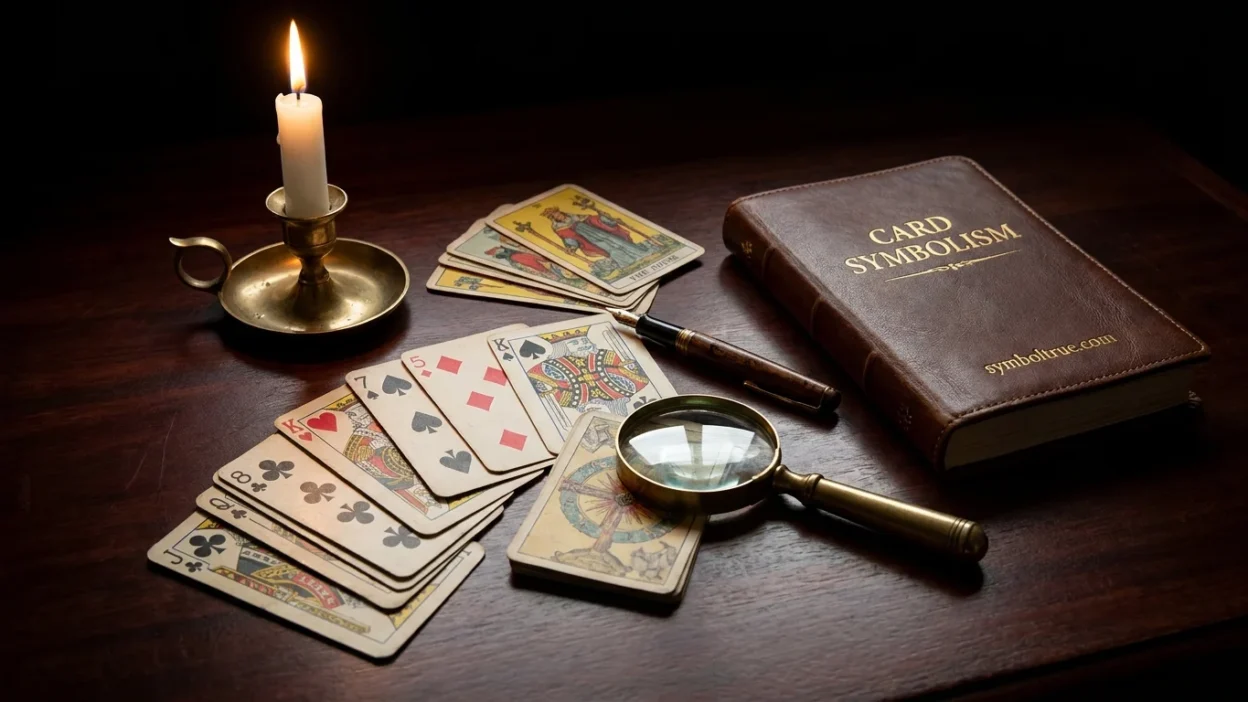
Card symbolism appears in many traditions, from playing cards and tarot decks to greeting cards, games, and visual storytelling. Symbols on cards can communicate ideas about identity, emotion, chance, relationships, transformation, and human experience.
The meaning of a card often depends on its design, cultural background, context, and the tradition in which people use it. A heart, crown, sword, star, or number may carry different associations across cultures and belief systems.
Understanding card symbolism helps explain why certain images remain meaningful and recognizable across generations.
Card Symbolism Meaning (Clear Definition)
Card symbolism refers to the meanings and ideas associated with the images, suits, numbers, colors, characters, and objects shown on cards.
Cards can function as more than simple objects. Their visual elements may communicate themes such as love, conflict, luck, power, mystery, success, loss, or transformation.
For example, traditional playing cards use four suits with distinct visual identities. Tarot cards go further by combining detailed illustrations with symbolic figures, objects, landscapes, and numerical structures.
There is no single universal interpretation of every card. Meaning develops through historical traditions, cultural practices, artistic choices, and personal interpretation.
What Does Card Symbolism Represent?
Card symbolism can represent a wide range of human experiences.
Common symbolic themes include:
- Luck and chance
- Love and relationships
- Power and authority
- Conflict and challenges
- Wealth and material concerns
- Creativity and inspiration
- Knowledge and wisdom
- Transformation and change
- Hope and uncertainty
- Choices and consequences
The surrounding context matters greatly. The same symbol may communicate something different depending on the type of card and the culture that uses it.
Symbols and Their Common Associations
Certain images appear repeatedly in card designs.
Hearts are commonly associated with love, affection, emotion, and relationships.
Diamonds can suggest value, wealth, beauty, or material concerns in some playing-card interpretations.
Clubs may be connected with action, strength, work, or growth in symbolic interpretations.
Spades are sometimes associated with challenges, intellect, conflict, or mortality.
These associations are interpretive rather than universal rules.
Spiritual Meaning of Card Symbolism
Some people approach symbolic cards as tools for spiritual reflection. In these settings, card imagery may encourage meditation, self-examination, or contemplation.
A card featuring a rising sun, for example, might inspire thoughts about renewal and hope. A card showing a journey could encourage reflection about personal growth or change.
Spiritual interpretations vary significantly between traditions. Some practitioners see cards as prompts for intuition, while others treat them as symbolic storytelling tools.
These interpretations represent beliefs or personal frameworks rather than established scientific facts.
Biblical / Religious Meaning of Card Symbolism
Cards do not have one universal biblical or religious meaning.
Some card imagery may contain symbols that also appear in religious traditions. Crosses, angels, crowns, light, water, and other images can carry religious associations. However, their presence on a card does not automatically give the card a biblical meaning.
Religious perspectives on divination and fortune-telling also differ. Some religious traditions discourage divination, while other people use symbolic cards without considering their practice religious.
For this reason, it is important to distinguish documented religious teachings from modern symbolic interpretations.
Card Symbolism in History and Culture
Playing cards developed in Asia before spreading into other regions, eventually becoming established in Europe during the late medieval period. European playing-card traditions developed different suit systems, artistic styles, and regional designs.
Tarot cards emerged in fifteenth-century Europe as a type of playing card. Their later association with divination and occult interpretation developed over subsequent centuries.
Card symbolism therefore reflects multiple historical layers rather than one original symbolic system.
Different cultures have also developed their own card games and visual traditions. Designs may reflect local customs, artistic styles, social values, and historical events.
Card Symbolism in Literature and Art
Cards have become powerful symbols in literature, painting, theater, film, and popular culture.
A deck of cards can symbolize chance, uncertainty, competition, fate, or social hierarchy. A card game may represent a struggle between characters, while a single card can become a clue or metaphor within a story.
Artists may also use card imagery to explore ideas about identity, randomness, mortality, wealth, or human choices.
Because cards are familiar objects, they can communicate complex ideas without requiring lengthy explanations.
Card Symbolism in Dreams
Cards can also appear in dreams, although dream symbolism does not have one scientifically established interpretation.
The meaning may depend on the dreamer’s experiences and feelings.
For example:
- A winning card might remind someone of opportunity or confidence.
- A lost card could evoke uncertainty or something missing.
- A playing-card deck might suggest choices, competition, or chance.
- A mysterious illustrated card could represent curiosity or unexplored ideas.
- A damaged card might remind someone of disappointment or change.
These interpretations are possibilities rather than fixed meanings.
Positive Symbolism of Card Symbolism
Cards can carry many positive associations.
Common examples include:
- Opportunity
- Luck
- Creativity
- Success
- Hope
- Connection
- Confidence
- Discovery
- Growth
- New possibilities
A card representing victory may symbolize achievement, while a heart can evoke affection and emotional connection.
Positive symbolism usually depends on context rather than the image alone.
Negative or Hidden Symbolism of Card Symbolism
Cards can also represent uncertainty and difficult experiences.
Common negative associations include:
- Risk
- Deception
- Conflict
- Loss
- Uncertainty
- Competition
- Betrayal
- Obsession
- Unexpected change
Playing cards are especially connected with chance and gambling in some cultural contexts. This can give card imagery a more complicated meaning involving risk, temptation, or unpredictability.
However, a card should not automatically be interpreted negatively simply because it appears in a particular context.
Common Interpretations of Card Symbolism
Several elements can influence how people interpret symbolic cards.
Colors
Colors often create emotional associations. Red may suggest passion or energy, while black may evoke mystery, seriousness, or authority.
These associations can vary by culture and design.
Numbers
Numbers can add another layer of meaning. One may suggest beginnings, while higher numbers can represent development, progression, or completion in certain symbolic systems.
Suits
Suits provide an important symbolic structure in playing cards and tarot. Their meanings vary according to tradition.
Characters
Kings, queens, knights, fools, heroes, and other figures can represent different roles, qualities, or stages of life.
Objects
Weapons, flowers, crowns, books, keys, animals, and other objects can add specific symbolic details to a card.
Direction and Position
The position of a figure or object can also influence interpretation. A person looking toward the horizon may suggest movement or anticipation, while a closed door might suggest limitation or mystery.
Why Does Card Symbolism Matter Today?
Card symbolism remains relevant because people continue to use cards in games, entertainment, art, spirituality, storytelling, and cultural traditions.
Modern artists often reinterpret traditional card imagery in new ways. Designers use recognizable symbols to create visual identities, while writers and filmmakers use cards to represent chance, mystery, competition, and destiny.
Tarot has also become increasingly visible in contemporary popular culture, where people approach it through spiritual, artistic, psychological, or recreational perspectives.
The continuing popularity of card imagery shows how familiar symbols can adapt to changing cultural contexts.
Frequently Asked Questions About Card Symbolism
What is card symbolism?
Card symbolism refers to the meanings associated with images, suits, numbers, colors, characters, and objects found on cards.
What do cards symbolize?
Cards can symbolize luck, chance, relationships, power, competition, uncertainty, transformation, opportunity, and many other themes.
What do the four playing-card suits symbolize?
Traditional playing-card suits have developed different interpretations. Hearts, diamonds, clubs, and spades may acquire symbolic associations involving emotions, value, action, and challenges, although these meanings are not universal.
Is card symbolism connected to tarot?
Yes. Tarot uses a structured system of symbolic imagery, including the Major and Minor Arcana. However, tarot symbolism differs from the symbolism of ordinary playing cards.
What does a card mean in a dream?
There is no universal dream meaning for cards. The interpretation can depend on the particular card, the dreamer’s feelings, and personal experiences.
Does card symbolism have religious meanings?
Some cards contain imagery that also appears in religious traditions, but there is no single religious interpretation of card symbolism.
Are card symbols universal?
No. Symbolic meanings can change across cultures, historical periods, artistic traditions, and individual experiences.
Conclusion
Card symbolism combines images, numbers, colors, suits, characters, and cultural traditions to communicate ideas about life and human experience. Cards can represent luck, love, conflict, opportunity, uncertainty, transformation, and much more.
Their meanings are rarely fixed. Understanding the historical and cultural context behind a card allows its symbolism to be explored with greater clarity while leaving room for different interpretations.

Henry Jack is the Administrator of SymbolTrue, ensuring the website runs smoothly while overseeing content quality, user experience, and daily operations. He is passionate about helping readers explore symbols, meanings, and cultural insights.