Luck has fascinated people for thousands of years. Across different cultures, people have looked for signs, objects, animals, numbers, and events that might represent good fortune or protection from misfortune. Luck symbolism brings these ideas together and helps explain why certain things are commonly associated with fortunate outcomes.
From a four-leaf clover and horseshoe to lucky numbers and meaningful coincidences, symbols of luck can carry different meanings depending on culture and personal belief. Some are rooted in historical traditions, while others have become popular through folklore, religion, literature, and modern culture.
Understanding luck symbolism does not require believing that a particular object can literally change the future. Instead, these symbols can offer insight into human hopes, traditions, fears, and the desire for positive change.
Luck Symbolism Meaning (Clear Definition)
Luck symbolism refers to the use of objects, signs, events, animals, numbers, colors, or actions to represent good fortune, favorable opportunities, protection, success, or positive outcomes.
The meaning of a lucky symbol is rarely universal. A symbol considered fortunate in one society may have a completely different interpretation somewhere else.
For example, the number seven is often associated with good fortune in many Western traditions, while other cultures may place greater importance on different numbers. Similarly, particular animals, plants, or objects can become lucky symbols because of historical stories and cultural traditions.
At its simplest, luck symbolism represents the human hope that circumstances will turn in a favorable direction.
What Does Luck Symbolism Represent?
Luck symbolism can represent several ideas at once.
Good Fortune
The most obvious meaning is good fortune. A lucky symbol may represent the hope that positive events, opportunities, or unexpected benefits are approaching.
Opportunity
Luck is often connected with being in the right place at the right time. Because of this, lucky symbols can represent opportunities that appear unexpectedly.
Protection
Some traditional lucky objects are also viewed as protective symbols. They may be carried or displayed because people believe they can help keep negative influences away.
Hope and Optimism
Lucky symbols can remind people to remain hopeful. Even when there is uncertainty, a meaningful symbol can become a small source of encouragement.
Success
Luck is frequently associated with achievement, especially in situations involving uncertainty. Sports, games, competitions, business decisions, and important life events often inspire lucky traditions.
Spiritual Meaning of Luck Symbolism
From a spiritual perspective, luck symbolism can be interpreted as a reminder to remain open to possibilities and pay attention to meaningful experiences.
Some spiritual traditions understand fortunate events as signs of divine favor, guidance, blessing, or alignment. Others view them as reminders that life contains uncertainty and that people should remain grateful for positive moments.
A lucky coincidence may therefore be interpreted personally rather than universally.
For example, repeatedly encountering a particular symbol might feel meaningful to one person. Another person may simply see it as coincidence. Neither interpretation can be established as a universal spiritual fact.
In symbolic terms, luck can represent:
- Hope during uncertain times
- Trust in life’s possibilities
- Unexpected opportunities
- Protection and reassurance
- Gratitude for positive experiences
- A fresh beginning
- Confidence in moving forward
The spiritual meaning depends strongly on the person’s beliefs and cultural background.
Biblical / Religious Meaning of Luck Symbolism
The idea of luck varies considerably among religious traditions, so it is important not to treat all religious interpretations as the same.
In Christianity, for example, the Bible generally emphasizes God’s providence, wisdom, faith, and human responsibility rather than presenting luck as an independent spiritual force. People may describe fortunate events as blessings, but that is different from claiming that a particular object automatically creates good fortune.
Other religious and cultural traditions have developed their own beliefs about auspicious signs, sacred objects, numbers, rituals, and favorable circumstances.
Therefore, when discussing the religious meaning of luck symbolism, context matters. A symbol may have religious significance in one tradition while functioning mainly as folklore in another.
It is also important to distinguish documented religious teachings from later popular customs.
Luck Symbolism in History and Culture
Lucky symbols have appeared throughout human history. People have traditionally used signs and objects to express hopes about prosperity, safety, fertility, victory, health, and successful journeys.
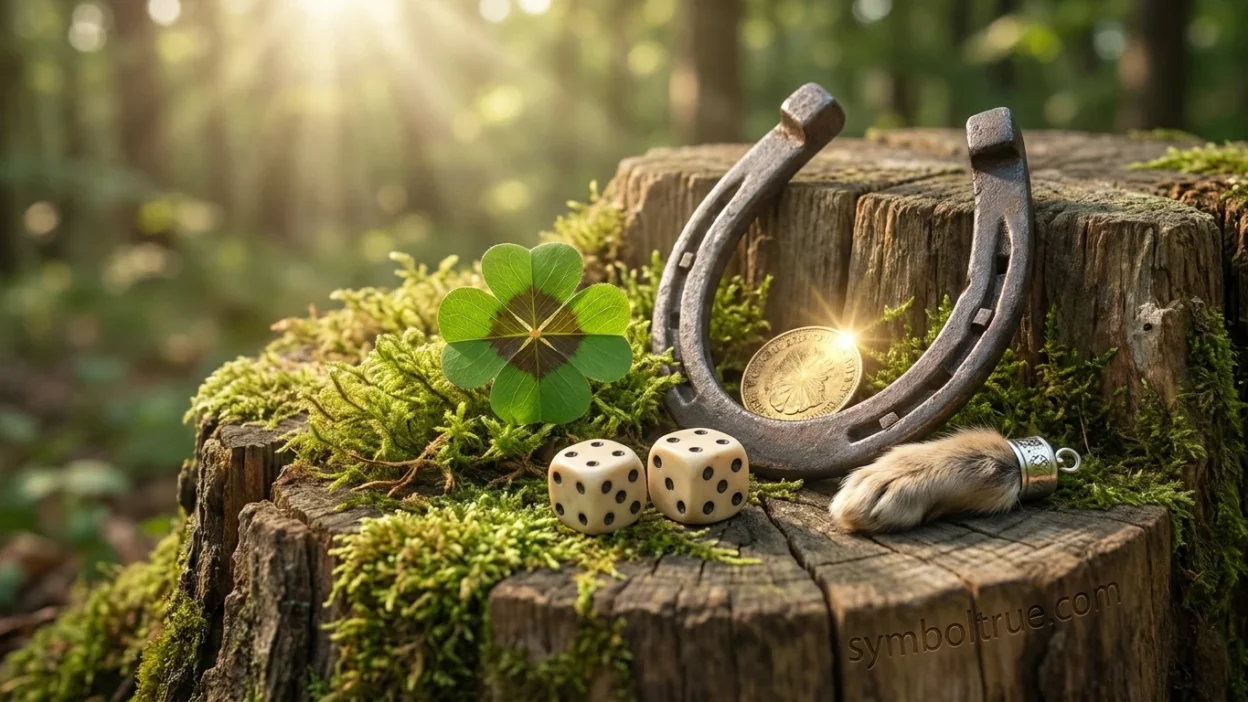
One famous example is the horseshoe, which became associated with protection and good fortune in European folklore. Its association with horses also connected it with strength, travel, and practical prosperity.
The four-leaf clover became another widely recognized symbol of good luck. Because four-leaf clovers are much less common than three-leaf clovers, finding one came to be regarded as a fortunate discovery.
Numbers have also played an important role. Some societies have considered certain numbers lucky because of religious, linguistic, historical, or cultural associations.
Other common lucky symbols include:
- Four-leaf clovers
- Horseshoes
- Lucky coins
- Certain numbers
- Rabbits or rabbit’s feet in some traditions
- Ladybugs
- Elephants in particular cultural contexts
- Lucky charms and amulets
- Certain colors
- Natural objects and plants
These traditions show that luck is not represented by one universal symbol. Instead, cultures create symbolic systems based on their own histories and experiences.
Luck Symbolism in Literature and Art
Luck is a powerful theme in literature because stories often revolve around unexpected changes in fortune.
A character may experience sudden success, an unexpected meeting, a fortunate discovery, or a dramatic reversal of circumstances. Such events can symbolize fate, opportunity, destiny, or the unpredictable nature of life.
Artists can also use lucky symbols visually. A coin, star, clover, horseshoe, or other familiar object can quickly communicate ideas of fortune and hope.
In storytelling, luck can serve two opposite purposes. It can represent a blessing that changes someone’s life, or it can highlight how unstable success can be.
This makes luck symbolism especially useful for exploring themes such as fate, chance, ambition, hope, uncertainty, and transformation.
Luck Symbolism in Dreams
Dreams involving luck can have highly personal meanings. There is no single scientifically established interpretation for seeing a lucky symbol in a dream.
However, symbolic dream interpretation often connects lucky imagery with optimism, opportunity, confidence, or a desire for positive change.
For example:
Finding a Lucky Object
Finding a coin, charm, clover, or other lucky object may symbolize discovering an opportunity or recognizing something valuable in your life.
Receiving a Lucky Symbol
Receiving a lucky object from someone may represent support, encouragement, affection, or a desire for someone to succeed.
Losing a Lucky Object
Losing something considered lucky may reflect worries about uncertainty, missed opportunities, or losing a sense of security.
Seeing Repeated Lucky Signs
Repeated symbols in dreams may reflect something that your mind considers important. Their meaning depends on your emotions and personal experiences.
Dream interpretation should therefore be viewed as a reflective practice rather than a guaranteed prediction of future events.
Positive Symbolism of Luck
Luck symbolism is often strongly positive.
Hope
Lucky symbols can encourage people to believe that circumstances can improve.
New Opportunities
Luck may represent unexpected openings or possibilities.
Prosperity
Many lucky traditions are connected with wealth, abundance, or material success.
Protection
Certain lucky charms are traditionally believed to offer protection from harm or misfortune.
Confidence
Carrying a lucky object can sometimes make a person feel more confident, particularly before an important event.
Celebration
Lucky symbols are often used during weddings, festivals, sporting events, holidays, and other celebrations to express good wishes.
In this way, the symbolic value of luck can be meaningful even when someone does not literally believe that an object controls events.
Negative or Hidden Symbolism of Luck
Luck does not always have a positive meaning.
Because luck depends on uncertainty, it can also symbolize unpredictability, dependence on chance, fear of bad fortune, or lack of control.
A person who becomes overly dependent on lucky rituals may begin to believe that success depends entirely on external signs. This can create anxiety when the symbol is unavailable.
Luck symbolism can therefore have a hidden message: life contains circumstances that cannot always be controlled.
This interpretation can encourage a healthier perspective. A lucky charm may provide comfort, but preparation, judgment, effort, and responsible decisions still matter.
Luck can also symbolize the unequal nature of opportunity. One person may receive an unexpected advantage while another faces difficulties despite working equally hard. Literature and art often use luck to explore this tension.
Common Interpretations of Luck Symbolism
Different situations can give luck symbolism different meanings.
| Lucky Symbol or Experience | Common Symbolic Meaning |
| Four-leaf clover | Good fortune and rare opportunity |
| Horseshoe | Protection and good luck |
| Lucky coin | Prosperity and abundance |
| Lucky number | Favorable circumstances or personal significance |
| Finding something valuable | Opportunity or unexpected benefit |
| Gifted lucky charm | Good wishes and support |
| Lucky animal | Fortune, protection, or cultural significance |
| Repeated fortunate event | Hope or meaningful coincidence |
| Winning unexpectedly | Chance, success, or favorable circumstances |
| Lucky dream | Optimism or desire for positive change |
These meanings are traditional or symbolic rather than guaranteed predictions.
Why Does Luck Symbolism Matter Today?
Luck symbolism remains popular because modern life still contains uncertainty.
People use lucky objects before examinations, competitions, interviews, journeys, performances, and important decisions. Even when someone does not literally believe in luck, a familiar symbol can provide emotional comfort.
Lucky traditions can also connect people with family and culture. A charm passed from one generation to another may have value because of the memories associated with it rather than because of any supernatural property.
Social media and popular culture have also helped familiar lucky symbols remain visible in everyday life.
Perhaps the most important modern meaning of luck symbolism is hope. A lucky symbol can remind someone to stay positive while also recognizing that outcomes depend on many factors.
It can be helpful to think of luck as a symbolic language rather than a guaranteed force. A charm can represent confidence. A lucky number can represent a meaningful memory. A fortunate coincidence can inspire gratitude.
FAQs;
About Luck SymbolismWhat is the main meaning of luck symbolism?
Luck symbolism mainly represents good fortune, opportunity, hope, protection, success, and favorable circumstances.
What is the spiritual meaning of luck?
Spiritually, luck may symbolize blessings, guidance, hope, divine favor, or openness to unexpected possibilities. Interpretations vary between individuals and traditions.
What is the most common symbol of good luck?
There is no single symbol that is universally recognized across all cultures. Four-leaf clovers, horseshoes, lucky coins, and certain numbers are among the most familiar examples.
Does seeing a lucky symbol mean something will happen?
Not necessarily. A lucky symbol can have personal or cultural significance, but it should not automatically be treated as a prediction of the future.
What does luck symbolize in dreams?
Luck in dreams may symbolize hope, opportunity, confidence, unexpected change, or concerns about uncertainty. The dreamer’s personal circumstances are important when interpreting it.
Can luck symbolize success?
Yes. Luck is commonly associated with success, especially when an outcome involves uncertainty or unexpected opportunity.
Is luck the same as fate?
No. Luck usually refers to unexpected favorable or unfavorable circumstances, while fate generally suggests a predetermined course of events. Different traditions define both concepts differently.
Why do people carry lucky charms?
People may carry lucky charms because of cultural tradition, personal memories, emotional comfort, family customs, or belief in their symbolic or spiritual significance.
Conclusion
Luck symbolism represents much more than simply winning or receiving good fortune. It can symbolize hope, opportunity, protection, prosperity, confidence, and the unpredictable nature of life.
Across cultures, lucky objects and signs have developed different meanings through folklore, history, religion, art, and personal experience. Some traditions are deeply rooted in cultural history, while others are modern customs or personal beliefs.
Ultimately, the meaning of a lucky symbol depends on context. Whether viewed as folklore, spiritual symbolism, cultural tradition, or a personal reminder of hope, luck symbols continue to reflect humanity’s desire for positive possibilities in an uncertain world.

Henry Jack is the Administrator of SymbolTrue, ensuring the website runs smoothly while overseeing content quality, user experience, and daily operations. He is passionate about helping readers explore symbols, meanings, and cultural insights.