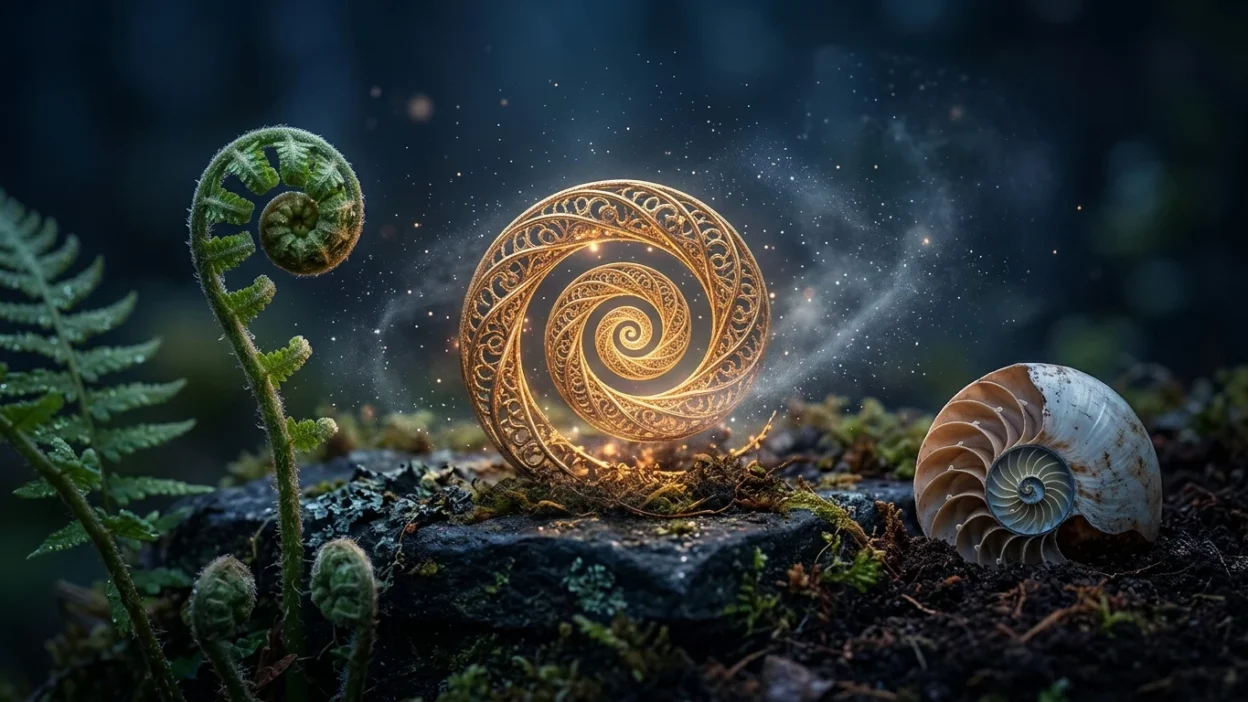
Spiral symbolism is often associated with growth, transformation, life cycles, personal development, and the connection between beginnings and endings. A spiral is a curved line that winds around a central point while gradually moving closer to or farther from it. This simple form appears in seashells, plants, galaxies, ancient artwork, architecture, and modern designs.
Across different cultures and belief systems, spirals have been interpreted in various ways. Some people view them as symbols of spiritual awakening or the journey inward, while others associate them with movement, renewal, and the continuous flow of life. These meanings are not universal, and the significance of a spiral depends on its context.Understanding spiral symbolism involves exploring its geometric form, historical uses, cultural interpretations, spiritual associations, and role in everyday life.
Spiral Symbolism Meaning (Clear Definition)
Spiral symbolism refers to the ideas and meanings people associate with a line or shape that curves around a central point while moving inward or outward. Common interpretations include growth, change, continuity, renewal, movement, and the cycles of life.
Unlike a circle, which returns to its starting point without necessarily changing direction or distance from the center, a spiral moves through space as it turns. This quality makes it a useful visual metaphor for progress, repetition, and experiences that develop over time.
Common meanings associated with spiral symbolism include:
- Growth: Gradual development through experience and learning.
- Transformation: Moving from one stage of life to another.
- Life cycles: The repeated patterns of beginnings, endings, and renewal.
- Spiritual exploration: Looking inward for reflection or understanding.
- Continuity: An ongoing process without a clearly defined endpoint.
- Expansion: Moving outward toward new experiences or possibilities.
- Introspection: Exploring thoughts, feelings, and personal identity.
- Renewal: Beginning again with greater awareness or a changed perspective.
- Connection: Linking the center of a pattern with its surrounding space.
These meanings are interpretations rather than fixed definitions. A spiral on a shell may simply reflect natural growth, while a spiral in a painting might symbolize a character’s emotional journey.
What Does Spiral Symbolism Represent?
The spiral’s distinctive movement gives it several possible symbolic meanings. Its direction, size, setting, and relationship with other shapes can influence how people interpret it.
1. Growth and Personal Development
One of the most common interpretations of spiral symbolism is growth. A spiral can expand gradually, suggesting development that happens through repeated experiences rather than one sudden change.
For example, someone learning a new skill may revisit the same challenges several times but understand them more deeply with each attempt. A spiral can represent this kind of progress: returning to familiar subjects while moving forward.
This makes the shape a useful symbol for education, self-improvement, and personal development.
2. Transformation and Change
Spirals are often used to represent transformation because they show movement through a changing path.
A spiral design might symbolize a transition between different stages of life, such as leaving school, starting a career, recovering from a setback, or entering a new phase of personal growth.
The spiral does not necessarily suggest that every change is positive. Depending on the context, it can also represent uncertainty, adjustment, or the difficulty of moving through a complicated period.
3. The Cycles of Life
Many experiences involve repetition. Seasons change, habits develop, relationships evolve, and people revisit questions they thought they had already answered.
A spiral can represent these cycles while suggesting that each return may happen under different circumstances. Unlike a simple circular path, it can imply that a repeated experience does not have to be exactly the same as before.
For example, a person may revisit an old goal after gaining new knowledge. The goal remains familiar, but their perspective has changed.
4. Continuity and Movement
A spiral creates a visual sense of movement. The line continues around a center and gradually shifts position, making the shape feel dynamic rather than static.
Symbolically, this can suggest an ongoing journey, the passage of time, or the continuous development of an idea.
In logos and artwork, a spiral may communicate energy, motion, and change. Its meaning depends on how the artist or designer uses it.
5. Inner Reflection and Self-Discovery
A spiral that moves inward can be interpreted as a journey toward the center or toward a deeper understanding of oneself.
This association appears in some modern spiritual and personal-development interpretations. The center may be treated as a metaphor for one’s essential values, identity, or inner life.
An inward spiral does not have a universal spiritual meaning, but it can serve as a personal reminder to pause, reflect, and understand the reasons behind one’s decisions.
6. Expansion and New Possibilities
An outward-moving spiral can suggest exploration, expansion, or the development of new opportunities.
For example, an artist might use an expanding spiral to represent the growth of imagination, while a business might use one to communicate movement and innovation.
This interpretation comes from the visual direction of the design rather than a fixed symbolic rule.
Spiritual Meaning of Spiral Symbolism
In some spiritual and philosophical interpretations, spiral symbolism represents the journey of the soul, personal transformation, awareness, and the relationship between inner and outer experience.
The spiral’s movement can encourage reflection on how people change over time. An inward path may suggest introspection, while an outward path may evoke engagement with the world. However, spiritual interpretations vary widely and should not be treated as beliefs shared by all religions or cultures.
Spiral Symbolism and Spiritual Growth
Some people view a spiral as a metaphor for spiritual growth that develops gradually.
Rather than imagining personal understanding as a straight line, the spiral suggests that people may return to familiar questions as their experiences and perspectives change.
For example, someone may reconsider the meaning of forgiveness several times throughout life. Each reflection may bring a different understanding.
This is a personal or philosophical interpretation, not a scientifically established description of spiritual development.
The Spiral as a Journey Inward
An inward spiral can represent contemplation, meditation, or the search for personal meaning.
In this interpretation, the center becomes a visual focus for attention. A person might use a spiral drawing during journaling or reflection to represent moving away from distractions and toward a clearer understanding of their thoughts.
Some contemporary spiritual practices use spiral paths as part of contemplative activities. The meaning of a particular design depends on the practice and the intentions of the people using it.
The Spiral as a Symbol of Renewal
A spiral may also represent renewal because its continuous movement can suggest that change is part of an ongoing process.
This interpretation can be meaningful during major life transitions. It may remind someone that an ending can lead to a new beginning and that personal growth does not always happen in a straight line.
The symbol can provide encouragement, but it does not guarantee that a particular change will lead to a positive outcome.
Spirals and the Natural World
Spirals appear in many natural forms, including certain shells, plant arrangements, and large-scale astronomical structures.
For some people, these patterns inspire a sense of connection with nature and the wider universe. They may interpret the spiral as a symbol of natural order or the relationship between small and large systems.
Scientific explanations of spiral patterns differ depending on the example. Their presence in nature can inspire spiritual reflection, but it does not by itself prove a supernatural meaning.
Biblical and Religious Meaning of Spiral Symbolism
The Bible does not establish one universal symbolic meaning for the spiral. Spirals appear in many kinds of religious art and architecture around the world, but their significance depends on the specific tradition, period, and design.
It is important to distinguish documented religious practices from modern interpretations that assign spiritual meanings to geometric shapes.
Does the Spiral Have a Biblical Meaning?
There is no widely accepted biblical teaching that identifies the spiral as a universal symbol of spiritual awakening, divine protection, or the journey of the soul.
Biblical texts contain imagery involving paths, journeys, creation, and renewal, which some readers may connect metaphorically with the movement of a spiral. Such connections are personal interpretations rather than direct biblical definitions of the shape.
Anyone studying a spiral in a Christian setting should consider the specific artwork, church, or historical source rather than assuming that the design has one standard meaning.
Spirals in Religious Art and Architecture
Curved and spiral forms appear in decorative traditions associated with various religious buildings, manuscripts, carvings, and ornamental designs.
Depending on the setting, these forms may serve structural, decorative, or symbolic purposes. A spiral staircase in a religious building, for example, might be practical architecture rather than a deliberate representation of spiritual ascent.
The historical context is essential when determining whether a particular spiral was intended to communicate a religious idea.
Spirals in Different Spiritual Traditions
Spiral patterns have appeared in archaeological artifacts and artistic traditions from different parts of the world. Their meanings are not necessarily the same across those contexts.
In some modern spiritual settings, spirals are used to represent life, renewal, or personal transformation. In other cases, a spiral is simply an ornamental form.
It is best to identify the specific culture or practice before attributing a particular meaning to a spiral symbol.
Spiral Symbolism in History and Culture
Spiral designs have a long history in human art and decoration. Archaeological examples show that people used spiral motifs in different regions and periods, although the original meanings of many ancient designs remain uncertain.
Ancient Spiral Motifs
Spiral patterns appear in prehistoric rock art, pottery, carvings, and other archaeological objects from various parts of the world.
These examples demonstrate that spirals were visually important to many communities. However, an object’s original symbolic meaning may not be fully known, especially when no written explanation survives.
Researchers must consider its location, age, surrounding imagery, and cultural context before proposing an interpretation.
Celtic Art and Spiral Patterns
Spiral motifs are associated with several forms of ancient and early medieval European art, including some traditions commonly described as Celtic.
Spirals appear in metalwork, stone carving, and ornamental designs. In modern Celtic-inspired art, they are sometimes interpreted as symbols of continuity, growth, or interconnectedness.
These contemporary meanings should not automatically be assigned to every historical example. The original purpose of a particular design may be uncertain or may have differed from modern interpretations.
Spirals in Ancient Art Around the World
Spiral patterns have also appeared in pottery, carvings, decorative objects, and monumental art from a range of societies.
Because spirals are relatively simple forms that can be drawn and repeated, similar designs may arise independently in different places. Visual similarity alone does not prove that two cultures shared the same beliefs or exchanged the same symbolism.
Each example should be studied in its own historical setting.
Spirals in Nature and Scientific Observation
Natural spiral forms have inspired artists, mathematicians, and observers for centuries.
Some shells grow in spiral patterns, certain plants display spiral arrangements, and spiral structures occur in astronomy. These patterns differ in their precise geometry and in the processes that create them.
Their scientific significance helps explain why spirals remain powerful visual forms in education, illustration, and design. Symbolic interpretations may build on these observations, but they should not replace the underlying science.
Spiral Symbolism in Literature and Art
In literature and visual art, a spiral can represent movement, change, repetition, obsession, or the gradual development of a character’s inner life. Its meaning depends on the story or artwork in which it appears.
Spirals as Symbols of Personal Growth
An artist may use a spiral to show a character’s journey toward greater understanding.
The character might revisit the same memories or problems, but each return reveals new information. The spiral provides a visual metaphor for growth that is complicated rather than linear.
Spirals as Symbols of Mystery
Spirals can also create a feeling of mystery because the eye naturally follows their curved path toward or away from the center.
In illustrations, films, or stories, a spiral may suggest a hidden destination, an unknown force, or a confusing experience. The effect depends on the colors, composition, and narrative surrounding the image.
Spirals and Repetition
The spiral can represent a recurring pattern that gradually changes.
A writer might use it as a metaphor for a person repeating familiar mistakes, revisiting unresolved emotions, or recognizing a pattern that has influenced their life.
In a different context, the same form may suggest learning and improvement rather than being trapped in repetition.
Spirals in Modern Design
Spiral motifs are used in logos, posters, textiles, tattoos, jewelry, and digital graphics.
A compact spiral can suggest focus or inward movement, while a wide spiral may communicate energy and expansion. Designers may also use spirals simply because their curved form creates visual interest.
There is no universal meaning that applies to every spiral design.
Spiral Symbolism in Dreams
Dreaming about a spiral may bring to mind change, repetition, uncertainty, or personal reflection. However, there is no scientifically established universal meaning for spiral dreams, and a dream should not be treated as a reliable prediction of future events.
Your emotions and current circumstances may provide more useful clues than a fixed interpretation.
Dreaming of an Inward Spiral
An inward spiral might remind you of introspection, concentration, or feeling drawn toward a particular issue.
You could reflect on whether you have been spending time examining a personal decision or trying to understand a recurring concern.
The dream does not prove that you are undergoing a spiritual awakening. Its meaning depends on your experience and associations.
Dreaming of an Outward Spiral
An outward spiral may suggest expansion, new possibilities, or a feeling that something is growing beyond its previous limits.
Consider whether you are starting a project, exploring a new interest, or adjusting to changes in your responsibilities.
These are possible reflections, not guaranteed interpretations.
Dreaming of a Fast-Spinning Spiral
A rapidly moving spiral might feel exciting, confusing, or overwhelming.
If the dream was uncomfortable, you might consider whether a situation in your waking life feels difficult to control. If it felt enjoyable, the image may remind you of energy, movement, or curiosity.
A dream alone cannot diagnose a problem or predict what will happen.
Dreaming of a Broken Spiral
A broken or incomplete spiral could bring to mind an interrupted plan, a change in direction, or a process that feels unfinished.
Think about what the image meant to you in the dream and how you felt when you saw it. Personal associations matter more than a universal dream dictionary.
Positive Symbolism of the Spiral
Spirals often have positive associations because they can visually express movement, development, and continuity.
Common positive interpretations include:
- Growth: Developing knowledge, skills, or understanding over time.
- Transformation: Moving through a significant change.
- Renewal: Recognizing the possibility of a new beginning.
- Continuity: Seeing life as an ongoing process.
- Expansion: Exploring new ideas or opportunities.
- Self-discovery: Reflecting on identity, beliefs, and personal values.
- Connection with nature: Appreciating patterns in the natural world.
- Creativity: Using movement and repetition to inspire artistic expression.
- Resilience: Continuing to develop despite setbacks.
- Awareness: Noticing patterns that influence everyday decisions.
For example, someone might choose a spiral tattoo to represent personal growth or use a spiral illustration in a journal to mark a period of change.
These meanings are personal interpretations rather than promises of success, luck, or protection.
Negative or Hidden Symbolism of the Spiral
Although spirals are often viewed positively, they can also represent difficult experiences depending on the context.
Feeling Trapped in a Repeating Cycle
A spiral can suggest returning to the same point repeatedly without feeling that progress is being made.
In art or personal reflection, this may represent recurring worries, unhealthy habits, or unresolved conflict. The image can be a reminder to notice patterns and consider whether a different approach might help.
Confusion and Loss of Direction
A tightly wound or visually complex spiral may create a sense of disorientation.
Artists sometimes use this effect to represent uncertainty, mental pressure, or a character’s struggle to find direction. The symbol does not have this negative meaning in every setting.
Obsession or Overthinking
A spiral that appears to pull attention toward its center may be used metaphorically to represent becoming increasingly absorbed in a thought or concern.
This can be a useful artistic image for rumination or obsession, but it is not a clinical diagnosis. A spiral symbol alone cannot reveal someone’s mental state.
Misinterpreting Spiritual Claims
Some sources present a particular spiral as a universal sign of divine messages, hidden energy, or guaranteed transformation.
Such claims should be treated cautiously unless supported by a clear historical tradition or reliable evidence. A symbol can be personally meaningful without having one objectively established supernatural meaning.
Common Interpretations of Spiral Symbolism
The context, direction, and appearance of a spiral can influence how it is understood.
| Spiral type or context | Possible interpretation |
| Inward spiral | Reflection, concentration, or an inward journey |
| Outward spiral | Expansion, exploration, or new possibilities |
| Expanding spiral | Growth, development, or increasing influence |
| Tight spiral | Focus, intensity, or feeling drawn into a situation |
| Broken spiral | Interruption, change, or an unfinished process |
| Spiral in nature | Growth patterns, natural structures, or connection with nature |
| Ancient spiral artwork | A historical motif whose meaning depends on its cultural context |
| Spiral in modern spiritual art | Personal transformation, continuity, or awareness |
| Spiral in a dream | A personal association with change, repetition, or uncertainty |
| Spiral in a logo | Movement, creativity, energy, or development |
These are possible readings, not fixed definitions. A spiral may be decorative, scientific, artistic, or symbolic depending on its purpose.
Why Does Spiral Symbolism Matter Today?
Spiral symbolism remains relevant because the shape can communicate movement and change without requiring words. Its recognizable form makes it useful in personal expression, design, education, and visual storytelling.
Personal Growth and Self-Reflection
People may choose spirals for tattoos, jewelry, journals, or personal artwork to represent growth and changing perspectives.
A spiral can serve as a reminder that progress is not always straightforward. People may revisit familiar challenges while developing new skills and understanding.
Branding and Graphic Design
Businesses and artists use spiral shapes to communicate motion, creativity, energy, and development.
A spiral logo may suggest innovation or continuous improvement, while a softer, rounded design might feel calm and organic. Its effect depends on the colors, proportions, and wider visual identity.
Architecture and Interior Design
Spirals appear in staircases, decorative details, garden layouts, and other design features.
A spiral staircase can guide movement through a building, while a spiral pattern on a wall or floor may create a strong visual focus. These examples show how the shape can be practical as well as expressive.
Education and Science
Spiral diagrams can help explain natural growth patterns, geometric concepts, and certain scientific structures.
They are useful in illustrations because the eye can follow the path and see how it changes around a center. Understanding the science behind these patterns also helps distinguish observable processes from symbolic interpretations.
Art, Meditation, and Personal Meaning
Some people use spiral drawings during creative exercises or quiet reflection. Following or drawing a spiral may provide a focus for attention, although any calming effect depends on the person and activity rather than a guaranteed property of the symbol.
Ultimately, the spiral remains meaningful because people can use it to express ideas about change, continuity, and the complexity of life.
FAQs:
1. What does a spiral symbolize spiritually?
In some spiritual interpretations, a spiral represents growth, transformation, self-discovery, continuity, or an inward journey. These meanings vary by belief system and personal experience, and no single interpretation applies to everyone.
2. What does an inward spiral mean?
An inward spiral may symbolize introspection, concentration, or a search for deeper understanding. Its meaning depends on the context in which it appears and the interpretation given to it.
3. What does an outward spiral symbolize?
An outward spiral is often interpreted as expansion, exploration, growth, or engagement with new possibilities. This is a common visual association rather than a universal spiritual rule.
4. What does a spiral symbolize in different cultures?
Spiral motifs appear in historical artwork and decorative traditions across different regions. Their meanings differ, and the purpose of a particular historical spiral may be uncertain. Cultural context is essential when interpreting one.
5. Does the spiral have a biblical meaning?
The Bible does not establish one universal symbolic meaning for the spiral. A spiral may appear in Christian art or architecture, but its significance depends on the particular design and historical setting.
6. What does a spiral mean in a dream?
A spiral dream may prompt reflection on change, repetition, growth, or uncertainty. There is no scientifically established universal interpretation, so consider your feelings and current life circumstances.
7. Are spirals symbols of growth?
Yes, growth is a common symbolic interpretation of spirals because their paths can expand or develop over time. The association is especially useful in art and personal reflection, but it is not a fixed meaning in every culture.
8. Is a spiral a positive or negative symbol?
A spiral can carry either positive or negative associations. It may represent growth and renewal, or it may suggest confusion and repetitive patterns. The meaning depends on the design, setting, and viewer’s interpretation.
Conclusion
Spiral symbolism commonly represents growth, transformation, continuity, renewal, and the cycles of life. Its curved movement makes it a powerful image for experiences that develop gradually rather than follow a straight path. Spirals also appear in nature, historical artwork, architecture, and modern design, where their meanings vary according to context.
Some people interpret spirals spiritually as symbols of self-discovery or interconnectedness, while others appreciate their geometric and scientific properties. Neither approach gives the shape one universal meaning. To understand a spiral, consider where it appears, how it is used, and what it means within its particular cultural or personal context.

Abigail Alice is a passionate writer at SymbolTrue, exploring the history, meanings, and cultural significance of symbols worldwide. She creates clear, engaging, and well-researched content that helps readers uncover the fascinating stories behind everyday and ancient symbols.