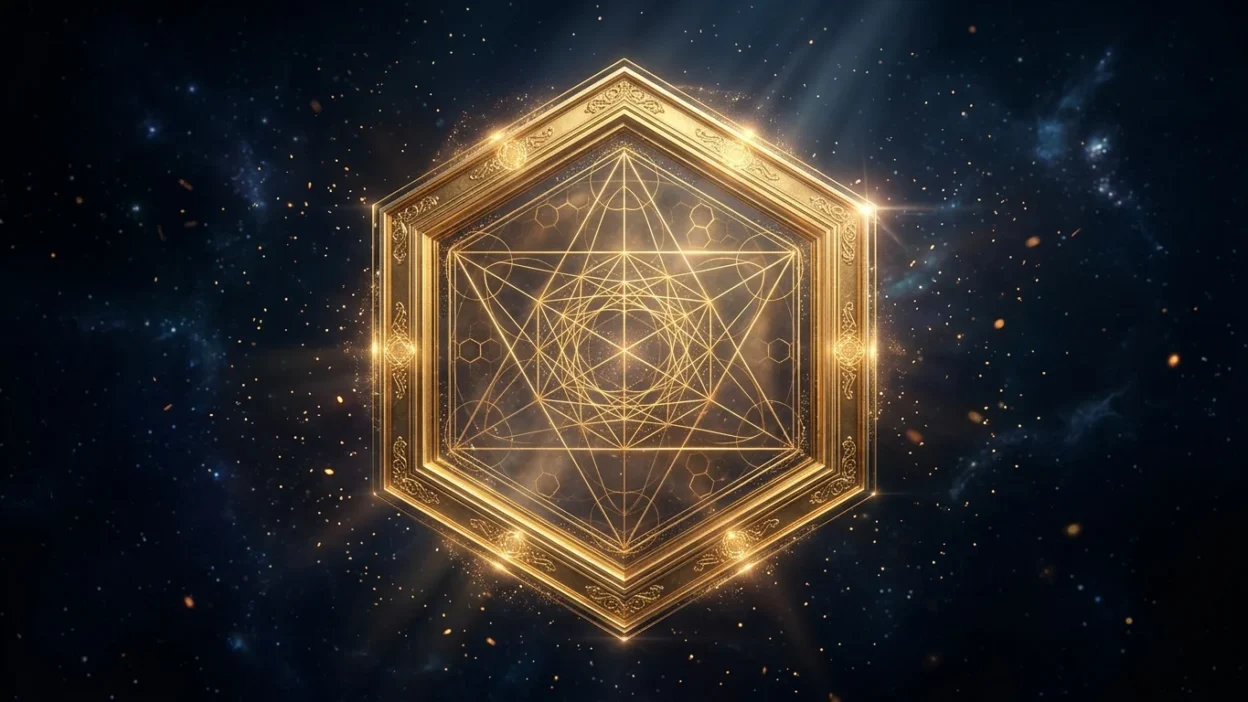
Hexagon symbolism is commonly associated with harmony, balance, unity, efficiency, and the patterns found in nature. A hexagon is a geometric shape with six sides and six angles. Its regular structure makes it a familiar symbol in honeycombs, crystals, architecture, decorative art, and modern design. Depending on the context, it may represent cooperation, natural order, stability, or the connection between individual parts and a larger whole.
Some people also explore hexagons through spiritual interpretations and sacred geometry, where geometric patterns can carry philosophical or personal meaning. However, these interpretations are not universal, and a hexagon does not have one fixed spiritual definition.Understanding hexagon symbolism means exploring the shape’s mathematical properties, natural appearances, cultural uses, and the different meanings people attach to it.
Hexagon Symbolism Meaning (Clear Definition)
Hexagon symbolism refers to the meanings people associate with a six-sided geometric shape. Common interpretations include harmony, balance, unity, cooperation, efficiency, and connection with nature.
A regular hexagon has six equal sides and six equal interior angles. Its symmetrical structure allows hexagons to fit together closely without leaving gaps when arranged in a repeating pattern. This property helps explain why the shape is associated with organization and efficient use of space.
Common meanings of hexagon symbolism include:
- Harmony: Representing different parts working together.
- Balance: Suggesting symmetry and proportion.
- Unity: Showing how separate elements can form a connected whole.
- Cooperation: Reflecting the way individual shapes can work together in a larger pattern.
- Efficiency: Representing the effective use of space and resources.
- Nature: Connecting with familiar patterns found in honeycombs and certain crystals.
- Stability: Suggesting an organized structure with repeating relationships.
- Interconnection: Representing relationships between individuals, systems, or ideas.
- Order: Reflecting patterns, organization, and geometric consistency.
These meanings are interpretations rather than universal rules. A hexagon on a floor tile may simply be decorative, while a hexagonal pattern in artwork might be intended to communicate unity or interconnectedness.
What Does Hexagon Symbolism Represent?
Hexagons can represent several ideas because of their symmetrical structure, repeating patterns, and appearances in the natural world.
1. Harmony and Balance
One common interpretation of hexagon symbolism is harmony. A regular hexagon has six equal sides and six equal angles, creating a visually balanced shape.
In art and design, this symmetry can produce a sense of order and consistency. Repeating hexagons can also create patterns in which individual shapes appear connected without losing their distinct boundaries.
Symbolically, a hexagon may represent finding balance between different responsibilities, relationships, or parts of life. For example, someone might use a hexagon as a personal reminder to give attention to several important priorities rather than focusing on just one.
2. Unity and Cooperation
Hexagons often appear in groups, particularly in honeycomb structures. Individual cells combine to form a larger pattern, making the shape a useful metaphor for cooperation and unity.
In a symbolic design, a collection of connected hexagons may represent people working toward a shared goal or different parts contributing to one system.
This association is especially useful in logos and illustrations that communicate teamwork, community, or collaboration. The meaning comes from the arrangement and intended message, rather than from a universal belief about the shape.
3. Efficiency and Resourcefulness
Hexagons are notable for how efficiently they cover a flat surface when repeated. Regular hexagons can fit together without gaps, creating an organized arrangement.
This geometric property helps explain their practical use in tiles, flooring, graphic patterns, and certain engineered structures.
Symbolically, a hexagon may represent resourcefulness, thoughtful planning, and making good use of available space or energy. These meanings are inspired by the shape’s properties rather than evidence of a hidden message in every hexagonal object.
4. Connection With Nature
Hexagons are especially recognizable in honeycombs, where bees construct cells in a repeating arrangement. Hexagonal patterns also occur in some mineral structures and natural formations.
These examples have made the shape a popular symbol of natural organization and interconnected systems.
For some people, a hexagon represents the idea that nature can produce complex structures through repeated patterns. This is a symbolic interpretation inspired by observable geometry, not proof that every hexagon carries a spiritual message.
5. Stability and Structure
A hexagon can create a strong visual impression of order because its sides and angles follow a regular pattern. Repeated hexagons can also form larger arrangements used in design and construction.
In symbolism, the shape may represent dependable systems, thoughtful organization, or a foundation built from several connected parts.
However, its structural performance depends on the material, design, and forces involved. A hexagonal shape alone does not guarantee that an object or building will be strong.
6. Interconnection and Community
When hexagons are placed beside one another, their shared edges create visible connections. This makes them useful for illustrating networks, relationships, and systems.
For example, a diagram made from connected hexagons might represent members of a community, parts of an organization, or different stages in a process.
Symbolically, the pattern can suggest that individual contributions matter while also showing how each part relates to a larger whole.
Spiritual Meaning of Hexagon Symbolism
The spiritual meaning of hexagon symbolism depends on the belief system, artwork, or personal interpretation involved. Some people associate the shape with harmony, unity, natural order, and the relationship between individual parts and a larger whole.
Hexagons also appear in discussions of sacred geometry, a broad area in which geometric forms and proportions are given philosophical, spiritual, or symbolic significance. The interpretations vary, so it is important not to present one modern spiritual explanation as a belief shared by every tradition.
Hexagon Symbolism and Sacred Geometry
Sacred geometry refers to the study or symbolic use of geometric forms and proportions in certain religious, philosophical, artistic, and spiritual contexts.
Within some contemporary spiritual interpretations, a hexagon may be viewed as a symbol of balance, interconnectedness, or order in the universe. Its repeating structure can inspire reflection on how different parts relate to one another.
However, sacred geometry includes many shapes and traditions. There is no single interpretation of the hexagon that applies to every spiritual system.
The Hexagon as a Symbol of Harmony
The regular hexagon’s symmetry may inspire the idea of harmony between different elements.
In personal reflection, someone might use the six sides as a metaphor for six important areas of life, such as health, relationships, work, learning, creativity, and rest.
This is a personal framework rather than an established spiritual teaching. It can still be useful as a reminder to consider whether different priorities receive enough attention.
Hexagon Symbolism and Natural Order
The hexagon’s appearance in honeycombs and certain crystalline structures makes it a natural choice for representing order in nature.
Some people interpret these patterns spiritually as reminders of the relationship between individual forms and larger systems. Others simply appreciate their mathematical and scientific beauty.
Both responses are valid ways of engaging with the shape, but a spiritual interpretation should be distinguished from a scientific explanation of how the pattern forms.
The Hexagon and Interconnectedness
A hexagonal pattern can continue across a surface, connecting one shape to another. In spiritual or philosophical reflection, this may represent the idea that people, events, or parts of life are related.
For example, a connected hexagon design might be used in a journal or meditation space as a reminder to consider how personal decisions affect other people.
This meaning comes from the way the pattern is interpreted, rather than from a universal religious rule.
Biblical and Religious Meaning of Hexagon Symbolism
The Bible does not provide a widely established, universal definition of the hexagon as a spiritual symbol. Although geometric shapes and carefully measured structures appear in biblical descriptions, it would be inaccurate to claim that the six-sided shape always represents a particular biblical teaching.
Religious meanings should be understood within the relevant text, tradition, and historical context.
Does the Hexagon Have a Biblical Meaning?
There is no broadly accepted biblical teaching that defines the hexagon itself as a symbol of divine harmony, protection, or perfection.
The number six appears in biblical passages and has different interpretations in Christian traditions. However, the presence of the number six does not automatically establish a symbolic connection with a hexagon.
For example, Genesis describes creation over six days. Some Christian interpretations connect this number with work, creation, or human labor, while others focus on the passage’s broader theological meaning. These interpretations concern the number and the biblical narrative, not a universal definition of hexagon symbolism.
Hexagons in Religious Art and Architecture
Geometric patterns appear in religious buildings, decorative surfaces, mosaics, and other forms of sacred art across different cultures.
Hexagonal designs may be chosen for their symmetry, visual rhythm, or ability to form repeating patterns. In some settings, a design may also carry a specific cultural or religious significance.
It is important to examine the particular building or artwork before assigning a religious meaning to its geometry. A hexagonal floor pattern, for example, may be primarily decorative.
Hexagons Across Spiritual Traditions
Geometric shapes have been used in many religious and philosophical traditions, but their meanings vary.
In some traditions, geometric arrangements form part of symbolic diagrams, architectural plans, or contemplative artwork. A hexagon may appear within such a design without serving as its main spiritual symbol.
The safest interpretation is to consider the entire design and the tradition associated with it rather than assuming that every hexagon has the same religious meaning.
Hexagon Symbolism in History and Culture
Hexagons have a long practical history in geometry, decoration, construction, and the study of natural patterns. Their cultural meanings depend on how and where they have been used.
Hexagons in Ancient Geometry
The hexagon has important mathematical properties and has been studied as part of geometry for centuries.
A regular hexagon can be divided into six equilateral triangles by drawing lines from its center to its vertices. This relationship makes it useful in geometric construction and helps explain why it appears in mathematical illustrations.
Geometric knowledge has influenced art, architecture, and decorative design in many societies. However, the use of a hexagon does not automatically show that an ancient designer intended a spiritual message.
Hexagons in Decorative Art
Hexagonal patterns appear in tiles, mosaics, textiles, jewelry, and architectural decoration.
Their ability to repeat without gaps makes them practical for covering surfaces while maintaining a consistent design. Depending on the culture and object, the pattern may communicate artistic style, regional identity, or a particular symbolic idea.
Similar geometric patterns can also develop independently in different places. Their meanings should not be assumed to be identical across cultures.
Hexagons in Honeycombs
Honeycomb structures are among the most familiar examples of hexagonal patterns in nature.
Bees construct combs from wax cells used for storing honey, pollen, and developing young. The arrangement is associated with efficient use of space, although the precise formation of honeycomb geometry involves biological behavior and physical processes.
Because of this familiar natural example, hexagons are often used in modern symbolism to represent cooperation, efficiency, and collective effort.
Hexagons in Science and Technology
Hexagons appear in the study of crystals, molecular structures, materials, and other scientific subjects. They are also used in engineering, product design, and computer graphics.
These uses demonstrate the shape’s practical and mathematical value. In a scientific diagram, a hexagon may simply represent a specific structure rather than a spiritual concept.
At the same time, scientific patterns can inspire artistic and personal interpretations of order and connection.
Hexagons in Modern Culture
Today, hexagons appear in company logos, app graphics, floor tiles, packaging, jewelry, and interior design.
A business might use connected hexagons to communicate teamwork or technology. A designer might choose a single hexagon because it looks distinctive and balanced.
In these settings, the shape’s meaning depends on the organization, visual style, and audience. Not every modern hexagon design contains a hidden symbolic message.
Hexagon Symbolism in Literature and Art
Writers and artists may use hexagons to explore themes of harmony, structure, cooperation, repetition, and interconnectedness. The shape’s meaning usually depends on how it is presented within a larger work.
The Hexagon as a Symbol of Harmony
A regular hexagon has a symmetrical appearance that can create a sense of visual order.
An artist might repeat hexagons to create a calm, balanced composition. A writer describing a patterned room might use the geometry to reinforce a setting that feels organized or carefully controlled.
These effects depend on the surrounding details and the audience’s associations.
Hexagons and Interconnected Systems
A group of connected hexagons can suggest a network in which separate elements depend on one another.
In a story or illustration, this pattern might represent a community, family, ecosystem, or organization. A missing hexagon could be used creatively to suggest disruption or the absence of an important part.
Such meanings are artistic choices rather than fixed definitions.
Hexagons and Repetition
Repeating geometric forms can create rhythm and consistency in visual art.
A hexagonal pattern may feel orderly and predictable, while a broken or irregular pattern may suggest change, tension, or individuality. The contrast between repetition and disruption can help an artist communicate an idea without explaining it directly.
Hexagons in Modern Visual Design
Designers often use hexagons because they offer a distinctive alternative to circles, squares, and rectangles.
A single hexagon can frame an icon or image, while a network of hexagons can suggest technology, data, collaboration, or a connected system.
These associations are common design choices rather than universal symbolic meanings.
Hexagon Symbolism in Dreams
Dreams involving hexagons may bring to mind harmony, order, nature, or interconnectedness. However, there is no scientifically established universal meaning for a hexagon in a dream, and dreams should not be treated as reliable predictions of future events.
Your feelings, memories, and current circumstances are more useful starting points than a fixed dream dictionary.
Dreaming of a Perfect Hexagon
A clear, regular hexagon might remind you of organization, balance, or a desire to bring different parts of life together.
You might reflect on whether you are managing several responsibilities or trying to establish a more consistent routine.
Dreaming of Connected Hexagons
A pattern of connected hexagons may bring to mind relationships, teamwork, or a network of responsibilities.
Consider whether you have recently been thinking about your role in a family, workplace, or community. The interpretation depends on your personal associations and the emotions you experienced.
Dreaming of a Broken Hexagon
A broken or incomplete hexagon could remind you of a disrupted plan, an unfinished task, or a change in a familiar pattern.
It does not necessarily predict a negative event. The image may simply reflect something that has been occupying your thoughts.
Dreaming of Hexagons in Nature
Hexagons appearing in honeycombs, flowers, or other natural settings may prompt thoughts about growth, cooperation, or the natural world.
You might consider whether you have been seeking a closer connection with nature or thinking about how different parts of your life fit together.
Dream symbolism is personal, so the meaning of the image cannot be determined from the shape alone.
Positive Symbolism of the Hexagon
Hexagon symbolism often has positive associations because the shape is symmetrical, repeatable, and familiar in nature.
Common positive interpretations include:
- Harmony: Different parts working together in a balanced arrangement.
- Unity: Individual elements contributing to a larger whole.
- Cooperation: People or parts of a system working toward a shared goal.
- Efficiency: Making thoughtful use of available space and resources.
- Stability: Maintaining an organized and consistent structure.
- Natural order: Reflecting the repeating patterns found in some natural forms.
- Interconnection: Recognizing relationships between different elements.
- Creativity: Using geometry to develop distinctive designs.
- Balance: Giving attention to several areas of life.
- Consistency: Creating a recognizable pattern through repetition.
For example, a connected hexagon design might represent teamwork in a company logo. A hexagonal ornament might remind someone of nature or the value of cooperation.
These are possible interpretations, not guarantees of good fortune, success, or spiritual protection.
Negative or Hidden Symbolism of the Hexagon
A hexagon is not inherently negative, but its meaning can change depending on its context and how it is used.
Excessive Structure or Control
Repeating hexagons can create a highly organized pattern. In an artwork, that order might be used to suggest a rigid system or an environment where everything is expected to fit into a fixed structure.
The same pattern may feel reassuring in one setting and restrictive in another. Its emotional effect depends on the composition and the viewer’s experience.
Conformity and Loss of Individuality
A large field of identical hexagons may be interpreted as a group of similar units following the same pattern.
An artist might use this effect to explore conformity or the tension between individuality and belonging. This is an artistic interpretation rather than a traditional negative meaning of the shape.
Misinterpreting Spiritual Meaning
Some modern discussions assign universal spiritual messages to geometric shapes without identifying a reliable historical or cultural source.
For example, it would be misleading to claim that every hexagon represents a particular divine message or predicts a specific life event. Interpretations should be presented as beliefs or personal reflections unless supported by clear evidence.
Confusing Symbolism With Scientific Fact
The hexagon’s appearance in nature can inspire symbolic ideas about harmony and order. However, natural patterns also have physical, chemical, and biological explanations.
Appreciating a pattern spiritually does not require treating it as evidence of a supernatural message. Keeping these explanations distinct makes the symbolism more accurate and useful.
Common Interpretations of Hexagon Symbolism
A hexagon’s meaning depends on its appearance, setting, and relationship with other shapes.
| Hexagon image or context | Possible symbolic meaning |
| A regular hexagon | Harmony, symmetry, or balance |
| Connected hexagons | Unity, cooperation, or interconnection |
| A honeycomb pattern | Efficiency, collective effort, or natural order |
| A hexagonal crystal pattern | Geometric structure or natural organization |
| Hexagonal floor tiles | Repetition, visual rhythm, or practical design |
| A hexagon in a logo | Identity, technology, teamwork, or structure |
| A broken hexagon | Change, disruption, or an unfinished pattern |
| A hexagon in sacred geometry | A spiritual or philosophical interpretation specific to the system |
| Hexagons in a dream | Personal associations with order, relationships, or nature |
| A hexagon surrounded by other shapes | A relationship between different elements, depending on the design |
These interpretations are possibilities rather than universal definitions. A hexagon may be decorative, mathematical, scientific, spiritual, or personal depending on the context.
Why Does Hexagon Symbolism Matter Today?
Hexagon symbolism remains relevant because the shape combines practical usefulness with visual appeal. It appears in everyday objects and technical designs while also offering a familiar pattern for expressing ideas about connection and balance.
Personal Expression and Self-Reflection
People may choose hexagons for tattoos, jewelry, artwork, or personal emblems.
A hexagon could represent six personal values, important relationships, or areas of development. Someone might also choose the shape simply because they appreciate its symmetry.
If you are considering a hexagon as a personal symbol, decide what it represents to you rather than relying on a single universal interpretation.
Branding and Graphic Design
Businesses and organizations use hexagons in logos, icons, packaging, and illustrations.
Connected hexagons can suggest teamwork, networks, or technology, while a single hexagon can create a clean, recognizable visual identity. These associations depend on the surrounding design and the organization’s purpose.
Architecture and Interior Design
Hexagonal tiles and patterns are common options in flooring, walls, decorative panels, and other design features.
Their repeating structure can create visual rhythm and cover surfaces efficiently. Depending on the colors, materials, and arrangement, the result may feel traditional, modern, playful, or formal.
Science, Technology, and Education
Hexagons are useful in mathematics, science, and engineering because of their geometric properties.
They appear in diagrams of certain crystal structures, in models of molecules, and in technical designs. Learning about these applications helps explain why the shape is so common without requiring a symbolic explanation for every use.
Community and Cooperation
The honeycomb provides a familiar image of many individual cells forming a larger structure. This makes hexagons a useful visual metaphor for community, teamwork, and shared responsibility.
For example, a community project might use connected hexagons to represent people contributing different skills toward a common goal.
The metaphor is meaningful because of the way the pattern is used, not because the shape guarantees cooperation.
FAQs:
1. What does a hexagon symbolize spiritually?
A hexagon may symbolize harmony, balance, unity, and interconnectedness in some modern spiritual interpretations. Its meaning depends on the tradition or personal belief involved, and there is no single spiritual definition accepted by everyone.
2. What does a hexagon represent in sacred geometry?
In some sacred geometry interpretations, a hexagon represents symmetry, balance, interconnectedness, or natural order. These meanings vary among practitioners and should not be treated as universal religious teachings.
3. Why are hexagons associated with nature?
Hexagons are familiar from honeycombs and occur in certain crystalline structures and other natural patterns. Their repeated appearance has inspired associations with efficiency and natural organization, while the patterns themselves have scientific explanations.
4. Does a hexagon have a biblical meaning?
The Bible does not establish one universal symbolic meaning for the hexagon. Although the number six appears in biblical passages, it would be inaccurate to assume that every reference to six directly represents the six-sided geometric shape.
5. What does a hexagon symbolize in dreams?
A hexagon in a dream may bring to mind balance, organization, nature, or relationships. Dream interpretation is personal, and there is no scientifically established universal meaning for this shape.
6. What does a honeycomb symbolize?
A honeycomb may symbolize cooperation, efficiency, community, and the relationship between individual parts and a larger whole. These are common interpretations inspired by the way honeycomb cells form a repeating structure.
7. Is a hexagon a lucky symbol?
A hexagon is not universally recognized as a symbol of luck. Some people may assign it positive personal or spiritual meaning, but there is no reliable evidence that the shape itself brings good fortune.
8. What is the difference between a hexagon and a six-pointed star?
A hexagon is a six-sided polygon. A six-pointed star is a different geometric design, often formed by overlapping triangles. The two shapes can have different historical, cultural, and religious associations, so their symbolism should not be treated as identical.
Conclusion
Hexagon symbolism is commonly associated with harmony, balance, unity, cooperation, efficiency, and natural order. The shape’s six-sided structure appears in honeycombs, crystals, architecture, decorative patterns, and modern design, making it both practically useful and visually meaningful.
Some people interpret hexagons through sacred geometry or personal spirituality, while others appreciate their mathematical properties and natural appearances. Neither approach gives the shape one universal meaning. To understand a particular hexagon, consider its context, cultural background, and intended purpose. Whether used in art, design, nature-inspired imagery, or personal reflection, the hexagon can offer a useful way to explore how individual parts connect to form a larger whole.

Abigail Alice is a passionate writer at SymbolTrue, exploring the history, meanings, and cultural significance of symbols worldwide. She creates clear, engaging, and well-researched content that helps readers uncover the fascinating stories behind everyday and ancient symbols.