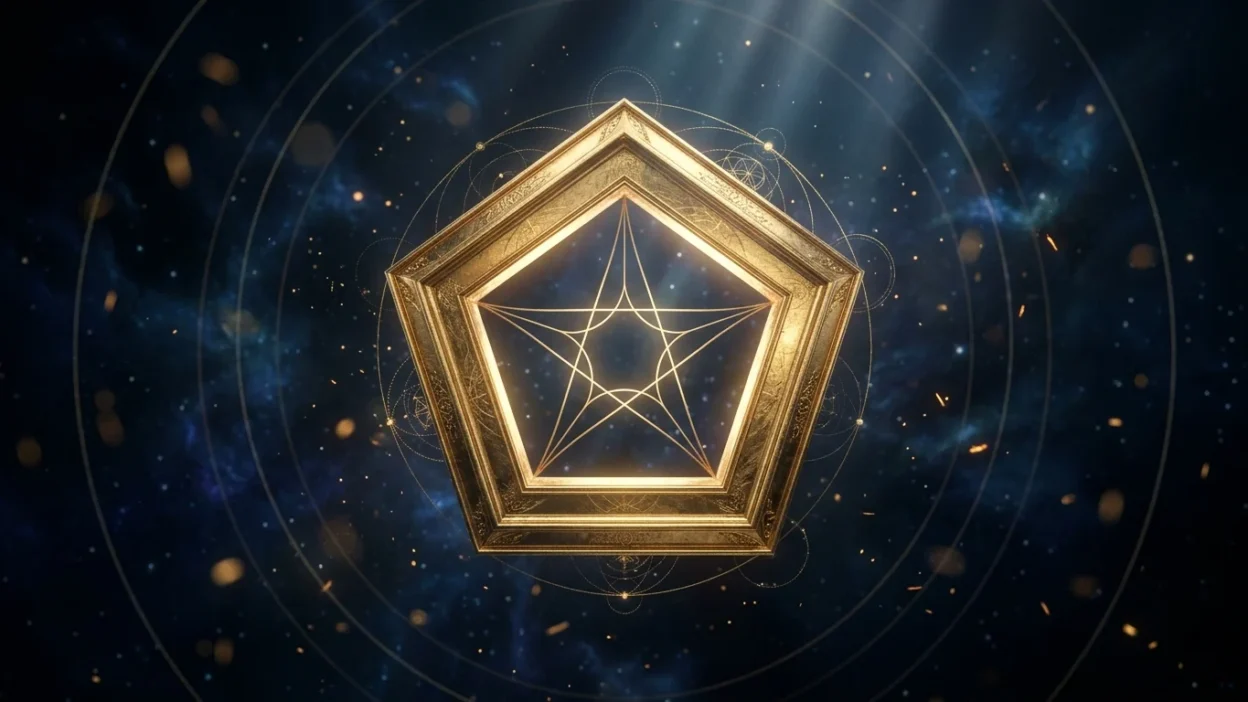
Pentagon symbolism is often associated with protection, balance, harmony, and the connection between different aspects of life. A pentagon is a five-sided geometric shape, and its meaning can change depending on its design, orientation, and cultural context. In some spiritual traditions, a pentagon is connected with the number five, natural elements, or human experience. When a pentagon is combined with a circle to form a pentagram, it can carry additional religious, spiritual, or cultural meanings.
Pentagons appear in architecture, mathematics, decorative art, and symbolic designs. They are also used in modern logos and institutional buildings. Although some interpretations have historical roots, others reflect personal beliefs or contemporary spiritual ideas.Understanding pentagon symbolism requires looking at the shape itself, its relationship with the number five, and the traditions in which it appears.
Pentagon Symbolism Meaning (Clear Definition)
Pentagon symbolism refers to the meanings people associate with a five-sided polygon. Common interpretations include balance, structure, harmony, protection, and the relationship between five connected elements.
A regular pentagon has five equal sides and five equal interior angles. Its organized geometry can suggest order and symmetry. However, a pentagon is not automatically a spiritual symbol. In mathematics, architecture, or everyday design, it may simply be a practical shape.
Common interpretations of pentagon symbolism include:
- Balance: Representing harmony among different parts of a system.
- Protection: Suggesting security in certain spiritual or personal interpretations.
- Harmony: Reflecting the relationship between several connected elements.
- Unity: Bringing five parts together within one complete shape.
- Structure: Representing organization, planning, and stability.
- Human experience: Connecting the number five with aspects of the body or senses in some interpretations.
- Personal growth: Serving as a reminder to develop different areas of life.
- Natural order: Reflecting the geometric patterns associated with fivefold symmetry.
These meanings are not universal. A pentagon used in a building may have a practical purpose, while a pentagon in a spiritual design may be intended to communicate a specific belief.
What Does Pentagon Symbolism Represent?
The pentagon can represent several ideas because of its five-sided structure and its connection with fivefold patterns.
1. Balance and Harmony
A regular pentagon has five equal sides and five equal angles. This symmetry can create a sense of order and visual balance.
In symbolic interpretations, the five sides may represent different elements that work together as part of a larger whole. For example, someone might use a pentagon as a personal symbol for balancing work, relationships, health, learning, and rest.
This is a possible modern interpretation rather than a meaning shared by every culture. The specific design and the creator’s intention help determine its significance.
2. Protection and Security
Pentagons and related five-pointed designs sometimes appear in protective symbolism, especially when incorporated into a pentagram or other established emblem.
In certain historical and spiritual traditions, pentagrams have been used as protective signs. Because a pentagram is created from a five-pointed star and can be drawn within or associated with a pentagon, the two shapes are sometimes discussed together.
However, a plain pentagon and a pentagram are different geometric forms. Their meanings should not be treated as identical.
3. Unity of Five Elements
The number five has symbolic significance in various cultural, philosophical, and religious systems.
A pentagon can provide a visual framework for representing five connected ideas. Examples might include five stages of a process, five personal priorities, or five elements within a particular philosophical system.
The meaning depends on the framework being used. There is no universal list of five elements that applies to every tradition.
4. Order and Structure
A pentagon is a clearly defined geometric shape with five sides and five corners. Its regular form can suggest organization and a system in which different parts fit together.
This interpretation can be useful in modern design, where geometric shapes often communicate structure and consistency.
In architecture and technical drawing, a pentagon may also be chosen for practical reasons rather than symbolic ones.
5. Connection With Nature
Fivefold symmetry appears in some natural forms, including certain flowers and starfish. These examples have helped make five-sided and five-pointed patterns familiar in art and design.
Some people interpret such patterns as reminders of harmony in nature. This is a symbolic association, not evidence that every fivefold pattern has a hidden spiritual meaning.
6. Individuality and Identity
A pentagon can also represent a distinct identity within a larger structure. Its recognizable shape makes it useful in emblems, badges, and visual branding.
In a personal design, the five sides might represent important values or experiences. Such meanings are created by the individual rather than assigned universally to the shape.
Spiritual Meaning of Pentagon Symbolism
The spiritual meaning of pentagon symbolism varies by tradition. It may be associated with balance, protection, the number five, or the relationship between human life and the natural world.
It is important to distinguish the pentagon from the pentagram, which is a five-pointed star. Although these forms are geometrically related, they can have different symbolic roles.
Pentagon Symbolism and the Number Five
In some spiritual and philosophical systems, the number five represents a group of connected elements or aspects of existence.
A pentagon can serve as a visual expression of that fivefold structure. For example, a personal spiritual practice might use five points or five sections to represent different qualities someone wishes to develop.
Such interpretations depend on the system being followed. The number five does not have one fixed spiritual meaning across all religions and cultures.
The Pentagon as a Symbol of Balance
The symmetry of a regular pentagon may suggest harmony and coordination.
Some people use the shape as a reminder to pay attention to different parts of their lives rather than focusing entirely on one responsibility. It may represent the idea that well-being depends on several connected factors.
This is a personal or contemporary symbolic interpretation, not a guarantee of spiritual balance.
Pentagon and Protective Symbolism
Protective meanings are more clearly documented for certain forms of the pentagram than for the plain pentagon.
In some historical traditions, the five-pointed star was used as a protective or meaningful emblem. When the star appears within a circle, it is commonly called a pentagram in a circle, although terminology and interpretation can vary.
A pentagon by itself does not automatically carry the same meaning. Its significance depends on the design, tradition, and intended use.
Pentagon Symbolism and Personal Growth
A pentagon can provide a simple structure for reflecting on five areas of personal development.
For example, someone might associate its sides with physical health, emotional well-being, relationships, knowledge, and purpose. This is a personal framework rather than a universal religious teaching.
The shape can still be useful as a reminder that personal growth often involves several connected areas.
Biblical and Religious Meaning of Pentagon Symbolism
The Bible does not establish a universal symbolic definition of the pentagon. Fivefold patterns and groups of five appear in religious texts and traditions, but these should not automatically be interpreted as references to a five-sided shape.
Religious symbolism depends on the specific text, historical setting, and tradition involved.
Does the Pentagon Have a Biblical Meaning?
There is no widely established biblical teaching that defines the pentagon itself as a symbol of protection, perfection, or divine power.
Biblical passages sometimes use the number five in descriptions of objects, measurements, and events. However, the appearance of that number does not necessarily establish a symbolic connection with the pentagon.
Any proposed interpretation should be considered alongside the passage rather than treated as a universal rule.
Fivefold Patterns in Religious Traditions
Some religious and philosophical traditions use groups of five to organize ideas about the world or human experience.
For example, particular Buddhist teachings discuss five precepts, while some Hindu philosophical systems describe five great elements. These are distinct teachings with their own meanings and contexts.
A pentagon might be used in a modern design to represent five related concepts, but it would be inaccurate to claim that all such traditions use the pentagon itself as their official symbol.
Pentagon and Pentagram in Spiritual Traditions
The pentagram has a longer and more varied history as a recognizable symbol than the plain pentagon in many discussions of spirituality.
It has appeared in different historical, religious, philosophical, and ceremonial contexts. Its meaning has changed across periods and communities.
Some traditions have used it in protective or positive ways, while other contexts have associated it with different beliefs. A pentagram should therefore be interpreted within its specific setting rather than assigned one universal religious meaning.
Pentagon Symbolism in History and Culture
Pentagons have a documented role in mathematics, architecture, and decorative design. Their symbolic interpretations developed within particular cultural settings and should be distinguished from the geometry itself.
Ancient Geometry and the Pentagon
The pentagon became important in the study of geometry because of its relationship to regular polygons, angles, and symmetry.
The ancient Greek mathematical tradition explored geometric relationships involving the pentagon and the five-pointed star. The pentagram, which can be constructed by connecting the vertices of a regular pentagon in a particular sequence, became especially important in some historical philosophical contexts.
The exact beliefs associated with these figures varied. It would be inaccurate to assume that every ancient use of a pentagon carried a spiritual message.
The Pentagon and Pythagorean Tradition
The Pythagoreans were an ancient Greek philosophical and mathematical community associated with the study of numbers and geometric relationships.
The pentagram is traditionally connected with this group in historical accounts, although details about the group’s practices and beliefs require care because much of the evidence comes from later sources.
The relationship between the pentagram and the pentagon illustrates how geometry can become meaningful within a particular intellectual or philosophical tradition.
Five-Sided Shapes in Architecture
Five-sided layouts can appear in buildings, fortifications, and planned spaces.
A pentagonal plan may offer practical advantages for a particular site or purpose, but it is not automatically evidence of spiritual symbolism. Architects consider factors such as circulation, function, visibility, and structural requirements.
The shape’s significance must be understood through the design and historical circumstances of each building.
The Pentagon Building in the United States
The Pentagon in Arlington, Virginia, is the headquarters of the United States Department of Defense. Its five-sided plan is a defining feature of the building.
In this case, the pentagon shape is primarily an architectural and institutional identifier. It has become widely recognized as a reference to the building and the organization associated with it.
This modern use demonstrates how a geometric shape can acquire a specific public meaning through a prominent building rather than through ancient spiritual tradition.
Pentagon Patterns in Art and Decoration
Pentagons and fivefold patterns appear in decorative art, textiles, illustration, and modern graphic design.
Their use may reflect mathematical symmetry, visual interest, cultural convention, or personal expression. A pentagonal motif does not have the same meaning in every region or historical period.
When interpreting a particular design, it helps to examine its origin, accompanying imagery, and intended audience.
Pentagon Symbolism in Literature and Art
Writers and artists can use pentagons to explore themes of order, identity, balance, and the relationship between individual parts and a larger whole.
The meaning usually depends on the surrounding story or artwork rather than the shape alone.
The Pentagon as a Symbol of Order
A regular pentagon has a clear and recognizable structure. In a visual composition, it may suggest organization, symmetry, or a carefully designed system.
An artist might repeat pentagonal forms to create rhythm and consistency. Another might disrupt the pattern to suggest disorder or change.
These effects are artistic choices, not universal symbolic rules.
Fivefold Designs and the Natural World
Artists may use pentagonal or five-pointed patterns to evoke flowers, starfish, or other natural forms with fivefold symmetry.
Such imagery can suggest nature, growth, or interconnectedness, depending on the artwork. The interpretation comes from the combination of shape, subject, and context.
The Pentagon and the Pentagram in Art
A pentagon and a pentagram can look related, but they are not interchangeable.
A pentagon is a five-sided polygon. A pentagram is a five-pointed star formed by connecting five points, often with intersecting lines. Artists may use either shape alone or combine them in a larger composition.
When a pentagram appears within a circle, it may have a specific spiritual, historical, or cultural meaning. The plain pentagon may instead serve a geometric or decorative purpose.
Pentagon Shapes in Modern Design
Modern designers sometimes use pentagons in logos, illustrations, badges, and interface elements.
The shape can make a design distinctive and may communicate precision, identity, or structure. In many cases, it is selected for visual reasons rather than a hidden symbolic meaning.
Pentagon Symbolism in Dreams
Dreams involving pentagons may prompt thoughts about balance, order, identity, or the number five. However, there is no scientifically established universal interpretation of a pentagon in a dream, and dreams should not be treated as reliable predictions of future events.
Your own feelings and experiences provide a more useful starting point than a fixed dream dictionary.
Dreaming of a Perfect Pentagon
A clear, regular pentagon might bring to mind order, balance, or a desire to organize several parts of your life.
You could reflect on whether you are trying to coordinate different responsibilities or build a more stable routine.
Dreaming of a Broken Pentagon
A broken or incomplete pentagon may remind you of an interrupted plan, a disrupted routine, or something that feels unfinished.
Its meaning depends on the dream’s emotional tone and your personal circumstances. It does not necessarily predict conflict or misfortune.
Dreaming of a Pentagon or Five-Pointed Star
If you dream about a pentagon alongside a five-pointed star, consider whether you associate the image with a particular belief, memory, book, film, or design.
The two shapes are different, so it is helpful to notice which one appeared and how it was used.
Dreaming of Repeated Pentagon Shapes
Repeated pentagons may bring attention to recurring patterns, organization, or a group of connected ideas.
You might consider whether a particular routine or decision has been occupying your attention. The dream’s meaning remains personal rather than universally fixed.
Positive Symbolism of the Pentagon
Pentagon symbolism can carry positive associations, particularly when the shape is used to represent symmetry, unity, or an organized whole.
Common positive interpretations include:
- Balance: Coordinating several parts of life.
- Harmony: Bringing different elements into a connected arrangement.
- Unity: Representing five parts within one structure.
- Order: Communicating organization and consistency.
- Protection: In some contexts, relating to protective traditions involving pentagrams or related designs.
- Personal growth: Serving as a reminder to develop different abilities or priorities.
- Creativity: Using geometric patterns to express new ideas.
- Identity: Creating a recognizable emblem or personal design.
- Natural connection: Evoking fivefold patterns found in some living forms.
For example, a person might use a pentagon in a personal emblem to represent five important values. A designer might choose it to make a logo visually distinctive.
These interpretations reflect intention and context. A pentagon does not automatically bring protection, success, or good fortune.
Negative or Hidden Symbolism of the Pentagon
A pentagon is not inherently negative, but its interpretation can change depending on how it appears and what it represents.
Confusion Between the Pentagon and Pentagram
One common misunderstanding is treating the pentagon and pentagram as the same symbol.
The pentagon is a five-sided shape, while the pentagram is a five-pointed star. Because the pentagram has been associated with different religious and cultural meanings, confusion between the two can lead to inaccurate interpretations of the plain pentagon.
Fear Based on Cultural Associations
Some people may associate five-pointed stars or related geometric symbols with particular religious, occult, or fictional contexts.
These associations do not apply automatically to every pentagon. A five-sided shape on a building, sign, or decorative object may have no spiritual meaning at all.
Rigidity and Over-Structure
In an artistic or personal interpretation, a highly regular geometric shape can suggest strict organization or a preference for control.
A pentagon might be used in a design to represent a system with clear rules. Depending on the surrounding imagery, this may feel reassuring or restrictive.
This is an interpretive possibility rather than a traditional negative meaning shared by all cultures.
Misinterpreting Fivefold Symbolism
The number five has different meanings in different traditions. Combining these meanings into one explanation can create misleading claims.
For example, a system that uses five elements may not have any historical connection to pentagonal geometry. Understanding the source of a symbol helps avoid assigning meanings that its original users may never have intended.
Common Interpretations of Pentagon Symbolism
The meaning of a pentagon depends on its form, setting, and relationship with other symbols.
| Shape or context | Possible interpretation |
| Regular pentagon | Symmetry, order, or geometric balance |
| Pentagon used in a personal design | Five connected values or ideas |
| Pentagon in a mathematical diagram | A five-sided polygon and its geometric properties |
| Pentagon in architecture | A functional or distinctive building plan |
| Pentagon in decorative art | Pattern, structure, or visual identity |
| Pentagon combined with a circle | A relationship between geometric forms; meaning depends on the design |
| Pentagon associated with fivefold patterns | Unity among five elements in a particular framework |
| Pentagram | A five-pointed star with meanings that vary across traditions |
| Pentagram inside a circle | A specific form that may carry religious, historical, or spiritual associations |
| Pentagon in a dream | Personal associations with order, identity, or balance |
These are general possibilities, not definitive answers. A pentagon may have a particular meaning within a specific tradition, building, artwork, or personal story.
Why Does Pentagon Symbolism Matter Today?
Pentagon symbolism remains relevant because geometric shapes are widely used to organize information, express identity, and communicate ideas.
Personal Expression and Identity
People may use pentagonal designs in jewelry, tattoos, artwork, or personal emblems.
A pentagon could represent five personal values or different areas of growth. Such a design can be meaningful without belonging to a formal spiritual tradition.
If you are choosing a pentagon for a tattoo or personal symbol, consider what the shape means to you and whether additional elements change its interpretation.
Branding and Graphic Design
Pentagons can help businesses and organizations create distinctive visual identities.
A five-sided logo may communicate structure or individuality, but its meaning depends on the organization’s purpose and the overall design. Sometimes the shape is chosen simply because it stands out from more common circles and squares.
Architecture and Public Identity
The Pentagon building in the United States has made the five-sided shape a recognizable symbol of a major government institution.
This association is specific to the building and its public role. It should not be confused with spiritual interpretations of pentagons or pentagrams.
Education and Geometry
Pentagons remain important in mathematics and geometry. Studying their angles, symmetry, and relationship to five-pointed stars helps explain how simple shapes can form complex patterns.
These mathematical properties can inspire artwork and design without requiring a spiritual interpretation.
Reflection and Personal Growth
A pentagon can serve as a personal framework for considering five connected priorities, such as health, relationships, work, learning, and creativity.
This approach is a modern reflective exercise rather than a universal symbolic tradition. Its value comes from helping a person organize thoughts and identify areas that need attention.
FAQs:
1. What does a pentagon symbolize spiritually?
A pentagon may represent balance, harmony, structure, or five connected elements in some personal and spiritual interpretations. Its meaning depends on the tradition and design, and it does not have one universal spiritual definition.
2. What is the difference between a pentagon and a pentagram?
A pentagon is a polygon with five sides and five angles. A pentagram is a five-pointed star formed by connecting five points. They are geometrically related but can have different symbolic meanings.
3. Does a pentagon symbolize protection?
Some people connect five-sided or five-pointed designs with protection, particularly through traditions involving the pentagram. However, a plain pentagon does not universally symbolize protection, and interpretations vary.
4. What does a pentagon mean in the Bible?
The Bible does not establish a universal symbolic meaning for the pentagon. References to the number five or fivefold arrangements should be interpreted within their passages rather than treated as direct definitions of pentagon symbolism.
5. What does the number five represent spiritually?
The number five has different meanings across spiritual and cultural systems. It may represent a group of five elements, principles, or practices in a particular tradition, but there is no single meaning shared by all religions.
6. What does a pentagon symbolize in dreams?
A pentagon in a dream may bring to mind balance, order, identity, or five connected priorities. Dream meanings are personal, and there is no scientifically established universal interpretation.
7. Is the pentagon an evil or negative symbol?
No. A pentagon is a geometric shape and is not inherently evil or negative. Some people may associate related symbols with particular beliefs or cultural contexts, but those associations do not apply universally.
8. Why is the Pentagon building shaped like a pentagon?
The Pentagon building in Arlington, Virginia, was designed with a five-sided plan as part of its architectural layout. Today, the shape is strongly associated with the United States Department of Defense because the building serves as its headquarters.
Conclusion
Pentagon symbolism can represent balance, harmony, structure, unity, and the relationship between five connected elements. Its geometric form appears in mathematics, architecture, art, and modern design, while related five-pointed symbols carry distinct meanings in particular historical and spiritual traditions.
The most important distinction is between a pentagon and a pentagram. Although they are related, they are not the same shape and should not automatically be assigned the same symbolism. Understanding the context, cultural background, and intended use of a design provides the clearest way to interpret what a pentagon means.

Ryan Thomas is a passionate writer at SymbolTrue, dedicated to exploring the meanings, history, and cultural significance of symbols worldwide. He creates engaging, well-researched content that helps readers discover the stories and symbolism behind everyday signs, icons, and traditions.