Chakra symbolism explores ideas about energy, balance, awareness, spirituality, and personal growth. In particular, chakra traditions connect certain subtle-body concepts with different areas of the body and aspects of human experience.
Today, people encounter chakra imagery in yoga, meditation, artwork, jewelry, wellness practices, and popular culture. However, different traditions and modern systems interpret chakras in different ways.
Therefore, understanding chakra symbolism requires looking at both its South Asian roots and its modern interpretations.
Chakra Symbolism Meaning (Clear Definition)
The word chakra comes from Sanskrit and commonly means “wheel” or “disc.” Various Indian traditions use the term in different ways when discussing subtle-body practices and spiritual concepts.
Importantly, historical traditions do not all describe chakras in the same way. Some systems identify different numbers of chakras, while others give them different locations, qualities, or spiritual functions.
Modern seven-chakra systems commonly connect chakras with:
- Body and subtle energy
- Emotional experiences
- Spiritual development
- Meditation
- Self-awareness
- Personal transformation
- Specific colors and symbols
- Balance and harmony
As a result, chakra symbolism does not have one universal definition. Instead, different cultures, traditions, and modern practices contribute to its meaning.
What Does Chakra Symbolism Represent?
Chakra symbolism often represents different dimensions of human experience. For example, modern interpretations connect lower chakras with grounding, creativity, and personal power, while they connect higher chakras with communication, insight, and spiritual awareness.
Balance
Balance forms one of the most common themes in modern chakra symbolism. Many practitioners use the chakra system as a symbolic framework for considering different areas of life.
For example, people may connect the root chakra with security and the heart chakra with emotional connection. Therefore, the complete system can represent harmony between different aspects of personal experience.
Energy
Many traditional and modern chakra systems discuss subtle energy. In traditional contexts, practitioners connect this idea with specific philosophical and spiritual understandings of the body.
Modern wellness culture, however, often uses the word “energy” more broadly to describe vitality, mood, or emotional states.
Self-Awareness
Chakra meditation encourages many people to reflect on their thoughts, emotions, and experiences. Consequently, chakra symbolism can represent introspection and greater self-awareness.
Transformation
Chakra symbolism can also represent personal transformation. For instance, moving through the chakra system from grounding toward spiritual reflection can symbolize a journey of personal development.
Spiritual Meaning of Chakra Symbolism
Different traditions give chakra concepts different spiritual meanings. Nevertheless, many chakra-related practices connect with meditation, yoga, subtle-body ideas, consciousness, and spiritual development.
Modern seven-chakra interpretations commonly associate the chakras with these themes:
- Root Chakra: Grounding, security, and stability
- Sacral Chakra: Creativity, emotions, and pleasure
- Solar Plexus Chakra: Confidence, willpower, and personal strength
- Heart Chakra: Love, compassion, and connection
- Throat Chakra: Communication and self-expression
- Third Eye Chakra: Intuition, insight, and perception
- Crown Chakra: Spiritual awareness and contemplation
However, these associations describe a popular modern framework rather than every historical chakra tradition.
Therefore, readers should consider the specific tradition or system before assigning a particular meaning to a chakra.
Biblical / Religious Meaning of Chakra Symbolism
Chakras do not originate in biblical teachings. Instead, chakra concepts developed within South Asian religious and philosophical traditions.
Hindu traditions contain important chakra teachings, particularly within certain yoga and Tantric systems. At the same time, Buddhist and Jain traditions developed their own approaches to meditation, subtle bodies, and spiritual practice.
However, these traditions do not all use the same chakra system.
Therefore, people should distinguish historical religious teachings from modern wellness interpretations. A contemporary chart showing seven colored chakras does not necessarily represent every traditional Indian understanding of chakras.
Chakra Symbolism in History and Culture
Chakra concepts have a complex history in South Asia. Over many centuries, different texts, philosophical schools, and spiritual traditions developed different ideas about subtle bodies and energy centers.
Some historical systems describe several chakras, while modern popular culture often focuses on seven.
Later, Western writers and spiritual movements introduced chakra concepts to wider international audiences. As yoga, meditation, and related practices gained global popularity, the seven-chakra model became particularly recognizable.
Consequently, modern chakra symbolism combines historical South Asian concepts with newer ideas about psychology, wellness, colors, personality, and personal development.
The Seven Chakras and Their Symbolism
1. Root Chakra — Muladhara
Modern chakra systems place the root chakra near the base of the spine.
Many contemporary interpretations connect it with:
- Grounding
- Security
- Stability
- Survival
- Physical connection
- Foundation
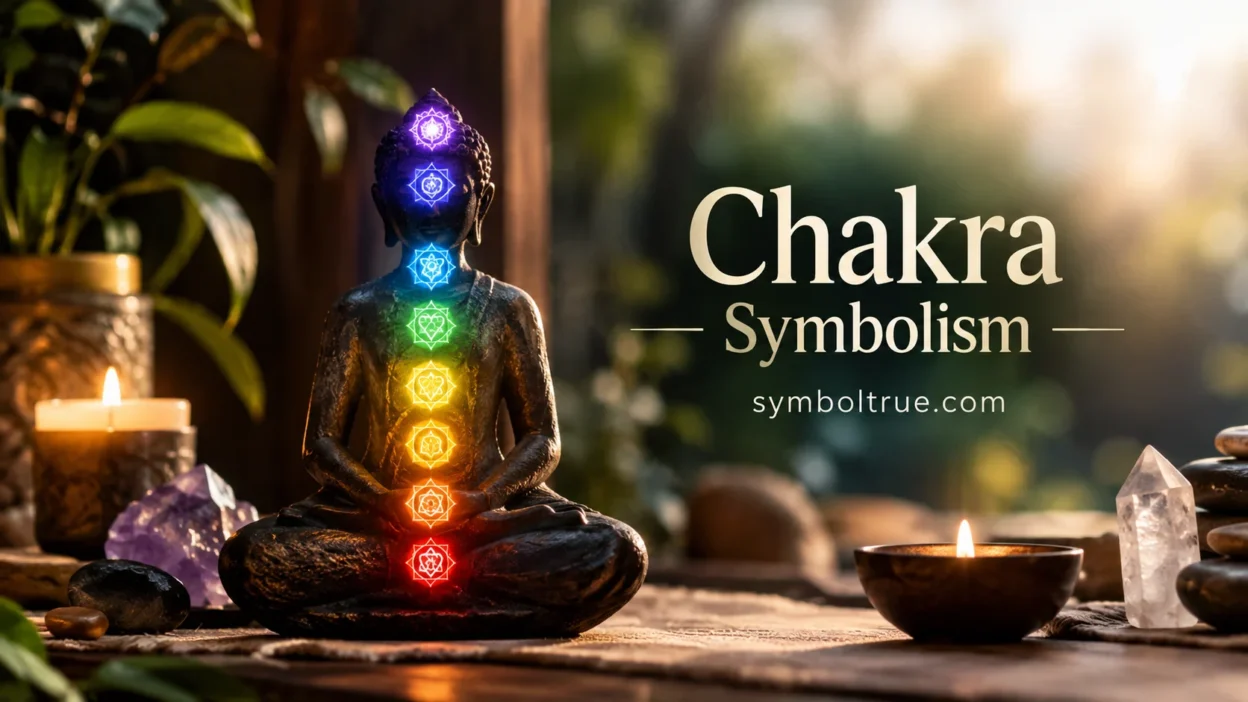
Modern systems commonly use red to represent the root chakra.
Therefore, red chakra imagery often symbolizes grounding, stability, and a strong foundation.
2. Sacral Chakra — Svadhisthana
Modern systems place the sacral chakra around the lower abdomen.
Contemporary interpretations connect it with:
- Creativity
- Emotion
- Pleasure
- Relationships
- Sensuality
- Adaptability
Similarly, many modern chakra charts use orange to represent this chakra.
As a result, orange chakra imagery often communicates creativity, emotional movement, and openness.
3. Solar Plexus Chakra — Manipura
Modern chakra systems associate the solar plexus chakra with the upper abdomen.
Its common symbolic themes include:
- Confidence
- Willpower
- Motivation
- Personal identity
- Determination
Meanwhile, yellow commonly represents this chakra.
Therefore, yellow chakra imagery often suggests confidence, energy, motivation, and personal strength.
4. Heart Chakra — Anahata
Modern chakra systems connect the heart chakra with the center of the chest.
Common interpretations associate it with:
- Love
- Compassion
- Forgiveness
- Connection
- Emotional openness
Many contemporary systems use green for the heart chakra.
Consequently, green chakra imagery often communicates harmony, compassion, healing, and emotional connection within modern spiritual symbolism.
5. Throat Chakra — Vishuddha
Modern chakra systems connect the throat chakra with the throat area.
Common symbolic themes include:
- Communication
- Self-expression
- Truth
- Listening
- Authenticity
In addition, modern seven-color systems commonly use blue to represent this chakra.
Therefore, blue chakra imagery often symbolizes communication, honesty, and clear expression.
6. Third Eye Chakra — Ajna
Modern systems associate the third eye chakra with the area between the eyebrows.
Common interpretations connect it with:
- Intuition
- Insight
- Perception
- Imagination
- Inner awareness
Many modern charts use indigo or deep blue for this chakra.
As a result, third eye imagery often represents introspection, intuition, and deeper perception.
7. Crown Chakra — Sahasrara
Modern interpretations place the crown chakra at the top of the head.
They commonly connect it with:
- Spiritual awareness
- Consciousness
- Contemplation
- Transcendence
- Connection with something greater
Modern chakra imagery often uses purple or white for the crown chakra.
Thus, crown chakra symbolism commonly represents spiritual reflection and expanded awareness.
Chakra Symbolism in Literature and Art
Artists, writers, photographers, and designers use chakra imagery in many different ways. For example, chakra symbols appear in meditation artwork, jewelry, posters, books, digital illustrations, and wellness branding.
Chakra Wheels
The circular shape of chakra symbols reflects the word’s association with a wheel or disc. In modern artwork, artists often use circles to communicate movement, energy, harmony, or continuity.
Lotus Flowers
Lotus imagery frequently appears alongside chakra symbols. Furthermore, lotus symbolism has a much broader history within South Asian religious and artistic traditions.
Depending on the cultural context, the lotus can represent different ideas such as purity, growth, beauty, or spiritual development.
Chakra Colors
Modern seven-chakra imagery commonly uses a sequence of colors:
Red → Orange → Yellow → Green → Blue → Indigo → Purple/White
However, color associations can vary between different systems and modern interpretations.
Mandalas
Mandalas often appear alongside chakra imagery. In contemporary spiritual artwork, they may symbolize balance, concentration, wholeness, and contemplation.
Nevertheless, mandalas also have specific historical meanings within different South Asian religious traditions.
Chakra Symbolism in Dreams
Dream symbolism remains highly personal. Therefore, no scientifically established universal interpretation can explain every dream involving chakras.
Still, chakra imagery in dreams may reflect themes such as:
- Self-reflection
- Emotional awareness
- Personal growth
- Desire for balance
- Spiritual curiosity
- Inner conflict
- Search for meaning
For example, someone might dream about a glowing heart chakra during a period of emotional reflection.
Similarly, a dream about a dark or blocked chakra might symbolize frustration or emotional difficulty within that person’s own belief system.
Ultimately, the dreamer’s emotions, experiences, and circumstances provide important context.
Positive Symbolism of Chakras
Chakra symbolism often communicates several positive ideas.
Balance
The seven-chakra framework can represent harmony between different areas of life. In this sense, each chakra contributes to a larger symbolic picture of balance.
Growth
The chakra system can symbolize personal development. For example, moving from grounding toward higher awareness can represent a journey of growth.
Awareness
Meditation and chakra practices encourage reflection. Therefore, chakra imagery often represents mindfulness and self-awareness.
Compassion
The heart chakra commonly represents love and compassion. As a result, heart chakra imagery frequently appears in artwork focused on kindness and emotional connection.
Communication
The throat chakra represents communication in many modern systems. Consequently, blue chakra imagery may symbolize honest expression and meaningful conversation.
Insight
Third eye symbolism commonly connects with intuition and perception. Similarly, artists may use an eye symbol to represent inner knowledge.
Spiritual Awareness
Crown chakra symbolism often represents contemplation and spiritual awareness. Thus, it can communicate ideas about connection, consciousness, and transcendence.
Negative or Hidden Symbolism of Chakras
Chakra symbolism can also express challenges and difficult emotions. For instance, modern spiritual language sometimes uses the idea of a “blocked chakra” to describe feeling stuck or disconnected.
Possible symbolic themes include:
- Fear
- Insecurity
- Emotional suppression
- Lack of confidence
- Communication difficulties
- Confusion
- Disconnection
- Excessive attachment
However, these interpretations belong to spiritual or symbolic frameworks rather than established medical science.
Therefore, people should not treat chakra imbalance as a medical diagnosis or assume that a health condition results from a blocked chakra.
Common Interpretations of Chakra Symbolism
| Chakra | Common Color | Common Symbolic Themes |
|---|---|---|
| Root | Red | Grounding, stability, security |
| Sacral | Orange | Creativity, emotion, pleasure |
| Solar Plexus | Yellow | Confidence, willpower, motivation |
| Heart | Green | Love, compassion, connection |
| Throat | Blue | Communication, expression, truth |
| Third Eye | Indigo | Intuition, insight, perception |
| Crown | Purple/White | Spiritual awareness, contemplation |
Keep in mind, these associations represent common contemporary interpretations. Therefore, they should not serve as a universal description of every historical chakra tradition.
Why Does Chakra Symbolism Matter Today?
Chakra symbolism remains popular because it provides a visual language for discussing balance, emotions, mindfulness, self-awareness, and spiritual exploration.
Today, people encounter chakra imagery in yoga studios, meditation practices, wellness content, jewelry, clothing, artwork, books, and social media.
Moreover, the color system makes chakra symbolism easy to recognize. For example, many people immediately connect red with the root chakra or green with the heart chakra because modern wellness culture uses these associations frequently.
At the same time, learning about the historical roots of chakras can provide important cultural context.
For this reason, people can approach chakra symbolism as both a historical subject and a modern symbolic framework.
Frequently Asked Questions About Chakra Symbolism
What is the main meaning of chakra symbolism?
Chakra symbolism commonly represents balance, awareness, personal development, spirituality, and different aspects of human experience. However, specific meanings vary between traditions.
What do the seven chakras represent?
Modern seven-chakra systems commonly connect the chakras with grounding, creativity, personal power, compassion, communication, intuition, and spiritual awareness.
What do chakra colors mean?
Modern systems commonly associate red with the root chakra, orange with the sacral chakra, yellow with the solar plexus, green with the heart, blue with the throat, indigo with the third eye, and purple or white with the crown.
Are chakras mentioned in the Bible?
No. Biblical teachings do not originate the chakra system. Instead, chakra concepts developed within South Asian religious and philosophical traditions.
Are chakras part of Hinduism?
Certain Hindu traditions contain important chakra teachings, particularly within some yoga and Tantric systems. However, Hindu traditions vary greatly, so not every Hindu tradition uses the same chakra framework.
What does a blocked chakra symbolize?
Modern spiritual practices may use “blocked chakra” to describe feelings of imbalance, emotional difficulty, or being stuck in an area of life. However, this concept does not function as an established medical diagnosis.
What does chakra symbolism mean in dreams?
Chakra imagery in dreams may symbolize balance, emotional awareness, personal growth, spiritual curiosity, or inner conflict. Ultimately, personal experiences and emotions influence dream interpretation.
What is the most powerful chakra?
Different traditions and modern systems approach chakras differently. Therefore, no single chakra has a universally accepted status as the “most powerful.”
Conclusion
Chakra symbolism represents ideas of balance, awareness, energy, personal growth, emotional connection, and spiritual reflection. At the same time, chakra traditions have a complex history, and different systems do not always use the same symbols or meanings.
Modern seven-chakra imagery has become especially popular through yoga, meditation, wellness culture, and contemporary spiritual practices. However, understanding its South Asian roots helps place these modern interpretations in a broader cultural context.
Ultimately, chakra symbolism offers a rich symbolic language for exploring balance, mindfulness, self-awareness, and personal transformation.

Henry Jack is the Administrator of SymbolTrue, ensuring the website runs smoothly while overseeing content quality, user experience, and daily operations. He is passionate about helping readers explore symbols, meanings, and cultural insights.