Yoga symbolism represents ideas of balance, discipline, mindfulness, self-awareness, harmony, and spiritual reflection. In particular, yoga is often associated with creating greater awareness of the connection between the body, mind, and inner experience. However, its meaning can vary depending on cultural, philosophical, religious, and personal context.
Although modern yoga is often practiced for fitness and wellness, its historical development includes diverse Indian philosophical and spiritual traditions. Therefore, understanding yoga symbolism requires looking beyond physical poses and considering the ideas associated with meditation, breathing, discipline, balance, and self-reflection.
Yoga Symbolism Meaning (Clear Definition)
Yoga symbolism refers to the ideas and meanings associated with yoga practices, poses, objects, imagery, and philosophical concepts.
The Sanskrit word yoga is commonly connected with ideas of joining, connection, or integration. However, yoga has developed through many different traditions, so it does not have one universally accepted definition.
Symbolically, yoga can represent:
- Balance between different aspects of life
- Physical and mental discipline
- Self-awareness
- Inner stillness
- Personal transformation
- Connection and integration
- Mindfulness
- Spiritual inquiry
- Patience and perseverance
- Harmony
For example, a balanced yoga pose may represent stability, while a quiet seated posture may suggest reflection or inner awareness. At the same time, these interpretations can change according to the tradition and situation.
What Does Yoga Symbolism Represent?
Yoga symbolism can communicate several important themes. Although these themes often overlap, each one can offer a different way to understand yoga imagery.
Balance
Balance is one of the most recognizable symbolic ideas associated with yoga. Many poses require physical stability and concentration. As a result, they can be interpreted as symbols of maintaining balance in everyday life.
Moreover, balance can represent harmony between activity and rest, effort and relaxation, or physical awareness and mental focus.
Inner Awareness
Yoga often encourages attention to breathing, posture, and bodily sensations. Therefore, yoga imagery may symbolize becoming more aware of one’s thoughts, emotions, and physical experience.
Rather than focusing entirely on the outside world, the practitioner may be represented as turning attention inward.
Discipline
Developing a regular yoga practice can require consistency and patience. For this reason, yoga can symbolize dedication and self-discipline.
Furthermore, the gradual process of learning poses can represent the idea that meaningful development often happens through repeated practice rather than instant results.
Connection
Connection is another important theme. In many interpretations, yoga can symbolize a relationship between body and mind, individual and environment, or physical practice and personal reflection.
Consequently, yoga imagery can communicate a sense of integration rather than separation.
Transformation
Yoga can also symbolize a journey of personal change. For example, someone beginning yoga may gradually develop greater physical awareness, patience, or concentration.
Thus, yoga symbolism can represent transformation as an ongoing process rather than a single moment.
Spiritual Meaning of Yoga Symbolism
Yoga has deep connections with Indian philosophical and spiritual traditions. Nevertheless, there is no single spiritual interpretation shared by every school or practitioner.
In some traditional contexts, yoga is connected with meditation, ethical discipline, concentration, self-knowledge, and liberation. Meanwhile, other approaches may emphasize different goals and practices.
From a broad symbolic perspective, yoga may represent:
- Inner awakening
- Self-discovery
- Spiritual discipline
- Awareness
- Detachment
- Compassion
- Concentration
- Harmony
- Liberation or freedom from limitations
Importantly, these meanings should be understood within their specific traditions rather than treated as universal definitions.
Biblical / Religious Meaning of Yoga Symbolism
Yoga does not originate from the biblical tradition, so there is no standard biblical meaning of yoga symbolism.
Instead, its historical development is closely connected with Indian religious and philosophical traditions. For example, yoga has important historical relationships with Hindu traditions, while Buddhist and Jain traditions also developed contemplative and disciplined practices within the wider South Asian religious landscape.
However, modern yoga is practiced in many different ways. Some people approach it as physical exercise, whereas others understand it as meditation, philosophy, or spiritual practice.
Therefore, it is useful to distinguish historical yoga traditions from contemporary fitness-oriented yoga. In this way, the symbolic meaning can be discussed without assuming that every modern yoga practice has the same religious purpose.
Yoga Symbolism in History and Culture
Yoga has a long and complex history in South Asia. Over time, different philosophical schools, texts, teachers, and communities contributed to its development.
Classical yoga is associated with traditions that discuss meditation, ethical practices, concentration, disciplined living, and spiritual goals. Later, physical postures became increasingly important in some forms of yoga.
In the modern era, yoga spread widely outside South Asia. As a result, it became associated with exercise, flexibility, mindfulness, relaxation, spirituality, and general wellness.
This history helps explain why yoga symbolism can mean different things today. For instance, a traditional practitioner, a fitness enthusiast, and an artist may all use the same yoga image while giving it different meanings.
Yoga Symbolism in Literature and Art
Yoga appears in literature, photography, painting, sculpture, advertising, film, and contemporary visual culture. In many cases, artists use yoga imagery to communicate peace, discipline, balance, solitude, or spiritual exploration.
Lotus Position
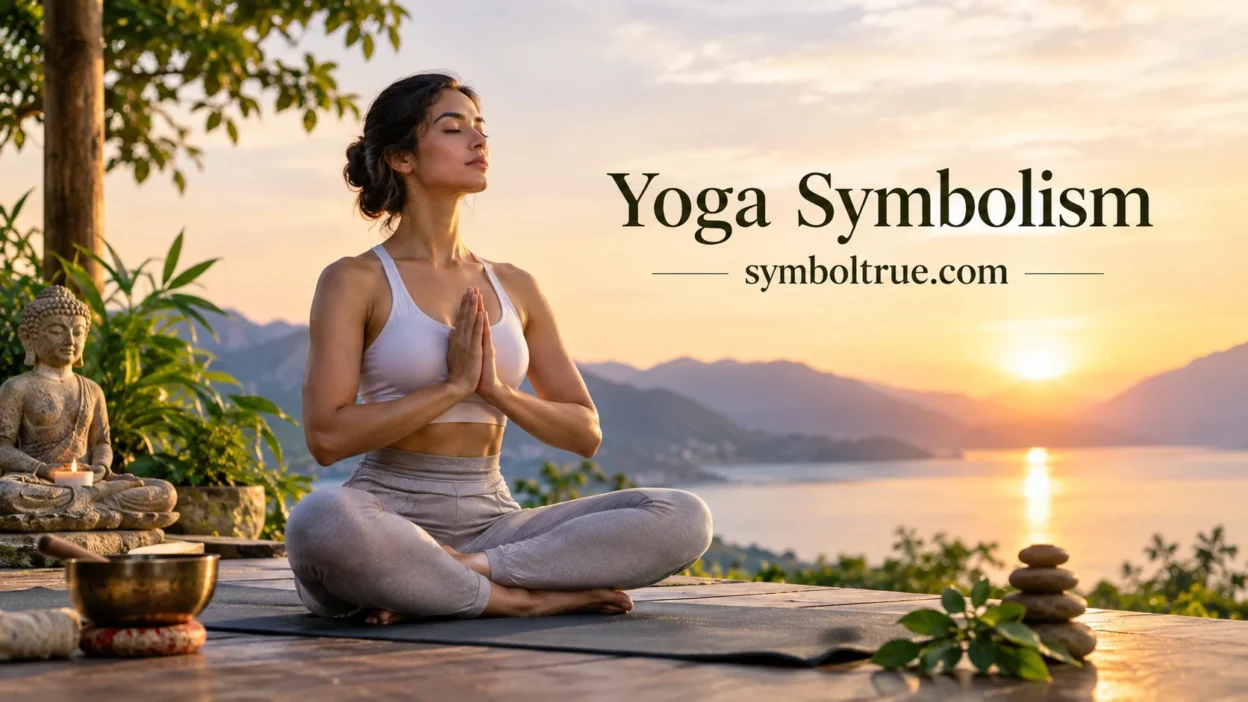
The lotus or cross-legged seated posture is widely recognized as meditation and yoga imagery. In particular, it can suggest contemplation, stillness, or spiritual practice.
However, its deeper significance varies across traditions and should not be reduced to one universal interpretation.
Namaste Gesture
Hands brought together near the chest are commonly associated with greeting or respect in South Asian contexts. At the same time, the gesture has become strongly associated with modern yoga culture in many parts of the world.
Its cultural meaning, however, extends beyond yoga.
Mandala
Mandala imagery appears in several South Asian religious and contemplative traditions. In modern yoga settings, mandalas are often used to suggest balance, wholeness, meditation, or spiritual reflection.
Nevertheless, their historical meanings are more specific and varied than modern wellness imagery may suggest.
Mountain Pose
Mountain Pose, or Tadasana, can symbolically suggest stability, groundedness, and upright awareness. For example, its steady posture can be used artistically to communicate strength and calm.
These are interpretive associations rather than fixed historical meanings.
Sun Imagery
Sun imagery sometimes appears in yoga-related designs, particularly around practices such as Sun Salutations. Symbolically, sunlight may suggest energy, vitality, renewal, or awareness.
Yoga Symbolism in Dreams
Dream symbolism is highly personal, and there is no scientifically established universal meaning for dreaming about yoga.
Nevertheless, a yoga-related dream may reflect themes such as:
- A desire for greater balance
- A need for relaxation
- Personal discipline
- Self-reflection
- Emotional adjustment
- A desire for physical or mental harmony
- A period of personal change
For example, successfully holding a difficult pose in a dream may feel very different from repeatedly falling out of that pose.
Similarly, peacefully practicing yoga may create a different symbolic impression from feeling frustrated or unable to concentrate.
Therefore, the emotions, setting, and personal experiences within the dream are often more useful than relying on a fixed dream dictionary.
Positive Symbolism of Yoga
Yoga is commonly associated with several positive symbolic ideas.
Peace
Quiet poses and controlled breathing can represent calmness and inner stillness. As a result, yoga imagery is frequently used to communicate peaceful environments.
Balance
Balancing poses can symbolize stability and the effort to remain centered. Moreover, they can represent finding harmony during periods of change.
Growth
Learning a new posture often takes time. Therefore, yoga can symbolize gradual development, patience, and continuous improvement.
Strength
Yoga imagery can communicate both physical and mental resilience. In addition, maintaining a difficult pose can represent persistence.
Flexibility
Physical flexibility can also work as a metaphor for adapting to changing circumstances. In this sense, yoga may symbolize openness and the ability to adjust.
Awareness
Focused attention during yoga can symbolize mindfulness and conscious living. Consequently, meditation and breathing imagery are often connected with presence and awareness.
Negative or Hidden Symbolism of Yoga
Yoga symbolism does not always have to represent positive qualities. Depending on the context, it may also communicate more complicated or negative themes.
For example, yoga may symbolize:
- Isolation
- Withdrawal
- Excessive self-focus
- Pressure for perfection
- Avoidance of difficult situations
- Physical struggle
- Conflict between discipline and freedom
For instance, an image of someone struggling to maintain a difficult pose might represent pressure, instability, or the challenge of maintaining control.
Similarly, a character who constantly retreats into solitary practice might symbolize emotional withdrawal rather than peace.
Thus, the surrounding story, emotions, and cultural context are essential when interpreting hidden symbolism.
Common Interpretations of Yoga Symbolism
The following table highlights common symbolic associations:
| Yoga Symbol or ThemePossible Symbolic Meaning | |
|---|---|
| Lotus pose | Meditation, contemplation, spiritual practice |
| Balance pose | Stability, harmony, self-control |
| Mountain pose | Grounding, strength, steadiness |
| Breathing | Awareness, calm, presence |
| Sun Salutation | Energy, movement, renewal |
| Lotus flower | Growth, purity, spiritual associations |
| Mandala | Wholeness, balance, contemplation |
| Yoga mat | Personal practice and dedicated space |
| Open hands | Openness, acceptance, or receptivity |
| Stillness | Reflection and inner calm |
Keep in mind that these are interpretive associations rather than universal definitions. Consequently, the same symbol may communicate something different depending on the viewer and cultural setting.
Why Does Yoga Symbolism Matter Today?
Yoga symbolism remains relevant because yoga has become part of global wellness and popular culture while retaining connections to its South Asian roots.
Today, images of yoga frequently communicate calmness, healthy living, mindfulness, flexibility, and personal development. At the same time, growing awareness of yoga’s history has encouraged more attention to its cultural and philosophical origins.
Understanding this background can make yoga imagery more meaningful. For example, it helps distinguish yoga as exercise from yoga as a philosophical or spiritual tradition.
Furthermore, yoga symbolism can be useful in art, writing, branding, personal reflection, and cultural discussions because it provides visual language for ideas such as balance, patience, awareness, and transformation.
Frequently Asked Questions About Yoga Symbolism
What is the main symbolism of yoga?
Yoga commonly symbolizes balance, awareness, discipline, connection, mindfulness, self-reflection, and personal transformation. However, its specific meaning can vary depending on cultural and personal context.
What does yoga symbolize spiritually?
In different traditional contexts, yoga can symbolize spiritual discipline, self-knowledge, meditation, inner awareness, and liberation. Nevertheless, these meanings are not identical across all yoga traditions.
What does a person doing yoga symbolize?
A person practicing yoga may symbolize balance, discipline, peace, concentration, physical strength, or a journey toward greater self-awareness. In visual art, the surrounding setting can further influence the interpretation.
What does the lotus symbolize in yoga?
The lotus has important associations in several South Asian religious and philosophical traditions. Depending on the context, it can represent ideas such as growth, purity, contemplation, or spiritual development.
What does yoga symbolize in dreams?
Yoga in dreams may relate to balance, relaxation, discipline, self-reflection, or personal change. However, dream interpretation is subjective, so personal emotions and experiences should also be considered.
Is yoga a religious practice?
Yoga has historical connections with several Indian religious and philosophical traditions. However, contemporary yoga is practiced in many different ways. Some people approach it spiritually, while others practice it primarily for physical fitness or wellness.
What does a yoga pose symbolize?
A yoga pose can have different symbolic associations. For example, balance poses may suggest stability, seated poses may suggest contemplation, and grounding poses may suggest strength or steadiness.
Why is yoga associated with inner peace?
Yoga is often associated with controlled movement, breathing, concentration, and relaxation. Because of these elements, modern yoga imagery frequently communicates calmness and inner peace.
Conclusion
Yoga symbolism reflects themes of balance, awareness, discipline, connection, mindfulness, strength, and transformation. At the same time, its deeper meanings are shaped by a long and diverse history as well as by modern interpretations.
From the lotus position and balanced poses to meditation and controlled breathing, yoga imagery can communicate different ideas about harmony and self-awareness. Ultimately, understanding its cultural, historical, spiritual, and personal context allows yoga symbolism to be interpreted more thoughtfully and meaningfully.

Henry Jack is the Administrator of SymbolTrue, ensuring the website runs smoothly while overseeing content quality, user experience, and daily operations. He is passionate about helping readers explore symbols, meanings, and cultural insights.