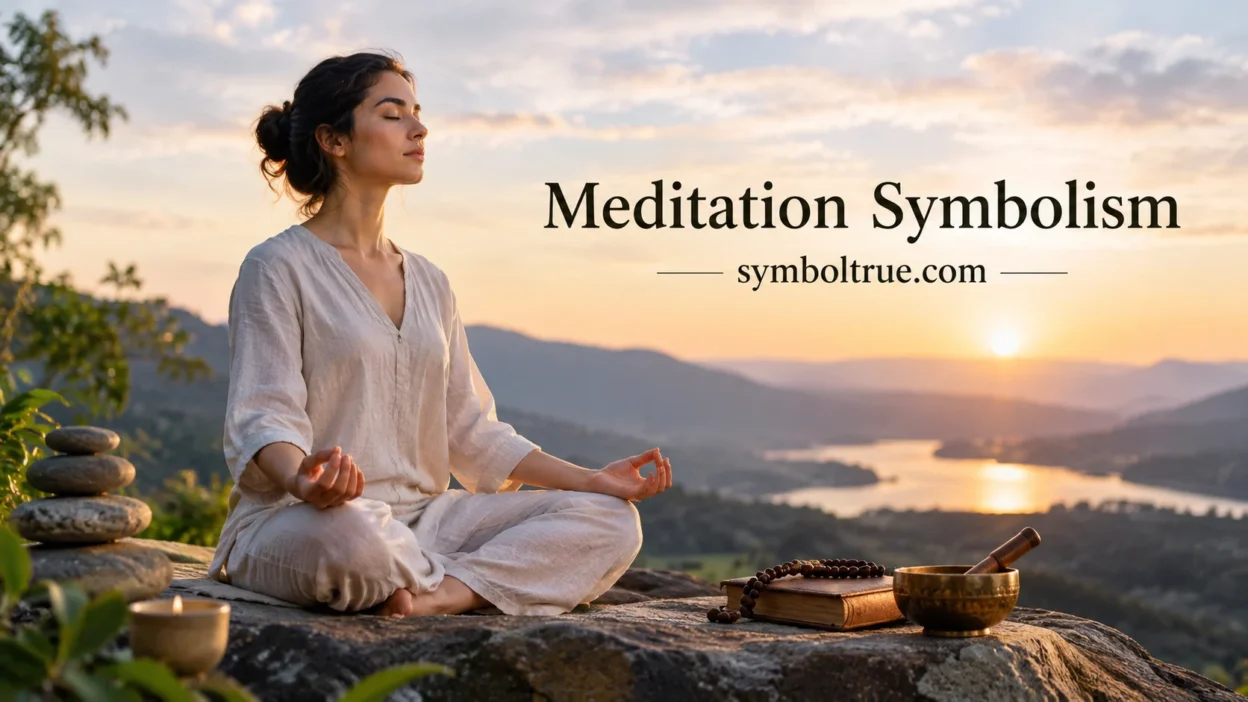
Meditation symbolism reflects ideas of inner peace, awareness, balance, reflection, spiritual growth, and connection with oneself. Across different traditions, meditation has been associated with stillness, focused attention, contemplation, and the search for deeper understanding.
Although the meaning of meditation can vary between religions and cultures, its symbolic themes often center on becoming more aware, quieting distractions, and creating space for reflection.
Meditation Symbolism Meaning (Clear Definition)
Meditation symbolism refers to the meanings and ideas represented by meditation practices, postures, spaces, objects, and visual imagery.
At its simplest level, meditation symbolizes stillness and awareness. A person sitting quietly with closed eyes may represent turning attention inward and temporarily stepping away from external distractions.
Other common symbolic meanings include:
- Inner peace and calm
- Self-awareness
- Spiritual reflection
- Emotional balance
- Discipline and patience
- Focus and concentration
- Personal transformation
- Connection and contemplation
- Letting go of distractions
The exact meaning depends on the cultural, religious, and personal context in which meditation appears.
What Does Meditation Symbolism Represent?
Meditation can represent several related concepts.
Inner Peace
A quiet meditation posture commonly symbolizes calmness and a desire for mental stillness. It can represent creating a peaceful space despite the activity of everyday life.
Self-Awareness
Meditation is often connected with observing thoughts and feelings. Symbolically, this can represent looking inward and becoming more conscious of one’s experiences.
Balance
A centered posture may symbolize balance between body, mind, emotions, and surroundings. This interpretation is especially common in artistic and spiritual representations.
Patience and Discipline
Regular meditation requires intentional practice in many traditions. For this reason, it can symbolize patience, commitment, and gradual personal development.
Transformation
Meditation imagery may also represent an inner journey. The movement from distraction toward awareness can be understood symbolically as a process of personal change.
Spiritual Meaning of Meditation Symbolism
The spiritual meaning of meditation varies significantly across traditions.
In some spiritual practices, meditation is associated with contemplation, prayer, mindfulness, or awareness of a deeper reality. In others, it may emphasize observing experience without attachment or cultivating compassion.
Symbolically, meditation can therefore represent:
- Inner awakening
- Reflection
- Presence
- Spiritual discipline
- Compassion
- Detachment from distractions
- Search for meaning
- Connection with the sacred
These interpretations should not be treated as universal. Meditation has developed through many different traditions, each with its own practices and theological or philosophical foundations.
Biblical / Religious Meaning of Meditation Symbolism
Meditation has different meanings across religious traditions, so its symbolism should be considered within its specific context.
In Christianity, biblical references to meditation generally involve thoughtful reflection on God’s teachings, words, or works rather than necessarily describing modern mindfulness practices. Biblical passages such as Psalm 1:2 and Joshua 1:8 are commonly associated with meditation on divine instruction.
In Buddhism, meditation encompasses a wide range of practices connected with mental cultivation, concentration, mindfulness, insight, and compassion.
In Hindu traditions, meditation has developed through diverse philosophical and spiritual systems and may be associated with concentration, contemplation, self-knowledge, or spiritual liberation.
Islam also has traditions of reflection, remembrance, contemplation, and devotion, although these should not automatically be equated with every modern form of meditation.
The important point is that religious meditation is not a single universal practice. Its symbolic meaning depends on the tradition, text, community, and practice being discussed.
Meditation Symbolism in History and Culture
Meditative practices have existed in different forms across Asian religious and philosophical traditions for centuries. Buddhist, Hindu, Jain, Taoist, and other traditions developed distinct approaches to contemplation and mental cultivation.
Meditation later became increasingly familiar in Western societies through religious exchange, philosophical movements, teachers, psychology, wellness practices, and modern mindfulness programs.
Today, meditation can appear in several contexts:
- Religious worship and spiritual practice
- Personal reflection
- Mindfulness programs
- Stress-management practices
- Yoga and wellness settings
- Artistic representations
- Contemporary self-development
Because these contexts differ, the same image of a person meditating can communicate different meanings to different audiences.
Meditation Symbolism in Literature and Art
Meditation frequently appears in literature and visual art as a symbol of reflection, wisdom, solitude, or transformation.
A character sitting quietly may represent a moment of self-discovery or decision-making. In paintings and illustrations, a peaceful meditation scene can create associations with serenity, contemplation, or spiritual searching.
Common artistic elements include:
Lotus Position
The seated lotus or cross-legged posture is widely recognized as meditation imagery. In particular cultural contexts, it may carry religious or philosophical associations beyond simply representing relaxation.
Closed Eyes
Closed eyes can symbolize turning attention inward, although they can also simply communicate concentration or tranquility.
Mountains
Mountains may represent stability, solitude, endurance, or spiritual aspiration when paired with meditation imagery.
Water
Calm water can reinforce themes of peace, clarity, reflection, and emotional stillness.
Light
Soft light, sunrise, or a glowing background may symbolize hope, awareness, insight, or spiritual discovery.
Meditation Symbolism in Dreams
Dream symbolism is personal and does not have one scientifically established interpretation.
Dreaming about meditation may reflect themes such as:
- A desire for peace
- Need for quiet or personal space
- Self-reflection
- Emotional processing
- Concentration on an important issue
- Desire to escape daily distractions
- A period of personal change
The surrounding details matter. For example, peacefully meditating in a dream may feel very different from being unable to concentrate during meditation.
Rather than assuming one fixed meaning, consider what meditation represents to you and what emotions were present in the dream.
Positive Symbolism of Meditation
Meditation is commonly associated with positive symbolic ideas such as:
Peace: A quiet meditation scene can represent calm and emotional stillness.
Clarity: Meditation may symbolize gaining a clearer perspective.
Focus: Concentration during meditation can represent attention and purposeful thinking.
Growth: The practice can symbolize gradual personal development.
Patience: Sitting quietly and returning attention to the present can represent persistence.
Self-understanding: Meditation imagery may symbolize learning to observe one’s thoughts and feelings.
Negative or Hidden Symbolism of Meditation
Meditation imagery does not always have a purely positive meaning.
Depending on the context, it may symbolize:
- Isolation
- Withdrawal
- Avoidance
- Emotional distance
- Excessive introspection
- Difficulty taking action
- Desire to escape responsibilities
For example, a fictional character who constantly retreats into meditation could symbolize avoidance rather than peace.
The surrounding story, emotions, and cultural context are important when interpreting these less obvious meanings.
Common Interpretations of Meditation Symbolism
Here are some common ways meditation symbolism may be understood:
| Symbolic ThemePossible Meaning | |
|---|---|
| Stillness | Peace, reflection, or pause |
| Closed eyes | Inner attention or concentration |
| Cross-legged posture | Meditation, discipline, or spiritual practice |
| Lotus | Spiritual and cultural associations depending on tradition |
| Calm water | Clarity and emotional tranquility |
| Sunrise | Renewal and new beginnings |
| Mountain | Stability, endurance, or aspiration |
| Candle | Focus, contemplation, or spiritual attention |
| Quiet surroundings | Solitude and reflection |
| Deep breathing | Presence and calm |
These are interpretive associations rather than universal definitions.
Why Does Meditation Symbolism Matter Today?
Meditation symbolism remains relevant because modern life often emphasizes constant activity, information, and digital interaction.
Images of stillness can provide a visual contrast to that environment. A person sitting quietly may symbolize the importance of slowing down, paying attention, and creating time for reflection.
Meditation imagery is now common in wellness branding, books, applications, social media, education, healthcare-related communication, and personal development.
Its meaning can therefore extend beyond religion. For some people, it represents mindfulness or relaxation; for others, it represents spiritual practice, philosophical inquiry, or personal reflection.
Frequently Asked Questions About Meditation Symbolism
What is the main symbolism of meditation?
The main symbolic themes of meditation include inner peace, awareness, focus, reflection, balance, patience, and personal growth.
What does meditation symbolize spiritually?
Spiritually, meditation can symbolize contemplation, inner awareness, discipline, awakening, compassion, or connection with the sacred, depending on the tradition.
What does a person meditating symbolize?
A person meditating may symbolize peace, concentration, self-reflection, spiritual practice, or the desire to become more aware.
What does meditation symbolize in dreams?
Meditation in dreams may relate to personal reflection, a desire for peace, emotional processing, or the need for greater focus. Dream meanings are highly personal.
Does meditation have the same meaning in every religion?
No. Different religious and philosophical traditions have developed distinct meditation practices and understandings. The meaning should be interpreted within its specific context.
What does a lotus symbolize in meditation?
The lotus has important symbolic associations in several Asian religious and philosophical traditions. Its meaning can include ideas connected with spiritual development, purity, awakening, or transformation, depending on the tradition.
Is meditation symbolism always positive?
No. In certain artistic, literary, or personal contexts, meditation may symbolize isolation, avoidance, withdrawal, or excessive introspection.
Conclusion
Meditation symbolism commonly represents inner peace, awareness, focus, balance, reflection, patience, and personal transformation. Its deeper meaning, however, depends on the cultural, religious, artistic, or personal context in which it appears.
From ancient contemplative traditions to modern mindfulness imagery, meditation continues to symbolize the human desire to pause, observe, understand, and find meaning within a busy world.

Henry Jack is the Administrator of SymbolTrue, ensuring the website runs smoothly while overseeing content quality, user experience, and daily operations. He is passionate about helping readers explore symbols, meanings, and cultural insights.