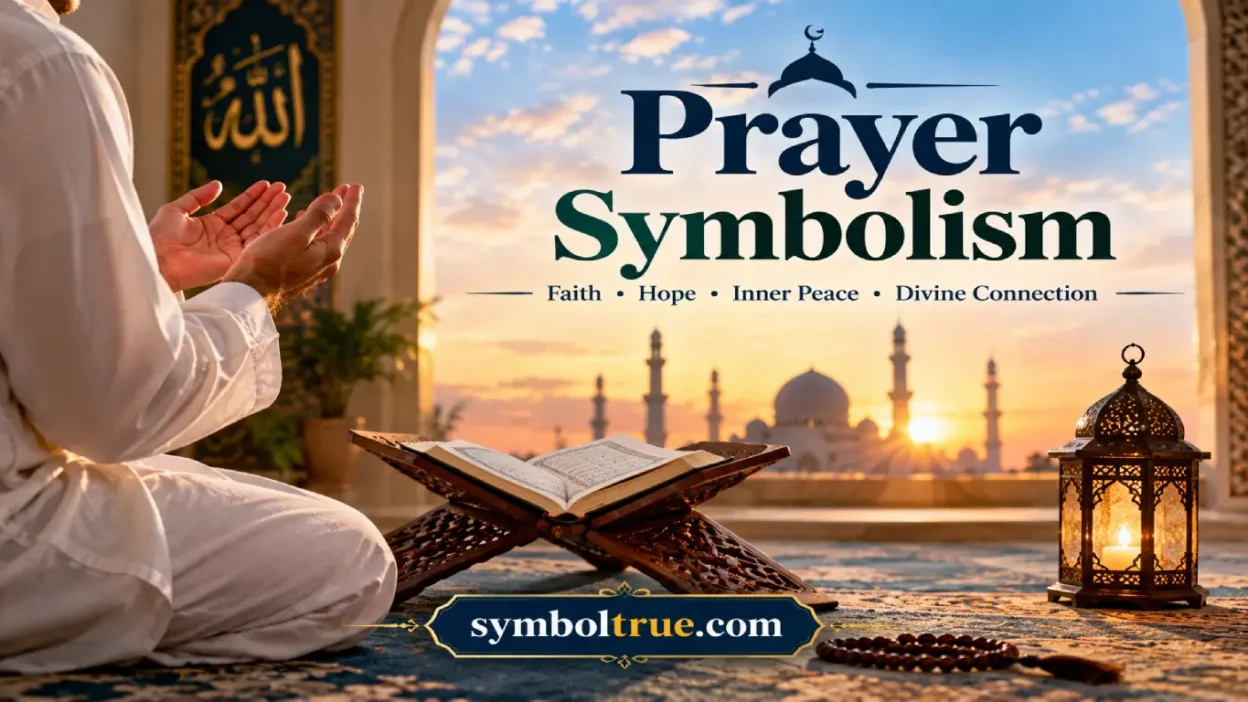
Prayer symbolism carries deep meanings connected with faith, devotion, hope, humility, gratitude, guidance, and spiritual connection. Across religions and cultures, prayer is more than spoken words or a private practice. It can represent a person’s desire to communicate with the Divine, seek strength, express gratitude, or find peace during difficult moments.
Prayer may be expressed through spoken words, silence, gestures, posture, sacred objects, music, or ritual. Because of this variety, prayer symbolism can take many forms while maintaining a central idea of reaching beyond the ordinary and focusing on something sacred or meaningful.
Understanding prayer symbolism can provide insight into spirituality, religion, history, art, dreams, and modern personal practices.
Prayer Symbolism Meaning (Clear Definition)
Prayer symbolism refers to the meanings represented by prayer, prayer gestures, sacred practices, and objects associated with spiritual communication. At its core, prayer commonly symbolizes faith, humility, hope, devotion, gratitude, guidance, and a desire for connection with the Divine.
Prayer can symbolize:
- Faith — trusting in a higher power
- Hope — looking toward comfort or a better future
- Humility — recognizing one’s limitations
- Gratitude — expressing thankfulness
- Guidance — seeking wisdom and direction
- Devotion — dedicating oneself to a spiritual path
- Repentance — acknowledging mistakes and seeking forgiveness
- Peace — finding calm through spiritual reflection
The meaning of prayer symbolism can differ according to religious tradition, personal beliefs, cultural background, and the circumstances in which prayer takes place.
What Does Prayer Symbolism Represent?
Prayer symbolism often represents the human desire to connect with something greater than oneself. It can provide a meaningful way to express emotions that may be difficult to communicate through ordinary language.
Faith and Trust
Prayer often represents trust in a higher power. A person may pray during uncertainty because prayer provides a way to express faith even when the outcome is unknown.
Hope and Comfort
Many people turn to prayer during difficult periods. In this context, prayer can symbolize hope, emotional comfort, resilience, and the belief that hardship can be endured.
Humility and Surrender
Prayer can involve acknowledging that not everything is under human control. Kneeling, bowing, or lowering the head may symbolize humility and surrender.
Gratitude
Prayer is not always about asking for something. Many traditions include prayers of thanksgiving, making gratitude an important part of prayer symbolism.
Guidance and Wisdom
Prayer can represent a search for direction. People may pray before making important decisions or when they feel uncertain about their path.
| Prayer Symbol or Practice | Common Symbolic Meaning |
|---|---|
| Folded hands | Devotion, focus, surrender |
| Kneeling | Humility and reverence |
| Bowed head | Respect and reflection |
| Raised hands | Praise, openness, supplication |
| Closed eyes | Concentration and inward reflection |
| Prayer beads | Repetition, remembrance, spiritual discipline |
| Candle during prayer | Hope, light, remembrance |
| Silence | Contemplation and spiritual listening |
Spiritual Meaning of Prayer Symbolism
The spiritual meaning of prayer symbolism is closely connected with inner connection, reflection, devotion, and awareness of the sacred.
Prayer can create a pause between everyday responsibilities and spiritual concerns. During that pause, a person may reflect on gratitude, personal struggles, relationships, forgiveness, or purpose.
Prayer can also symbolize surrender. Rather than attempting to control every outcome, a person may express trust in a higher wisdom or Divine will.
Another important meaning is transformation. Regular prayer may encourage patience, compassion, forgiveness, self-awareness, and a deeper sense of purpose.
In this way, prayer symbolism is not only about speaking. It can also symbolize listening, reflecting, accepting, and changing.
Biblical / Religious Meaning of Prayer Symbolism
Prayer has an important place in many religious traditions, including Christianity, Islam, Judaism, Hinduism, Buddhism, and other faiths. Although forms of prayer differ, many traditions use prayer to express devotion, gratitude, repentance, praise, or a request for guidance.
In Christianity, prayer is commonly associated with communication with God. Biblical prayers include praise, thanksgiving, confession, requests, intercession, and expressions of trust.
In Islam, salah is the formal ritual prayer performed at prescribed times, while dua refers broadly to supplication or calling upon Allah. Prayer can therefore represent worship, submission, remembrance, and spiritual discipline.
In Judaism, prayer has long been an important part of worship and communal religious life, including blessings, thanksgiving, praise, and petitions.
Other religious traditions have their own prayer practices, such as mantras, meditation, chanting, devotional recitation, or ritual offerings.
Because prayer exists in many forms, its symbolism should be understood within the specific religious tradition being discussed.
Prayer Symbolism in History and Culture
Prayer has been part of human religious and cultural life for thousands of years. Ancient civilizations developed different ways to communicate with their deities, ancestors, or sacred forces.
Historical prayer practices have included spoken prayers, songs, chants, offerings, gestures, kneeling, standing, prostration, and silent contemplation.
Religious buildings also developed spaces specifically designed for prayer. Mosques, churches, synagogues, temples, shrines, monasteries, and other sacred places often use architecture to create an atmosphere suitable for spiritual reflection.
Prayer traditions can also reflect local culture. Clothing, music, language, gestures, prayer objects, and communal customs may differ greatly between societies.
Despite these differences, prayer has repeatedly served as a way for communities and individuals to express their deepest spiritual concerns.
Prayer Symbolism in Literature and Art
Prayer is a powerful theme in literature and art because it can communicate hope, desperation, devotion, grief, gratitude, and inner conflict.
Paintings and sculptures often portray people kneeling, standing with raised hands, closing their eyes, or gathering in communal prayer. These gestures immediately communicate spiritual intention.
In literature, prayer may reveal a character’s private thoughts. A character who prays during a crisis may be expressing fear, hope, guilt, trust, or a desire for guidance.
Poetry frequently uses prayer-like language to explore questions about existence, love, suffering, mortality, and the search for meaning.
Prayer symbolism can therefore function on two levels: it may represent religious devotion while also expressing universal human emotions.
Dream Meaning of Prayer Symbolism
Dreams involving prayer can have different meanings depending on the dreamer’s experiences, emotions, beliefs, and circumstances. There is no single interpretation that applies to every prayer dream.
Possible symbolic associations include:
- Praying in a dream: May represent a desire for guidance, comfort, protection, or emotional support.
- Praying with others: Can symbolize community, belonging, shared faith, or a need for connection.
- Praying alone: May reflect personal reflection, private concerns, or a desire for inner peace.
- Unable to pray: Could symbolize feelings of uncertainty, emotional difficulty, distraction, or spiritual questioning.
- Someone praying for you: May represent support, care, hope, or the feeling that someone is concerned about you.
- Praying during a crisis: Can symbolize fear, vulnerability, hope, or a search for strength.
- Feeling peaceful while praying: May reflect emotional acceptance, comfort, or spiritual reassurance.
Dream symbolism is personal rather than predictive. The emotions and circumstances surrounding the dream are often more meaningful than a fixed interpretation.
Modern Meaning of Prayer Symbolism
In modern life, prayer continues to have religious, personal, and cultural significance. People may pray in traditional places of worship or in private spaces at home, while traveling, or during significant life events.
Prayer may be part of weddings, funerals, celebrations, religious holidays, family traditions, and moments of personal difficulty.
For many people, prayer is also connected with mindfulness, reflection, gratitude, and emotional balance. However, its meaning remains deeply influenced by the individual’s religious or spiritual beliefs.
Digital technology has also changed how some communities practice prayer. People may participate in online religious gatherings, use prayer applications, listen to recorded prayers, or connect with faith communities from different parts of the world.
Despite these changes, the fundamental symbolism remains familiar: prayer creates a deliberate moment to express what matters most.
Frequently Asked Questions About Prayer Symbolism
What does prayer symbolize?
Prayer commonly symbolizes faith, hope, humility, devotion, gratitude, guidance, forgiveness, and spiritual connection. Its meaning varies across religions and individual experiences.
What is the spiritual meaning of prayer?
Spiritually, prayer can symbolize communication with the Divine, inner reflection, surrender, gratitude, and a search for guidance or peace.
What do folded hands symbolize in prayer?
Folded hands can symbolize devotion, concentration, humility, and surrender. Their exact meaning can vary according to cultural and religious traditions.
What does praying in a dream symbolize?
Praying in a dream may represent a desire for guidance, comfort, protection, hope, or emotional support. Personal circumstances are important when interpreting such dreams.
Why is prayer important in religious symbolism?
Prayer represents a direct expression of faith and devotion in many religions. It can symbolize the relationship between individuals, communities, and the Divine.
Conclusion
Prayer symbolism reflects some of the deepest human experiences: faith, hope, gratitude, humility, uncertainty, and the search for meaning. Whether expressed through silence, words, gestures, sacred rituals, or communal worship, prayer creates a space for spiritual connection and reflection.
At its heart, prayer symbolizes the willingness to pause, look beyond oneself, and place trust in something greater. Its enduring presence across cultures shows how powerful the human desire for hope, guidance, peace, and connection can be.
Henry Jack is the Administrator of SymbolTrue, ensuring the website runs smoothly while overseeing content quality, user experience, and daily operations. He is passionate about helping readers explore symbols, meanings, and cultural insights.