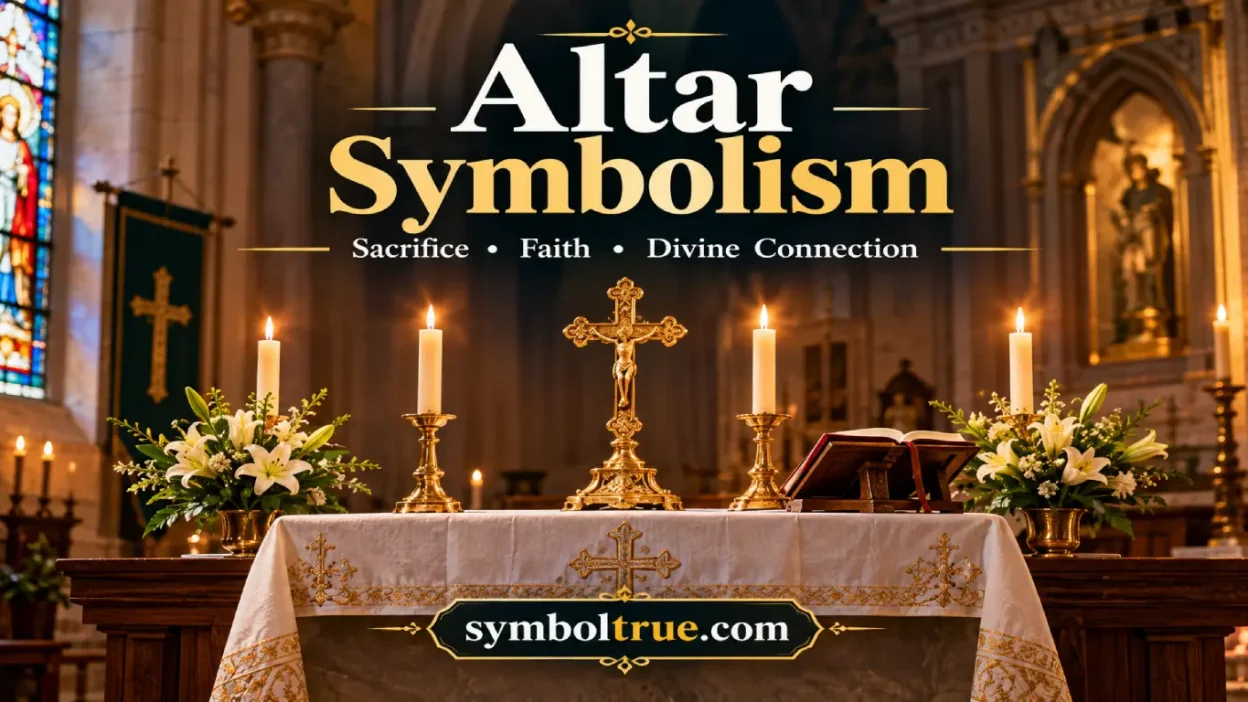
Altar symbolism carries deep meanings connected with devotion, sacrifice, prayer, sacred space, remembrance, and spiritual transformation. Across different religions and cultures, an altar can serve as a meaningful focal point where people express faith, gratitude, hope, mourning, or commitment.
Although altars differ greatly in appearance and religious purpose, they often share a central idea: creating a dedicated space where ordinary life meets spiritual meaning. Candles, flowers, offerings, sacred objects, incense, or religious symbols may add further layers of meaning.
Understanding altar symbolism can reveal how people have used sacred spaces throughout history and why the image of an altar continues to appear in religion, art, literature, dreams, and modern life.
Altar Symbolism Meaning (Clear Definition)
Altar symbolism refers to the spiritual, religious, cultural, and emotional meanings associated with an altar. An altar commonly symbolizes devotion, sacrifice, prayer, offering, remembrance, and connection with the sacred.
In many traditions, an altar provides a physical focal point for religious practices. It may be used for prayer, offerings, ceremonies, rituals, or remembrance.
Common meanings associated with an altar include:
- Devotion — dedication to a spiritual path or higher purpose
- Sacrifice — giving something valuable for a meaningful purpose
- Prayer — creating a focused place for spiritual communication
- Offering — presenting gifts, gratitude, or intentions
- Remembrance — honoring people, events, or spiritual traditions
- Transformation — marking an important spiritual or personal change
- Commitment — expressing dedication to a belief, relationship, or purpose
The precise meaning of an altar depends on the religion, culture, historical setting, and way it is being used.
What Does Altar Symbolism Represent?
Altar symbolism often represents the human desire to create a dedicated space for what is considered sacred or deeply meaningful.
Sacrifice and Giving
One of the strongest associations with altars is sacrifice. Historically, offerings placed on altars could represent gratitude, devotion, repentance, or a desire to honor a deity or sacred principle.
Symbolically, sacrifice can also mean letting go of something in order to pursue a greater purpose.
Prayer and Devotion
An altar can provide a physical focus for prayer. It may remind a person to pause, reflect, and direct attention toward spiritual concerns.
Sacred Connection
An altar separates a particular space from ordinary surroundings. This distinction can symbolize the relationship between everyday life and the sacred.
Remembrance
Memorial altars can preserve the memory of loved ones, historical events, ancestors, or important religious traditions.
Transformation
Because altars are often associated with ceremonies and major life events, they can symbolize transition. They may represent leaving one stage of life behind and entering another.
| Altar SymbolCommon Symbolic Meaning | |
|---|---|
| Candles | Light, hope, prayer, remembrance |
| Flowers | Beauty, life, renewal, mortality |
| Incense | Prayer, purification, spiritual atmosphere |
| Bread or food | Offering, nourishment, gratitude |
| Water | Cleansing, renewal, life |
| Sacred texts | Wisdom, guidance, religious teaching |
| Cross or religious emblem | Faith, devotion, sacred identity |
| Personal objects | Memory, connection, honoring someone |
Spiritual Meaning of Altar Symbolism
The spiritual meaning of altar symbolism centers on intentional devotion. An altar creates a physical reminder that spiritual life requires attention, reflection, and commitment.
For some people, an altar represents a place of stillness. It can encourage prayer, meditation, gratitude, or contemplation.
The altar may also symbolize surrender. Placing an offering on an altar can represent giving up control, expressing trust, or dedicating something important to a higher purpose.
Another important theme is transformation. Religious ceremonies held around altars often mark beginnings, endings, commitments, or changes in spiritual identity.
In this sense, altar symbolism can remind people that meaningful transformation often involves both receiving and releasing.
Biblical / Religious Meaning of Altar Symbolism
Altars have significant roles in several religious traditions, including Judaism and Christianity. In the Hebrew Bible, altars appear in accounts involving worship, offerings, covenant, thanksgiving, and encounters with God.
Figures such as Noah, Abraham, Isaac, Jacob, and Moses are associated with altar-building or altar-related worship. These biblical accounts give the altar meanings connected with devotion, obedience, gratitude, sacrifice, and remembrance.
In Christianity, the meaning of an altar varies according to denomination and tradition. In many churches, the altar is associated with worship, prayer, communion, sacrifice, and the central message of Christian faith.
Altars also appear in other religious traditions, although their forms and meanings differ. In some cultures, they are used for offerings, ancestor remembrance, meditation, or honoring sacred figures.
Therefore, there is no single universal meaning of an altar. Its symbolism should always be understood within its particular religious and cultural context.
Altar Symbolism in History and Culture
The use of altars stretches back thousands of years. Ancient civilizations developed dedicated spaces for offerings, sacrifices, prayers, and ceremonies.
Altars have been found or described in connection with ancient Egyptian, Greek, Roman, Jewish, and many other religious traditions. Their designs differed according to local beliefs, materials, rituals, and artistic customs.
In ancient societies, an altar could serve as a central point for communal religious ceremonies. Offerings might include food, drink, incense, flowers, animals, or other objects considered appropriate to a particular tradition.
Over time, altars also became important parts of religious architecture. Their location, decoration, materials, and surrounding artwork could communicate important theological ideas.
The continued presence of altars across cultures demonstrates how people have long used physical spaces to express invisible spiritual ideas.
Altar Symbolism in Literature and Art
Altars are powerful symbols in literature and visual art because they can represent sacrifice, devotion, love, loss, temptation, commitment, and transformation.
In paintings, an altar may establish a sacred atmosphere or draw attention to a religious story. Religious artwork frequently places important figures, objects, or events around an altar to emphasize devotion and spiritual significance.
In literature, the altar can have both religious and metaphorical meanings. A character may metaphorically “place something on the altar” to suggest sacrifice or surrender.
Wedding imagery provides another familiar example. The altar can represent commitment, partnership, promises, and a major transition in life.
Memorial art may also use altar-like arrangements of candles, flowers, photographs, or personal objects to symbolize remembrance and continuing emotional connection.
Dream Meaning of Altar Symbolism
Dreams involving altars can have different meanings depending on the dreamer’s personal beliefs, emotions, experiences, and the details of the dream. There is no single interpretation that applies to everyone.
Possible symbolic associations include:
- Seeing an altar: May represent spirituality, devotion, reflection, or an important personal commitment.
- Praying at an altar: Can suggest a desire for guidance, comfort, forgiveness, or spiritual connection.
- Lighting candles on an altar: May symbolize hope, remembrance, intention, or seeking clarity.
- A beautiful altar: Could reflect feelings of peace, reverence, gratitude, or spiritual inspiration.
- A broken altar: May represent disruption, disappointment, changing beliefs, or a sense of spiritual uncertainty.
- Building an altar: Can symbolize creating a meaningful foundation, honoring something important, or beginning a new spiritual chapter.
- Leaving something on an altar: May suggest sacrifice, surrender, or letting go of something emotionally significant.
Dream interpretation is personal rather than predictive. The emotions experienced during the dream and the individual’s real-life circumstances can be especially important.
Modern Meaning of Altar Symbolism
In modern life, altar symbolism extends beyond traditional religious buildings. People may create small sacred or reflective spaces in homes, meditation rooms, memorial settings, or cultural ceremonies.
A modern personal altar might contain candles, photographs, flowers, meaningful stones, religious objects, books, or other items connected with memory and intention.
For some people, such a space represents prayer and faith. For others, it may serve as a place for meditation, remembrance, gratitude, or personal reflection.
Altars can also appear at weddings, funerals, memorials, cultural celebrations, and public commemorations. In these settings, the altar often becomes a visual expression of shared values, memory, love, or commitment.
The modern meaning of an altar therefore remains connected to its oldest function: creating a dedicated space for something considered deeply important.
Frequently Asked Questions About Altar Symbolism
What does an altar symbolize?
An altar commonly symbolizes devotion, sacrifice, prayer, offering, remembrance, commitment, and connection with the sacred.
What is the spiritual meaning of an altar?
Spiritually, an altar can represent a dedicated place for prayer, reflection, surrender, gratitude, and transformation. Its meaning varies between religious and cultural traditions.
What does an altar symbolize in the Bible?
In the Bible, altars are associated with worship, offerings, sacrifice, thanksgiving, covenant, and devotion to God. Their meaning can vary depending on the specific biblical account.
What does seeing an altar in a dream mean?
Seeing an altar in a dream may symbolize faith, commitment, sacrifice, spiritual reflection, or an important personal transition. The interpretation depends on the dream’s details and the dreamer’s circumstances.
What do candles on an altar symbolize?
Candles on an altar can symbolize light, hope, prayer, remembrance, spiritual awareness, or the presence of a sacred intention, depending on the tradition.
Conclusion
Altar symbolism brings together some of humanity’s oldest spiritual ideas: devotion, sacrifice, prayer, remembrance, offering, and transformation. Whether found in a place of worship, a work of art, a historical tradition, or a personal dream, an altar represents the act of setting something meaningful apart.
At its deepest level, an altar can remind us to pause, reflect, honor what matters, and approach important moments with intention and reverence.

Henry Jack is the Administrator of SymbolTrue, ensuring the website runs smoothly while overseeing content quality, user experience, and daily operations. He is passionate about helping readers explore symbols, meanings, and cultural insights.