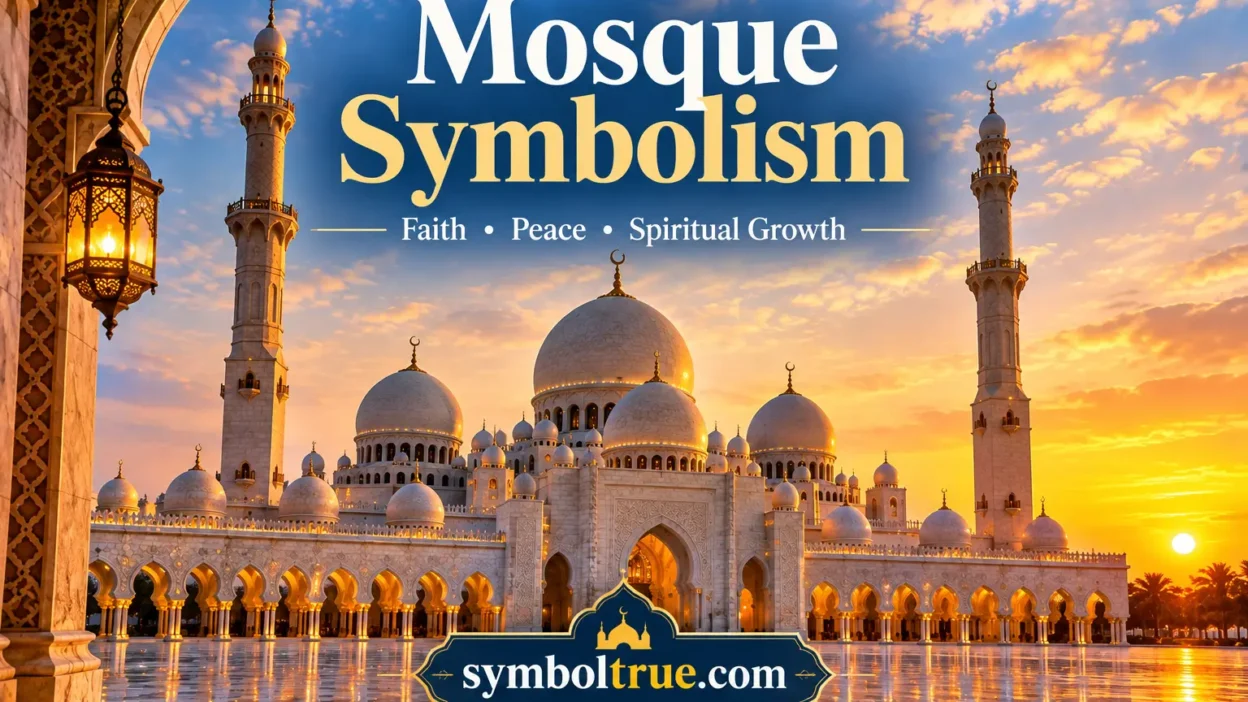
Mosque symbolism carries deep meanings connected with faith, worship, community, peace, guidance, and spiritual connection. A mosque is more than a physical building; it is a sacred space where Muslims gather to pray, remember Allah, seek knowledge, and strengthen their relationship with their faith.
Across different cultures and historical periods, mosques have developed distinctive architectural features and artistic traditions. Domes, minarets, arches, prayer halls, courtyards, geometric patterns, and calligraphy can all carry religious, cultural, or symbolic significance.
Understanding mosque symbolism can therefore provide insight into Islamic spirituality, history, architecture, dreams, literature, and modern culture.
Mosque Symbolism Meaning (Clear Definition)
Mosque symbolism refers to the religious, spiritual, cultural, and architectural meanings associated with a mosque. At its heart, a mosque symbolizes a place of worship, devotion, community, peace, and remembrance of Allah.
The Arabic word masjid is associated with the idea of a place of prostration. This reflects the central purpose of the mosque: a place where worshippers humble themselves before Allah through prayer and devotion.
A mosque can symbolically represent:
- Faith and devotion
- Peace and spiritual calm
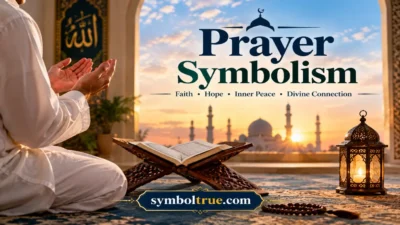
- Prayer and worship
- Unity and community
- Guidance and knowledge
- Humility before Allah
- Belonging and fellowship
- Hope and spiritual renewal
The exact symbolism can vary according to the culture, architecture, historical period, and personal experience connected with a particular mosque.
What Does Mosque Symbolism Represent?
Mosque symbolism commonly represents the connection between human beings, worship, and the Divine. It can also symbolize the importance of community in Islamic life.
Faith and Devotion
A mosque is primarily a place of worship. Seeing or thinking about a mosque can therefore represent dedication to faith, prayer, and spiritual practice.
Peace and Tranquility
The quiet atmosphere of a mosque can symbolize inner peace. For many people, the image of a mosque evokes feelings of calm, reflection, and relief from everyday concerns.
Community and Unity
Mosques bring people together for daily prayers, Friday prayer, Ramadan activities, religious education, charity, and community events. Because of this, a mosque can symbolize unity and belonging.
Guidance and Knowledge
Historically, mosques have also served as places of learning. They can therefore represent the search for religious knowledge, wisdom, guidance, and personal growth.
Humility
The act of prostration during prayer is an important expression of humility and submission to Allah. Mosque symbolism can consequently represent surrendering pride and remembering one’s spiritual responsibilities.
| Symbolic ElementCommon Symbolic Meaning | |
|---|---|
| Mosque building | Faith, worship, community |
| Prayer hall | Devotion, humility, spiritual focus |
| Minaret | Call to prayer and religious identity |
| Dome | Architectural expression and spiritual aspiration |
| Mihrab | Direction toward the Kaaba and prayer |
| Courtyard | Community, openness, and gathering |
| Islamic calligraphy | Faith, remembrance, and sacred words |
| Geometric patterns | Order, beauty, and artistic tradition |
Spiritual Meaning of Mosque Symbolism
The spiritual meaning of mosque symbolism is closely connected with worship, remembrance, humility, and the search for closeness to Allah.
A mosque can represent a spiritual refuge from the noise and pressures of everyday life. Entering a mosque is often associated with leaving worldly distractions behind and focusing the heart and mind on worship.
The mosque can also symbolize a spiritual journey. A person may enter seeking forgiveness, guidance, peace, knowledge, or renewed faith.
In a broader sense, mosque symbolism can remind a person that spirituality is not only about private belief. It can also involve community, compassion, discipline, charity, learning, and service to others.
Biblical / Religious Meaning of Mosque Symbolism
The mosque is an Islamic institution and does not have a specific biblical symbolism. The Bible predates the historical emergence of Islam, so biblical references to mosques do not exist.
Within Islam, however, mosques hold major religious significance. The Quran describes mosques as places where the name of Allah is remembered and worship is performed.
The concept of the mosque is particularly associated with prayer and devotion. Muslims face the Kaaba in Makkah during formal prayer, making orientation an important aspect of mosque design.
Some mosques also have a mihrab, a niche indicating the direction of prayer, known as the qiblah. The mihrab therefore has an important religious and architectural meaning.
The mosque should not be understood as a sacred object itself. Rather, it is a dedicated place for worship, remembrance, learning, and community life.
Mosque Symbolism in History and Culture
Mosques have played important roles in Muslim societies for centuries. While their basic purpose is worship, their cultural functions have often extended into education, community organization, charity, and public life.
Early mosques were generally simple spaces, while later Islamic civilizations developed distinctive architectural traditions.
Different regions developed their own styles. Ottoman mosques, Persian mosques, Mughal mosques, North African mosques, and Southeast Asian mosques can look dramatically different while serving similar religious purposes.
Architectural elements such as domes, minarets, courtyards, arches, tiles, stonework, woodwork, and calligraphy became important expressions of regional artistic traditions.
The mosque therefore symbolizes both shared Islamic faith and the cultural diversity of Muslim communities around the world.
Mosque Symbolism in Literature and Art
Mosques frequently appear in literature, poetry, paintings, photography, architecture, and contemporary visual art.
In artistic representations, a mosque may symbolize spirituality, home, cultural identity, memory, or a connection to one’s heritage.
A mosque beneath a peaceful sky may communicate tranquility and hope. A historic mosque may represent the endurance of tradition and the passage of generations.
Islamic art associated with mosques often emphasizes calligraphy, geometric patterns, arabesque designs, symmetry, and architectural beauty. These elements can create an atmosphere of order and contemplation without relying on human or animal imagery in sacred architectural contexts.
In literature, a mosque can also serve as a setting for moments of reflection, community, celebration, grief, or personal transformation.
Dream Meaning of Mosque Symbolism
Dream interpretations are personal and can vary according to an individual’s experiences, beliefs, emotions, and circumstances. There is no single interpretation that applies to every dream involving a mosque.
Common symbolic associations may include:
- Seeing a mosque: A possible association with faith, reflection, guidance, or spiritual concerns.
- Entering a mosque: May represent a desire for peace, worship, belonging, or spiritual renewal.
- Praying in a mosque: Can reflect devotion, hope, humility, or a wish for guidance.
- A beautiful mosque: May symbolize admiration for faith, peace, beauty, or spiritual aspirations.
- An empty mosque: Could represent loneliness, reflection, distance from community, or a personal spiritual concern.
- A damaged mosque: May symbolize feelings of loss, disruption, or concern about something personally meaningful.
- Building a mosque: Can represent service, community, generosity, or a desire to create something meaningful.
Dream symbolism should not be treated as a guaranteed prediction of future events. Personal context is usually more important than any universal dream dictionary.
Modern Meaning of Mosque Symbolism
Today, mosque symbolism continues to connect religious devotion with community, identity, education, charity, and cultural heritage.
Modern mosques can be found in almost every region of the world, and their architecture often reflects the local environment while maintaining important Islamic traditions.
For Muslims, a mosque may represent a place to pray, learn, meet others, participate in Ramadan, attend Friday prayer, or contribute to charitable activities.
For visitors and observers, mosque architecture can also represent Islamic history, artistic achievement, cultural diversity, and religious identity.
In modern society, the mosque can therefore carry both spiritual and cultural meanings. Its significance may extend beyond its walls through education, community service, charitable work, and social connection.
Frequently Asked Questions About Mosque Symbolism
What does a mosque symbolize?
A mosque commonly symbolizes worship, faith, humility, peace, community, guidance, and remembrance of Allah. It can also represent belonging and spiritual reflection.
What does a mosque symbolize spiritually?
Spiritually, a mosque can symbolize devotion, inner peace, humility, prayer, and the desire to strengthen one’s relationship with Allah.
What does seeing a mosque in a dream mean?
Seeing a mosque in a dream may be associated with faith, guidance, peace, reflection, or spiritual concerns. The meaning depends heavily on the dreamer’s personal circumstances and emotions.
What do mosques represent in Islamic culture?
Mosques represent places of worship and community while often serving broader roles in education, charity, religious learning, and cultural life.
What does a mosque represent in art?
In art, a mosque can represent spirituality, peace, cultural identity, heritage, community, and architectural beauty. Its meaning often depends on the artistic context.
Conclusion
Mosque symbolism reflects some of the deepest themes of Islamic life: faith, worship, humility, peace, knowledge, community, and remembrance of Allah. Whether encountered in architecture, history, art, culture, or a personal dream, the image of a mosque can inspire reflection on spirituality and the importance of belonging to a community.
At its heart, a mosque symbolizes a place where people pause from worldly distractions, turn toward worship, and seek peace, guidance, and connection through faith.

Henry Jack is the Administrator of SymbolTrue, ensuring the website runs smoothly while overseeing content quality, user experience, and daily operations. He is passionate about helping readers explore symbols, meanings, and cultural insights.