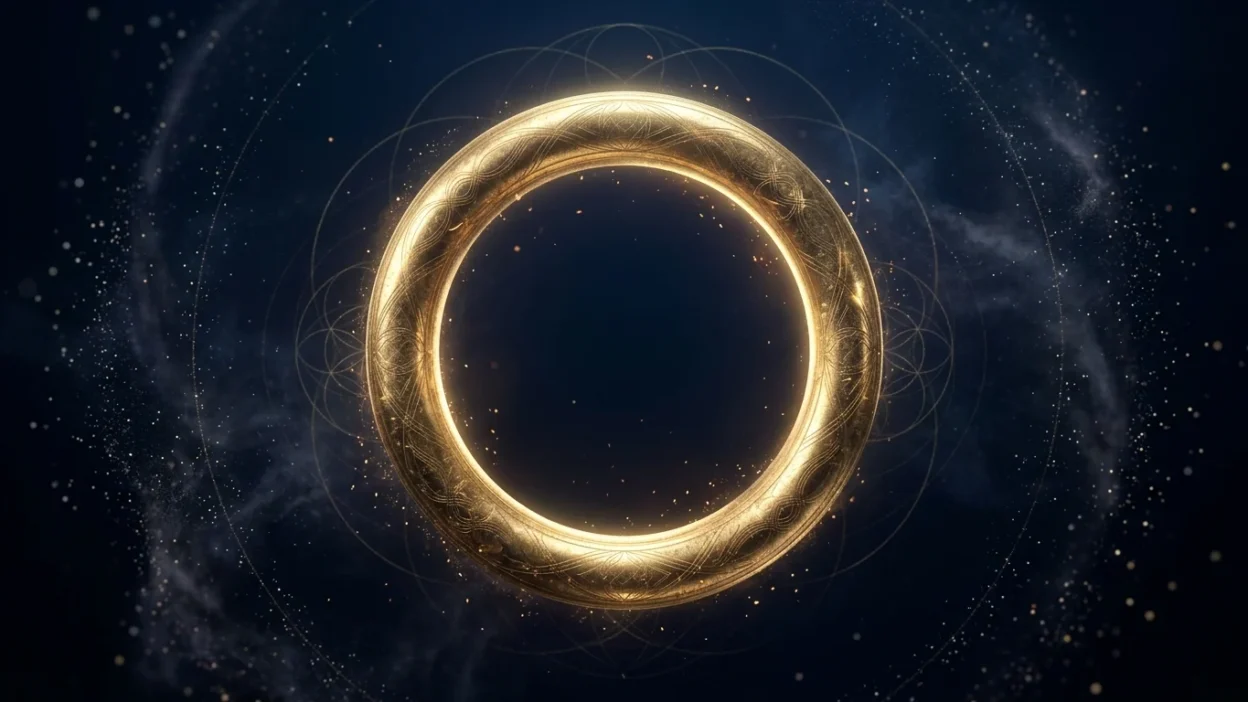
Circle symbolism represents wholeness, unity, eternity, balance, and the cycles of life.
A circle has no visible beginning or ending, making it a powerful symbol of continuity, completeness, and connection.
Across different contexts, it can represent the sun, the moon, family bonds, spiritual unity, protection, and the natural rhythms of existence.
The circle is also one of the simplest and most recognizable shapes in human life. It appears in nature, architecture, religious art, jewelry, logos, and everyday objects. Its meaning changes depending on the culture, tradition, and situation in which it appears.
Understanding circle symbolism helps explain why this shape has remained meaningful in art, spirituality, philosophy, and personal expression. Although some interpretations have deep historical roots, others are modern or personal associations rather than universal beliefs.
Circle Symbolism Meaning (Clear Definition)
Circle symbolism refers to the meanings people associate with the circular shape, including completeness, unity, eternity, harmony, protection, and life’s recurring cycles.
Unlike a line with two distinct endpoints, a circle forms a continuous closed shape. This visual quality makes it a natural representation of things that seem connected, complete, or ongoing.
Common meanings of circle symbolism include:
- Wholeness: Feeling complete or recognizing the relationship between different parts of life.
- Unity: Bringing people, ideas, or experiences together.
- Eternity: Representing something without a clear beginning or ending.
- Balance: Suggesting harmony, proportion, and stability.
- Protection: Creating a symbolic boundary around a person, place, or object.
- Cycles: Representing recurring patterns in nature and human experience.
- Connection: Expressing relationships, belonging, and shared identity.
- Renewal: Reflecting repeated processes of change and regeneration.
These interpretations are not fixed rules. A circle in a wedding ring may symbolize commitment, while a circle in a diagram may simply organize information. Context determines which meaning is most appropriate.
What Does Circle Symbolism Represent?
The circle can represent several important ideas because of its continuous shape and lack of corners or endpoints.
1. Wholeness and Completeness
One of the most common interpretations of a circle is wholeness. Its continuous boundary creates the impression of a complete form without a missing section.
Symbolically, this may represent a sense of personal completeness, the integration of different experiences, or the idea that several parts can form one whole.
For example, a circular design in artwork might represent a person bringing different aspects of their identity together. In a personal context, it could symbolize accepting both strengths and weaknesses.
Wholeness does not necessarily mean perfection. It can simply represent recognizing and accepting the different parts of yourself.
2. Eternity and Continuity
Because a circle has no obvious starting or ending point, it is often used to represent eternity or continuity.
This association appears in jewelry, decorative patterns, artwork, and symbolic designs. A circular ring, for example, can represent a commitment intended to continue over time.
The shape does not prove that something lasts forever. Instead, it offers a visual metaphor for enduring connection and ongoing existence.
3. Unity and Togetherness
A circle can symbolize unity because all points along its boundary belong to the same connected shape.
In social settings, people sitting in a circle may experience the arrangement as a sign of participation and shared attention. Some groups use circular seating to encourage conversation because everyone can see one another more easily.
A circle can also appear in logos, community emblems, and organizational designs to communicate cooperation or collective identity.
4. Balance and Harmony
A circle is symmetrical around its center, which can create a sense of visual balance and order.
In symbolic art, this quality may represent harmony between different parts of life. It can suggest the relationship between work and rest, thought and action, or personal needs and responsibilities.
However, balance is an interpretation of the shape rather than a guaranteed effect. The surrounding design and the viewer’s experience influence how it feels.
5. Protection and Boundaries
A closed circle can represent a boundary that separates an inside from an outside.
In some spiritual, religious, and folkloric practices, circles have been used to mark spaces or create symbolic boundaries. Their specific meaning varies according to the tradition.
In everyday life, a circular fence, enclosure, or arrangement can also communicate the idea of a protected space.
6. Cycles and Renewal
Many natural processes repeat in recognizable patterns. The changing seasons, recurring phases of the moon, and daily movement from sunrise to sunset can all inspire circular imagery.
Although these processes do not always follow perfect geometric circles, the shape offers a simple way to represent repetition and continuity.
A circle may therefore symbolize change that happens in stages, with one phase leading into another.
Spiritual Meaning of Circle Symbolism
The spiritual meaning of circle symbolism often includes wholeness, unity, eternity, balance, and the connection between different aspects of existence.
People may use circles in meditation, spiritual artwork, ceremonial spaces, or personal designs. Their meanings depend on individual beliefs and the traditions in which the symbols are used.
Circle as a Symbol of Wholeness
In some spiritual interpretations, a circle represents the idea that different parts of life belong to a larger whole.
It may encourage people to consider their relationships, values, emotions, and responsibilities as connected rather than completely separate.
For someone exploring personal growth, the circle can serve as a reminder to acknowledge different experiences without defining themselves by only one part of their life.
Circle and the Idea of Eternity
The continuous shape of a circle can represent timelessness or an existence that extends beyond ordinary beginnings and endings.
Some people connect this interpretation with spiritual beliefs about the soul, the universe, or eternal life. These connections vary widely and should not be treated as universal religious teachings.
Circle as a Symbol of Inner Balance
The circle’s visual symmetry can suggest stability and harmony.
As a personal spiritual metaphor, it may encourage reflection on whether your daily actions align with your values. It can also remind you that maintaining balance often requires adjustment rather than reaching a permanently perfect state.
The Circle in Meditation and Contemplation
A simple circular form can provide a focus for meditation or quiet reflection.
Some people concentrate on a circle’s shape, center, or continuous boundary to help direct their attention. In other settings, circular patterns are used as visual aids for contemplation.
There is no single spiritual meaning shared by everyone who uses a circle. Its significance depends on the practice, tradition, and intention involved.
Biblical and Religious Meaning of Circle Symbolism
The Bible does not provide one universal definition of the circle as a symbol. Nevertheless, circular forms and related ideas appear in biblical imagery, religious architecture, and theological interpretations.
It is important to distinguish what a religious text explicitly describes from meanings that people later associate with a shape.
The Circle and God’s Eternal Nature
Some Christian interpretations associate a circle’s lack of endpoints with God’s eternal nature.
This is a symbolic comparison rather than a specific biblical rule declaring the circle to be God’s official symbol.
Biblical passages such as Psalm 90:2 describe God as existing from everlasting to everlasting. Christians may connect the idea of eternity in this passage with a continuous circular shape, but the text itself does not prescribe that visual interpretation.
Circular Imagery in the Bible
Isaiah 40:22 refers to God sitting above the circle of the earth in many English translations. The wording and interpretation of this passage have been discussed in different historical and theological contexts.
It should not automatically be treated as a direct definition of circle symbolism. The passage’s meaning must be considered within its literary, historical, and translation context.
Circles in Other Religious Traditions
Circular forms appear in different religious settings, including Buddhist mandalas, Hindu yantras, and sacred architectural designs.
These forms can have specific meanings tied to their traditions, rituals, and teachings. They should not be treated as interchangeable simply because they contain circles.
The circle’s religious meaning is therefore best understood within the context where it is used.
Circle Symbolism in History and Culture
Circular forms have appeared in human-made objects, architecture, artwork, and ceremonial settings across many periods of history. Their specific meanings differ between communities and historical contexts.
Ancient Circular Structures
Prehistoric and ancient communities built circular structures for different purposes, including dwellings, monuments, gathering places, and ceremonial sites.
Some well-known stone monuments use circular arrangements, but their precise purposes may remain debated or vary by site. It would be inaccurate to assume that every ancient circle represented the same spiritual idea.
Circular structures can reflect practical considerations as well as cultural or ceremonial significance.
The Sun and Moon
The sun and moon appear approximately circular when viewed from Earth. Their shapes have inspired circular imagery in calendars, art, mythology, and religious traditions.
The sun may be associated with light, life, warmth, or authority in particular cultures. The moon can be linked with timekeeping, changing phases, or cycles.
These associations differ across traditions. The circle itself does not have one universal meaning for either celestial body.
Circular Patterns in Traditional Art
Many artistic traditions use circles in textiles, pottery, jewelry, architecture, and decorative patterns.
A circular motif may be decorative, represent a specific cultural idea, or form part of a larger symbolic design.
Understanding such patterns requires attention to their origin and use. Similar-looking circles from different cultures may carry very different meanings.
The Circle in Contemporary Culture
Today, circles appear in company logos, sports emblems, digital icons, road signs, and product design.
Their simple shape can communicate continuity, inclusion, focus, or visual unity. In some cases, a circle is chosen mainly because it is easy to recognize and works well across different sizes.
Modern design uses demonstrate how the circle can be both symbolic and practical.
Circle Symbolism in Literature and Art
In literature and visual art, circles often provide a way to explore ideas about time, identity, relationships, and the structure of human experience.
The Circle as a Symbol of Life
Writers and artists may use circular imagery to represent recurring stages of life.
A story might begin and end in the same place, suggesting that events have come full circle. This structure can imply resolution, repetition, or the return of an unresolved problem.
The interpretation depends on what has changed between the beginning and the ending.
Circles and Relationships
A circle can symbolize a close relationship or a connected community.
In a painting, a group of people arranged in a circle may suggest shared purpose or belonging. In a poem, circular imagery might represent a relationship that continues to influence the speaker.
The meaning becomes clearer when considered alongside the work’s other images and themes.
The Circle as a Symbol of Mystery
Some artists use circles to represent the unknown, the universe, or ideas that cannot easily be explained.
A large circle in an abstract painting might suggest a planet, an opening, a boundary, or an imagined world. Its meaning may remain deliberately open to interpretation.
Circular Designs and Mandalas
Mandalas are structured designs that commonly use circular arrangements. They appear in several religious and artistic traditions, with distinct meanings depending on their cultural and spiritual context.
In some Buddhist and Hindu practices, mandalas serve as meaningful ritual or contemplative forms. In modern art and coloring activities, similar circular patterns may be used primarily for creative expression or relaxation.
Not every circular pattern is a mandala, and not every mandala has the same meaning.
Circle Symbolism in Dreams
Dreams involving circles may bring up ideas about completeness, repetition, boundaries, or relationships. However, there is no scientifically established universal interpretation of a circle in a dream, and dreams should not be treated as reliable predictions of future events.
Your personal experiences and emotions are more useful starting points than a fixed dream dictionary.
Dreaming of a Perfect Circle
A clear, complete circle may remind you of unity, a goal, or a desire for stability.
Consider whether you are bringing a project to completion or trying to create more balance in your life.
Dreaming of a Broken Circle
A broken or incomplete circle may reflect a concern about separation, disruption, or something that feels unfinished.
It could relate to a relationship, an interrupted plan, or a personal goal that needs further attention. It does not necessarily indicate that something bad will happen.
Dreaming of Drawing a Circle
Drawing a circle may suggest an effort to establish order, define a boundary, or bring different ideas together.
Think about what you were drawing and how you felt during the dream. Those details may provide a more personal interpretation.
Dreaming of Being Inside a Circle
Being inside a circle may relate to belonging, safety, or feeling included in a group.
If the circle felt restrictive, it might instead reflect a concern about limitations or pressure. The emotional experience matters more than the shape alone.
Dreaming of Repeating Circles
Repeated circles may bring to mind routines, recurring problems, or patterns that continue over time.
You might consider whether something in your daily life feels repetitive or whether a familiar habit is helping you maintain stability.
Positive Symbolism of the Circle
The circle is often associated with positive qualities because of its continuous shape and balanced appearance.
Common positive interpretations include:
- Wholeness: Accepting different parts of yourself and your life.
- Unity: Building connections and shared understanding.
- Eternity: Representing lasting love, memory, or commitment.
- Harmony: Seeking balance among different responsibilities.
- Protection: Creating a sense of safety or belonging.
- Continuity: Recognizing that experiences influence one another.
- Renewal: Understanding change as part of an ongoing process.
- Community: Representing inclusion and collective identity.
- Completion: Marking the end of a task or stage.
For example, a circular design on a commemorative gift might symbolize a lasting friendship. A circle used in a group activity may help communicate shared participation.
These positive meanings are interpretations rather than guarantees that a circle will bring good fortune or protection.
Negative or Hidden Symbolism of the Circle
Although circles often suggest harmony and connection, they can also represent less comfortable experiences.
Repetition and Feeling Stuck
A circle may symbolize a repeated pattern that never seems to change.
For example, someone who keeps returning to the same unresolved disagreement might use the phrase “going around in circles” to describe the experience.
In this context, circular imagery can represent frustration rather than continuity.
Restriction and Confinement
A circle creates a boundary between its interior and exterior. Depending on the situation, that boundary may feel protective or limiting.
A character surrounded by a circle in a painting might appear secure, isolated, or trapped. The surrounding imagery helps determine the meaning.
Incomplete Wholeness
A broken circle can suggest disruption or separation, especially in artwork or personal designs.
However, an incomplete circle can also symbolize change, openness, or the possibility of something new. It does not automatically carry a negative meaning.
Endless Uncertainty
The idea of an unending cycle may feel unsettling when a person wants a clear conclusion.
A circle can therefore represent a situation that seems impossible to resolve or a question that continues to return.
These interpretations show that the circle is not inherently positive or negative. Its meaning depends on how and why it is used.
Common Interpretations of Circle Symbolism
The meaning of a circle can change depending on its appearance, setting, and accompanying imagery.
| Circular image | Possible symbolic meaning |
| A complete circle | Wholeness, unity, or completion |
| A circle with no visible center | Continuity or endlessness |
| Two interlocking circles | Connection, partnership, or overlap |
| A broken circle | Change, separation, or an unfinished process |
| A circle around a person | Protection, belonging, or restriction |
| A circle with a dot in the center | Focus, origin, or central importance |
| A circle representing the sun | Light, life, or energy in a particular cultural context |
| A circular ring | Commitment, continuity, or personal connection |
| Repeating circular patterns | Cycles, rhythm, or recurring experiences |
| A circle in a dream | A personal association with boundaries, unity, or repetition |
These meanings are general possibilities, not universal definitions. A circle may have a specific meaning in a particular religion, artwork, organization, or personal experience.
Why Does Circle Symbolism Matter Today?
Circle symbolism remains relevant because circles are easy to recognize and can communicate complex ideas through a simple shape.
From personal jewelry to digital interfaces, circular designs continue to appear in daily life. Their symbolic meaning depends on how people use and interpret them.
Personal Identity and Self-Expression
People may choose circular tattoos, pendants, or artwork to represent family, friendship, personal growth, or a meaningful life experience.
A circle can communicate a personal message without requiring a detailed explanation. Its meaning may be private or shared with others.
Relationships and Commitment
Circular rings are widely used in engagement and wedding traditions in many societies. Their continuous form can symbolize an enduring commitment.
The exact customs and meanings vary across cultures, religions, and individuals. The symbolism comes from tradition and personal intention rather than a physical guarantee of permanence.
Art, Branding, and Communication
Designers often use circles in logos and visual layouts because they create a clear, recognizable form.
Depending on the design, a circle can suggest friendliness, connection, movement, or completeness. It can also serve a purely practical purpose by organizing information or drawing attention to an element.
Reflection and Personal Growth
The circle can serve as a reminder to review experiences, recognize recurring habits, and consider how one stage of life connects to another.
Rather than seeing growth as a straight path with one final destination, circular imagery can encourage an understanding of learning as an ongoing process.
Connection With Nature
Circular patterns appear in many natural forms, including the visible shape of the sun and moon, tree rings, ripples in water, and some plant structures.
These examples can inspire appreciation for patterns, cycles, and relationships in the natural world. They also remind us that nature contains many shapes and processes that do not fit a perfect circle.
FAQs:
1. What does a circle symbolize spiritually?
A circle may symbolize wholeness, unity, eternity, balance, and interconnectedness in spiritual contexts. Its meaning depends on the tradition or personal beliefs involved, and there is no single interpretation shared by all spiritual communities.
2. What does a circle mean in the Bible?
The Bible does not assign one universal symbolic meaning to the circle. Some Christians associate circular imagery with eternity or God’s enduring nature, but these are interpretations rather than a single prescribed biblical definition.
3. Why does a circle symbolize eternity?
A circle has no obvious beginning or ending point, making it a useful visual metaphor for something that continues indefinitely. This association appears in various artistic, decorative, and personal uses.
4. What does a circle symbolize in love?
A circle may represent lasting affection, unity, commitment, and a relationship intended to endure. Wedding rings are a familiar example, although their customs and meanings differ among cultures and individuals.
5. What does a circle symbolize in dreams?
A circle in a dream may bring to mind completeness, boundaries, repeated experiences, or a desire for stability. Its meaning depends on your feelings, experiences, and the situation represented in the dream.
6. What does a broken circle symbolize?
A broken circle may represent separation, disruption, change, or something unfinished. In some contexts, it can also suggest openness and new possibilities rather than loss.
7. What is the difference between circle symbolism and mandala symbolism?
Circle symbolism refers broadly to meanings associated with circular shapes. A mandala is a structured design that often uses circular arrangements and has specific roles in certain religious, cultural, and artistic traditions. The two concepts overlap, but they are not interchangeable.
8. Does a circle symbolize good luck?
Some people may associate circles with positive ideas such as harmony, protection, or continuity. However, there is no reliable evidence that a circle universally brings good luck or guarantees a particular outcome.
Conclusion
Circle symbolism represents wholeness, unity, eternity, balance, protection, and the recurring cycles of life. Its continuous form makes it a meaningful image in art, religion, culture, relationships, and personal expression.
Although some interpretations have historical or cultural roots, others depend on individual beliefs and context. Whether it appears in a ring, a painting, a dream, or a natural pattern, the circle invites us to consider how different parts of life connect and how experiences continue to shape our understanding of the world.

Henry Jack is the Administrator of SymbolTrue, ensuring the website runs smoothly while overseeing content quality, user experience, and daily operations. He is passionate about helping readers explore symbols, meanings, and cultural insights.