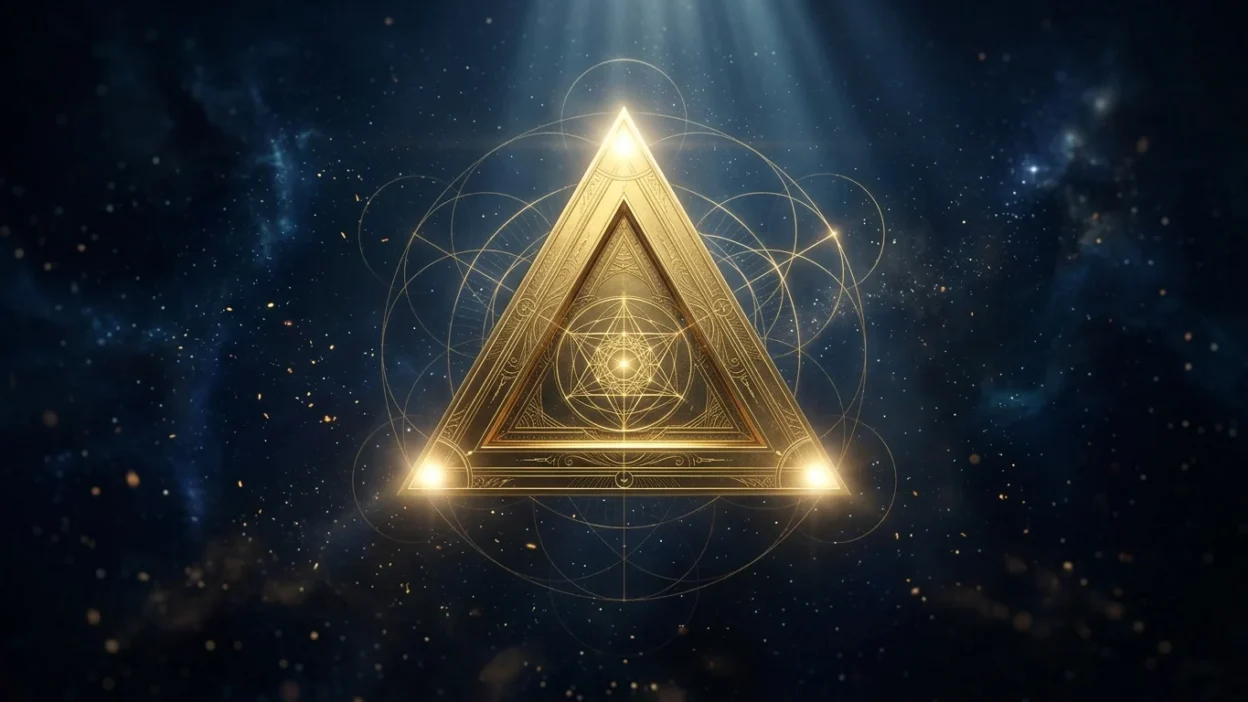
Triangle symbolism is often associated with strength, balance, direction, creativity, and transformation. With three sides and three corners, the triangle can represent the relationship between different forces, ideas, or stages of life. Depending on its shape and cultural context, it may also symbolize spiritual growth, stability, ambition, or the connection between mind, body, and spirit.
Triangles appear throughout nature, architecture, mathematics, religious art, jewelry, and modern design. Their meanings are not universal, however. An upright triangle may have a different interpretation from an inverted one, and a triangle used in a religious tradition may carry a meaning that does not apply to ordinary geometric shapes.Understanding triangle symbolism means exploring its common interpretations while recognizing the difference between documented cultural traditions and personal or spiritual beliefs.
Triangle Symbolism Meaning (Clear Definition)
Triangle symbolism refers to the ideas and meanings people associate with a three-sided geometric shape. Common interpretations include strength, stability, balance, direction, creativity, and the relationship between three connected elements.
The triangle’s structure helps explain some of these associations. Its three sides form a closed shape, while its corners create clear points of direction. Triangles can also be arranged in different ways, giving them a range of possible symbolic meanings.
Common meanings of triangle symbolism include:
- Strength: A triangular structure can distribute forces effectively, making the shape important in engineering and architecture.
- Balance: Three connected points may represent harmony between different elements.
- Growth: An upward-pointing triangle can suggest progress, aspiration, or rising energy in some interpretations.
- Transformation: Three stages may represent a process of change, development, and renewal.
- Unity: Three separate elements can form one connected structure.
- Direction: The triangle’s point can suggest movement, focus, or a goal.
- Creativity: The shape may represent the combination of different ideas or abilities.
- Spiritual connection: Some traditions use triangles to express relationships among spiritual concepts.
These are possible interpretations, not fixed definitions. A triangle on a road sign, for example, may communicate a warning, while a triangle in artwork may represent a much more personal idea.
What Does Triangle Symbolism Represent?
The triangle can represent several ideas because of its geometric structure, orientation, and use in different settings.
1. Strength and Stability
One of the clearest associations of the triangle comes from engineering. Triangular frameworks can resist changes in shape and help distribute loads, which is why triangles are widely used in bridges, roof trusses, and other structures.
This practical strength has also influenced symbolic interpretations. A triangle may represent resilience, reliability, and the ability to remain stable under pressure.
In personal symbolism, it can serve as a reminder that strong foundations and supportive relationships help people navigate challenges.
2. Balance and Harmony
A triangle can represent balance between three elements. For example, someone might use it to symbolize the relationship between work, family, and personal well-being.
In some spiritual or philosophical interpretations, the three points represent connected aspects of existence. The exact meaning depends on the belief system or design.
A triangle does not automatically symbolize harmony, though. An uneven or broken triangle in an artwork could communicate tension, instability, or conflict.
3. Growth and Direction
An upright triangle has a point at the top, which can visually suggest upward movement.
Because of this appearance, some modern symbolic interpretations connect it with ambition, achievement, personal development, and reaching toward a goal.
For example, a triangular logo pointing upward may communicate progress or forward momentum. This meaning comes from the design and its context rather than a universal rule about triangles.
4. Unity of Three Elements
The number three has significance in many cultural, philosophical, and religious systems. A triangle provides a simple visual way to represent three connected ideas within one structure.
Possible examples include:
- Mind, body, and spirit.
- Past, present, and future.
- Beginning, middle, and end.
- Birth, life, and death.
- Thought, word, and action.
These combinations are interpretive examples rather than a single traditional definition. Different cultures and belief systems assign different meanings to groups of three.
5. Change and Transformation
A triangle may represent transformation when its three points are interpreted as stages in a process.
For instance, a personal growth design might use a triangle to represent learning, adapting, and moving forward. In a story or artwork, it might symbolize a transition from one state of life to another.
The idea of transformation comes from the meaning assigned to the three points or the triangle’s orientation, not from an inherent property of the shape.
6. Focus and Ambition
The triangle’s pointed form can draw attention toward a particular direction. Designers may use this quality to suggest focus, determination, or movement.
A triangle used in a personal emblem might represent a commitment to a goal. In a business logo, it could direct the viewer’s eye toward a particular message.
Spiritual Meaning of Triangle Symbolism
The spiritual meaning of triangle symbolism varies across traditions. It may be associated with unity, balance, spiritual development, or relationships among three aspects of existence.
Triangles appear in several religious and spiritual settings, but their meanings should be understood within their specific contexts rather than combined into one universal explanation.
Triangle as a Symbol of Mind, Body, and Spirit
Some modern spiritual interpretations use a triangle to represent mind, body, and spirit as connected aspects of a person.
In this interpretation, the three points are distinct but form one whole. The symbol may encourage someone to consider physical needs, emotional experiences, and personal values together.
This is one possible framework for reflection, not a definition shared by every spiritual tradition.
Triangle and Personal Growth
An upright triangle is sometimes interpreted as a symbol of aspiration, progress, or movement toward a higher goal.
Someone may choose a triangular pendant or tattoo to represent personal growth, resilience, or the decision to move beyond a difficult experience.
These meanings are personal associations. There is no established evidence that wearing a triangle automatically creates spiritual growth or changes a person’s destiny.
Triangle as a Symbol of Balance
A triangle can provide a visual metaphor for balancing three areas of life.
For example, a person might use it to reflect on the relationship between ambition, rest, and relationships. If one area receives too much attention, the other two may need greater care.
The symbol can serve as a reminder to reflect, but it does not prescribe one correct way to live.
Upright and Inverted Triangles
The direction of a triangle can influence its interpretation.
- Upright triangle: May suggest aspiration, stability, fire, or upward movement in certain symbolic systems.
- Inverted triangle: May suggest water, receptivity, descent, or inward reflection in particular traditions.
- Interlocking triangles: May represent union, complementary forces, or a combination of opposing principles in some contexts.
- Three connected triangles or points: May be used to express a specific relationship among three elements.
These meanings are not universal. The same orientation may be used for practical, decorative, mathematical, or unrelated cultural purposes.
Biblical and Religious Meaning of Triangle Symbolism
Triangle symbolism has religious associations, but no single meaning applies to every religion or spiritual tradition.
The Triangle in Christianity
In Christian art and theology, a triangle has sometimes been used to represent the Holy Trinity: the Father, the Son, and the Holy Spirit.
The three sides or points may visually express the relationship between three persons within one God, according to Christian Trinitarian belief. Some religious artworks place a triangle around an eye as a representation associated with divine knowledge or providence.
These are established forms of Christian symbolism in particular artistic contexts. However, the triangle is not explicitly defined as a universal religious symbol in every biblical passage.
The Triangle and the Holy Trinity
The Holy Trinity is a central doctrine in many Christian traditions. Triangular imagery can provide a visual representation of the doctrine’s threefold structure.
Different artists and churches have depicted the Trinity in different ways. A triangle used in a Christian setting may refer to this doctrine, but its meaning depends on the artwork, accompanying symbols, and religious context.
Triangles in Other Religious Traditions
Triangles also appear in Hindu, Buddhist, and other religious or spiritual art. In some Hindu traditions, triangular forms occur within yantras and other sacred diagrams. Their placement, orientation, and relationship to surrounding forms can be important.
Buddhist art may also include triangles as parts of larger designs, although a triangle does not have one universal meaning across Buddhism.
It is important not to assume that all religious triangles symbolize the same concept. Their meaning depends on the specific tradition and design.
Triangle Symbolism in History and Culture
Triangles have been important in mathematics, architecture, art, and cultural symbolism for thousands of years. Their historical use includes both practical applications and meaningful visual representations.
Ancient Geometry
Triangles were studied in ancient mathematical traditions because they are basic geometric shapes with useful properties.
Their role in geometry contributed to their use in surveying, construction, measurement, and astronomy. These documented practical uses should be distinguished from spiritual interpretations that may have developed in particular cultural settings.
Ancient Egypt and Pyramids
The pyramids of ancient Egypt are among the most recognizable structures associated with triangular profiles. Their shape is especially visible when viewed from the side.
Pyramids had important funerary and religious roles in ancient Egyptian society, particularly in royal burial practices. However, it would be inaccurate to claim that every triangular symbol has the same meaning as an Egyptian pyramid.
The historical significance of a pyramid depends on its period, function, and cultural context.
Triangles in Architecture
Triangles are widely used in architecture because of their structural properties.
Roof trusses, bridges, towers, and other frameworks often rely on triangular arrangements to improve rigidity. This practical role helps explain why the triangle is commonly associated with strength and stability in modern symbolic interpretations.
The engineering function is documented; the emotional or spiritual meaning attached to it is interpretive.
Triangles in Cultural Art
Triangles appear in textiles, pottery, decorative patterns, jewelry, and ceremonial objects from many regions.
Depending on the culture, a triangular motif may have specific traditional meaning or may serve primarily as decoration. Similar shapes can develop independently in different places, so appearance alone is not enough to establish a shared origin.
To understand a particular triangle motif, it is best to consider the community that created it and how it was used.
Triangle Symbolism in Literature and Art
Artists and writers use triangles to express relationships, conflict, hierarchy, and change. Their meaning often emerges from the surrounding story or visual composition.
The Triangle as a Symbol of Relationships
In literature, the phrase love triangle describes a situation involving three people whose romantic relationships create tension or conflict.
Here, the triangle represents a relationship among three individuals rather than spiritual balance or strength. It can suggest competing loyalties, emotional complexity, or difficult choices.
This example demonstrates how a shape can acquire a specialized meaning in everyday language.
Triangles and Conflict
Artists may use sharp triangular forms to create tension or direct attention toward a particular subject.
A composition filled with sharp angles can feel energetic or unsettling, while a symmetrical triangle may feel stable. These impressions depend on the artwork’s colors, scale, surrounding shapes, and subject matter.
Triangles as Signs of Power
A triangle arranged with one point at the top may resemble a pyramid or a hierarchy. Artists and designers may use it to communicate leadership, authority, or a structure with a central focus.
This interpretation is common in some visual designs but is not a universal cultural meaning.
Triangles in Modern Design
Triangles are common in logos, illustrations, user interfaces, and advertisements.
An arrow-like triangle may suggest movement, while a group of connected triangles may communicate teamwork or technical precision. In some cases, the shape is selected simply because it is visually distinctive.
Triangle Symbolism in Dreams
Dreams involving triangles may bring to mind balance, direction, relationships, or change. However, there is no scientifically established universal meaning for a triangle in a dream, and dreams should not be treated as reliable predictions.
Your personal associations and emotions are more useful than a fixed symbolic dictionary.
Dreaming of an Upright Triangle
An upright triangle might remind you of ambition, progress, or a goal you are working toward.
Consider whether you are making a decision, beginning a new project, or trying to move forward in an area of life.
Dreaming of an Inverted Triangle
An inverted triangle may prompt reflection on uncertainty, changing priorities, or a situation that feels different from what you expected.
Its meaning depends on your emotional response and the events surrounding the dream. It does not automatically indicate danger or negative energy.
Dreaming of a Broken Triangle
A broken triangle could represent a disrupted plan, tension among three people, or a sense that something is incomplete.
It may also reflect an ordinary image or memory. A dream symbol alone cannot establish what is happening in your life.
Dreaming of Repeated Triangles
Repeated triangles may bring attention to patterns, routines, or a recurring issue.
You could ask yourself whether you are facing the same decision repeatedly or trying to balance several responsibilities. Such questions can support reflection without assuming that the dream carries a supernatural message.
Positive Symbolism of the Triangle
Triangles are often associated with positive ideas, particularly when they appear as balanced, stable, or upward-pointing shapes.
Common positive interpretations include:
- Strength: Remaining steady through difficult situations.
- Stability: Building a reliable foundation.
- Balance: Managing three important areas of life.
- Unity: Bringing different elements together.
- Growth: Working toward personal or professional goals.
- Focus: Directing attention toward a priority.
- Creativity: Combining different ideas into a new result.
- Resilience: Adapting while maintaining a strong foundation.
- Connection: Recognizing the relationship between different people or experiences.
For example, a person might choose a triangle tattoo to represent strength during a period of change. Another person may use the shape in a logo to communicate precision and progress.
The symbol’s positive meaning comes from its intended use and the interpretation given to it.
Negative or Hidden Symbolism of the Triangle
Although the triangle often represents stability or strength, it can also carry more complicated meanings.
Conflict Between Three People
A triangle can represent competition or tension, especially in the expression love triangle.
In this context, the shape may suggest conflicting interests, divided loyalties, or a relationship that is difficult to resolve.
Instability and Imbalance
An uneven or broken triangle may be used in artwork to suggest instability or a lack of harmony.
This is a visual interpretation rather than a fixed symbolic rule. An irregular triangle may simply be an artistic choice.
Restriction and Hierarchy
A triangle with a wide base and narrow top can resemble a hierarchy, with many people or elements supporting a smaller group at the top.
In some contexts, this arrangement may symbolize leadership or organization. In others, it may suggest unequal power or restricted access.
Warning and Danger
Triangles are widely used in warning signs, including road signs and hazard labels. In these settings, the shape can attract attention and communicate caution.
This is a practical convention that depends on the sign’s design and local standards. It should not be confused with a universal spiritual meaning.
Common Interpretations of Triangle Symbolism
A triangle’s meaning often depends on its orientation, setting, and surrounding imagery.
| Triangle type or context | Possible meaning |
| Upright triangle | Aspiration, direction, strength, or upward movement |
| Inverted triangle | Receptivity, water, descent, or inward focus in certain traditions |
| Three connected points | Unity among three ideas or elements |
| Interlocking triangles | Union or complementary forces in some symbolic systems |
| Triangle in Christian art | May represent the Holy Trinity |
| Triangle in a pyramid | Architecture, historical significance, or cultural symbolism |
| Triangle in a warning sign | Caution or potential danger |
| Triangle in a love triangle | Romantic conflict involving three people |
| Broken triangle | Disruption, change, or incompleteness |
| Triangle in a logo | Direction, precision, strength, or movement |
These interpretations are starting points rather than definitive answers. A triangle may have a specific meaning within a particular religion, organization, artwork, or personal story.
Why Does Triangle Symbolism Matter Today?
Triangle symbolism remains relevant because the shape combines practical usefulness with a wide range of possible visual meanings.
Personal Expression
People may choose triangular tattoos, pendants, or artwork to represent strength, balance, growth, or a meaningful relationship.
A triangle can also be combined with other symbols to create a more personal design. For example, a triangle containing a mountain might represent perseverance or a connection with nature, depending on the creator’s intention.
Branding and Visual Communication
Businesses and designers use triangles to suggest direction, innovation, stability, or movement.
A triangle pointing to the right may resemble a play button, while an upward-pointing shape may suggest progress. These interpretations depend on familiar design conventions and the context in which the symbol appears.
Architecture and Engineering
Triangles remain important in modern structures because of their strength and rigidity.
Their use in bridges, roof frames, towers, and other designs helps explain the association between triangular shapes and stability. This connection is based on practical geometry rather than spiritual belief.
Reflection and Personal Growth
Some people use triangles as visual reminders to maintain balance between different responsibilities or to work toward a meaningful goal.
A triangle might represent health, relationships, and work, for example. The three points can help organize reflection, even though the particular interpretation is personal rather than universal.
Digital and Everyday Symbols
Triangles are used in play buttons, navigation icons, warning signs, maps, and technical diagrams.
Their clear shape makes them useful for directing attention or communicating information quickly. In these settings, function may be more important than symbolism.
FAQs:
1. What does a triangle symbolize spiritually?
A triangle may symbolize balance, unity, growth, or the relationship between three aspects of existence. Its spiritual meaning depends on the tradition, orientation, and context in which it appears.
2. What does an upright triangle symbolize?
An upright triangle can represent strength, direction, aspiration, or upward movement. In certain symbolic systems, it is also associated with fire. These meanings are context-dependent rather than universal.
3. What does an inverted triangle symbolize?
An inverted triangle may represent water, receptivity, descent, or inward reflection in some traditions. In other contexts, it may be purely decorative or have a different specific meaning.
4. What does a triangle mean in Christianity?
In some Christian artwork, a triangle represents the Holy Trinity: the Father, the Son, and the Holy Spirit. This association is established in certain Christian symbolic traditions, but not every triangle has a religious meaning.
5. Why is the triangle associated with strength?
Triangles are structurally rigid and are widely used in engineering to help prevent frameworks from changing shape under load. This practical property has contributed to their symbolic association with stability and resilience.
6. What does a triangle symbolize in dreams?
A triangle in a dream may prompt thoughts about direction, balance, relationships, or recurring decisions. Dream interpretation is personal, and the symbol does not have a scientifically established universal meaning.
7. Does a triangle symbolize mind, body, and spirit?
Some modern spiritual interpretations use the three points of a triangle to represent mind, body, and spirit. Other traditions and individuals assign different meanings to the shape.
8. Is triangle symbolism positive or negative?
Triangle symbolism can be positive or negative depending on the context. It may represent strength, unity, and growth, but it can also suggest conflict, restriction, warning, or imbalance.
Conclusion
Triangle symbolism is commonly associated with strength, balance, unity, direction, and transformation. Its three-sided structure makes it useful in engineering and provides a visual framework for representing three connected ideas.
Across spiritual traditions, history, art, dreams, and modern design, triangles can carry different meanings. Understanding the context is essential: a triangle may represent the Holy Trinity in Christian art, caution on a road sign, or personal growth in a tattoo. Its significance ultimately depends on how and where the shape is used.
Abigail Alice is a passionate writer at SymbolTrue, exploring the history, meanings, and cultural significance of symbols worldwide. She creates clear, engaging, and well-researched content that helps readers uncover the fascinating stories behind everyday and ancient symbols.