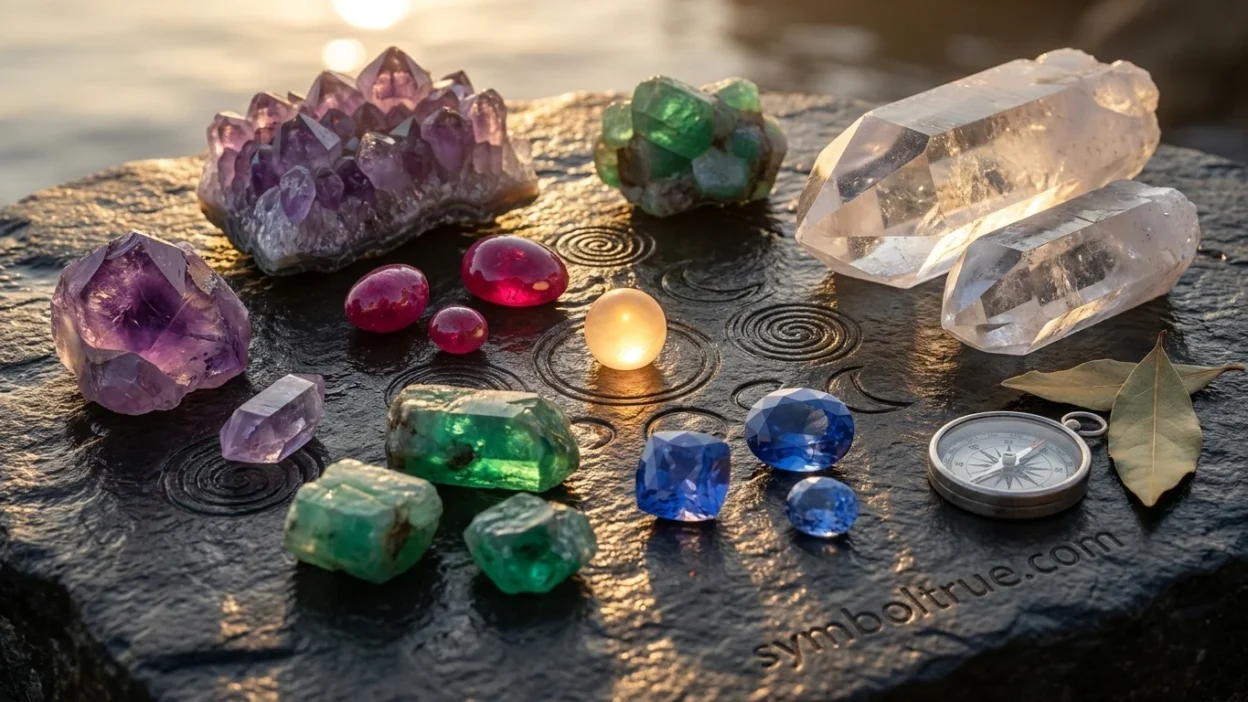
Gemstones have fascinated people for thousands of years. Their colors, rarity, shine, and natural beauty have made them symbols of love, protection, strength, wisdom, and transformation. Gemstone symbolism explores the meanings people have traditionally connected with different stones and explains why these beautiful objects continue to hold special significance today.
From a ruby representing passion to an emerald associated with renewal, each gemstone can carry its own story. These meanings can vary across cultures, religions, historical periods, and personal beliefs, making gemstones both beautiful and deeply symbolic.
Gemstone Symbolism Meaning (Clear Definition)
Gemstone symbolism refers to the meanings, ideas, emotions, and spiritual associations that people connect with gemstones.
These meanings are usually influenced by a gemstone’s color, appearance, rarity, historical use, cultural traditions, and religious beliefs. A single stone may represent different things in different societies.
For example, diamonds are commonly associated with commitment and lasting love, while amethyst has often been connected with spirituality, calmness, and wisdom.
Gemstone symbolism can be understood through several common themes:
- Love and commitment
- Protection and strength
- Wisdom and clarity
- Spiritual growth
- Good fortune and prosperity
- Healing and renewal in traditional beliefs
- Transformation and personal growth
- Peace and emotional balance
These meanings are symbolic rather than universal facts. The significance of a gemstone often depends on the person and cultural tradition interpreting it.
What Does Gemstone Symbolism Represent?
Gemstones can represent many human qualities and experiences. Their natural formation over long periods has also made them powerful symbols of endurance and transformation.
Here are some widely recognized gemstone associations:
| GemstoneCommon Symbolic Meaning | |
|---|---|
| Diamond | Love, commitment, strength, eternity |
| Ruby | Passion, courage, vitality |
| Emerald | Renewal, growth, hope |
| Sapphire | Wisdom, loyalty, truth |
| Amethyst | Spirituality, peace, reflection |
| Pearl | Purity, innocence, wisdom |
| Opal | Creativity, imagination, transformation |
| Garnet | Passion, devotion, energy |
| Turquoise | Protection, friendship, communication |
| Citrine | Abundance, optimism, confidence |
Gemstone colors also influence symbolism. Red stones are often connected with passion and courage, blue stones with peace and wisdom, green stones with nature and renewal, and purple stones with spirituality and mystery.
Because of these associations, gemstones are frequently given as meaningful gifts during important moments in life.
Spiritual Meaning of Gemstone Symbolism
In spiritual traditions, gemstones are often viewed as symbols of inner qualities and personal transformation.
Some people use particular stones as reminders of intentions such as patience, courage, gratitude, or spiritual awareness. The stone itself becomes a physical representation of an idea that a person wants to keep close.
Amethyst, for example, has long been associated in various traditions with spirituality and contemplation. Clear quartz is often given symbolic associations with clarity and intention, while rose quartz is commonly connected with love and compassion.
It is important to distinguish symbolic or traditional beliefs from scientifically established effects. The spiritual meaning of a gemstone can be personally meaningful without requiring the belief that the stone has supernatural powers.
At a deeper level, gemstone symbolism can encourage people to reflect on qualities they want to develop in their own lives.
Biblical / Religious Meaning of Gemstone Symbolism
Gemstones appear in several religious traditions and sacred texts, where they can represent beauty, wealth, holiness, authority, identity, or spiritual significance.
In the Bible, precious stones are mentioned in descriptions of sacred objects and religious imagery. The breastplate associated with the high priest, for example, is traditionally described as containing twelve different stones connected with the twelve leagues of Israel.
Gemstones also appear in biblical descriptions of wealth, kingship, heavenly imagery, and the foundations of the New Jerusalem in Revelation.
However, the exact identification of some ancient gemstones can be difficult because the names of minerals and stones have changed over time. Therefore, modern gemstone names do not always perfectly match the stones referred to in ancient translations.
Outside Christianity, gemstones have also played important roles in Hindu, Buddhist, Islamic, Jewish, and other cultural and religious traditions. Their meanings differ depending on the tradition.
Gemstone Symbolism in History and Culture
Throughout history, gemstones have been valued not only for their beauty but also for what they represented.
Ancient civilizations used gemstones in jewelry, crowns, seals, religious objects, burial items, and ceremonial decorations. Their rarity made them symbols of social position and wealth, while their unusual colors and durability encouraged people to connect them with supernatural or spiritual ideas.
In ancient Egypt, stones such as lapis lazuli, turquoise, carnelian, and amethyst were used in jewelry and burial objects. Some stones were associated with protection, status, or the afterlife.
In ancient Rome, gemstones were commonly used in rings, jewelry, and engraved seals. During later European history, precious stones became strongly associated with royalty, power, marriage, and inherited wealth.
Across Asia, gemstones have also held important cultural and spiritual meanings. Jade, for example, has had a particularly important place in Chinese culture, where it has been associated with virtues such as purity, integrity, and harmony.
These traditions show that gemstone meanings are not fixed. They develop through stories, beliefs, customs, and human experiences.
Gemstone Symbolism in Literature and Art
Gemstones have long appeared in literature and art as visual symbols.
Writers often use jewels to represent wealth, temptation, beauty, desire, power, or hidden value. A precious stone can also symbolize something rare that a character wants to protect or obtain.
In poetry, gemstones may be compared with stars, eyes, tears, sunlight, or the human spirit. Their colors make them especially useful for creating emotional imagery.
Artists have also used gemstones to communicate status and identity. Crowns, necklaces, rings, religious objects, and ceremonial clothing decorated with stones can instantly suggest wealth, authority, devotion, or importance.
The contrast between a rough natural stone and a polished jewel can also symbolize transformation. Something formed deep within the earth can become an object of extraordinary beauty, creating a powerful metaphor for personal growth.
Dream Meaning of Gemstone Symbolism
Dreams about gemstones are often interpreted symbolically rather than literally. Their meaning may depend on the type of gemstone, its color, condition, and what happens to it in the dream.
Finding a gemstone may symbolize discovering something valuable about yourself or recognizing an opportunity.
Receiving a gemstone as a gift may represent appreciation, affection, recognition, or an important relationship.
Losing a gemstone may reflect concerns about losing something personally valuable, although dream interpretation is highly subjective.
A sparkling or brightly colored gemstone may symbolize beauty, confidence, hope, or personal potential.
A broken gemstone could represent disappointment, change, or the feeling that something once considered valuable has changed.
There is no single universal interpretation of gemstone dreams. Personal experiences and emotions are usually more important than a fixed dream dictionary.
Modern Meaning of Gemstone Symbolism
Today, gemstones continue to carry symbolic meanings in jewelry, fashion, celebrations, spirituality, and personal expression.
Engagement rings are perhaps one of the clearest examples. Diamonds are widely associated with lasting commitment, while other gemstones can be chosen to represent individuality or a personal story.
Birthstones are another modern expression of gemstone symbolism. Different months are traditionally associated with particular stones, giving people a symbolic connection to their birth month.
People also choose gemstones based on color, family traditions, cultural meaning, memories, or personal preferences.
Modern gemstone symbolism is therefore less about one universal definition and more about personal meaning.
A gemstone may remind someone of a loved one, represent an important achievement, mark a new beginning, or serve as a quiet reminder of a personal value.
Common Gemstone Symbolism by Color
Color is one of the easiest ways to understand gemstone symbolism.
- Red gemstones often symbolize passion, courage, love, and determination.
- Blue gemstones are commonly associated with wisdom, loyalty, peace, and truth.
- Green gemstones often represent growth, renewal, nature, and harmony.
- Purple gemstones can symbolize spirituality, mystery, imagination, and reflection.
- Yellow gemstones are often connected with happiness, confidence, warmth, and abundance.
- White gemstones commonly represent purity, clarity, innocence, and new beginnings.
- Black gemstones can symbolize strength, mystery, protection, and grounding.
- Pink gemstones are frequently associated with affection, compassion, tenderness, and love.
These associations vary by culture and individual interpretation, but color remains an important part of gemstone meaning.
Why Are Gemstones So Symbolically Powerful?
Gemstones combine several qualities that naturally invite symbolism.
They are formed through geological processes that can take extremely long periods of time. Many are rare, durable, and visually striking. Humans have also used them across generations for ceremonies, jewelry, religious objects, and important celebrations.
Their physical qualities therefore become metaphors for human experiences.
A durable stone can represent strength. A brilliant stone can represent hope. A rare stone can represent something precious. A stone formed through pressure and heat can represent resilience and transformation.
This is one reason gemstone symbolism continues to feel meaningful even in modern life.
How to Choose a Gemstone Based on Its Symbolism
Choosing a gemstone does not have to be based only on appearance or value. Its traditional meaning can also make the choice more personal.
Consider these questions:
- What quality do you want the stone to represent?
- Are you choosing it for yourself or someone else?
- Does its color have personal significance?
- Is there a cultural or family tradition connected to the stone?
- Does the gemstone remind you of an important memory?
- Are you looking for a birthstone or a symbolic gift?
For example, someone celebrating a new beginning might choose a gemstone traditionally connected with renewal, while someone marking a relationship milestone might prefer a stone associated with love or commitment.
The most meaningful gemstone is often the one whose symbolism connects naturally with your story.
FAQs:
What is gemstone symbolism?
Gemstone symbolism is the study of the meanings and associations people traditionally connect with different gemstones. These meanings can involve emotions, spiritual ideas, cultural traditions, and personal experiences.
What gemstone symbolizes love?
Diamonds and rubies are commonly associated with love, although the meaning varies by culture and tradition. Rose quartz is also widely associated with affection and compassion in modern spiritual traditions.
What gemstone symbolizes protection?
Turquoise, black tourmaline, and certain other stones are traditionally associated with protection in different cultural and spiritual practices. These are symbolic beliefs rather than scientifically established protective effects.
What gemstone symbolizes strength?
Diamonds are often used as a symbol of strength and endurance because of their exceptional hardness. Rubies can also symbolize courage, vitality, and determination.
Why do gemstones have different meanings?
Gemstone meanings developed through history, religion, folklore, color symbolism, cultural traditions, and the physical characteristics of stones. As a result, the same gemstone can have different meanings in different cultures.
Conclusion
Gemstone symbolism gives ordinary stones a deeper layer of meaning by connecting their colors, beauty, rarity, history, and cultural traditions with human emotions and experiences. Whether a gemstone represents love, strength, wisdom, protection, renewal, or personal transformation, its most important meaning can be the one that resonates with the person who chooses it.
A gemstone may be small, but the story attached to it can be remarkably meaningful.

Henry Jack is a passionate writer at SymbolTrue, dedicated to exploring the meanings, history, and cultural significance of symbols. He creates clear, engaging, and well-researched content that helps readers understand symbols from around the world.