Wealth is more than money, possessions, or financial success. Across history, people have used wealth as a symbol of security, abundance, power, prosperity, freedom, achievement, and social status. At the same time, wealth can represent greed, inequality, temptation, or attachment.
Understanding wealth symbolism means looking beyond material value and asking what wealth represents emotionally, spiritually, culturally, and personally. The meaning can change depending on the object involved, the culture, and the situation in which wealth appears.
Wealth Meaning (Clear Definition)
Wealth generally refers to an abundance of valuable resources, such as money, property, goods, land, or other assets. Symbolically, however, wealth can represent much more than financial resources.
Common symbolic meanings of wealth include:
- Abundance and having more than enough
- Security and protection from uncertainty
- Success and achievement
- Power and influence
- Freedom and independence
- Status and social recognition
- Opportunity and personal choice
- Generosity when wealth is shared
- Greed when wealth becomes an unhealthy obsession
The symbolic meaning depends heavily on context. Wealth given as a gift may suggest generosity, while wealth that is hoarded may symbolize fear or insecurity.
What Does Wealth Represent?
Wealth can represent different ideas depending on how it is gained, used, or displayed.
Abundance
One of the most common meanings is abundance. Wealth suggests having sufficient resources and being able to meet one’s needs comfortably.
Because of this, wealth is often associated with prosperity, growth, and a sense of having enough.
Security
Money and possessions can provide practical protection against uncertainty. Symbolically, wealth may therefore represent stability and preparation for the future.
Power and Influence
Throughout history, financial resources have often been connected with social and political influence. Wealth can symbolize the ability to make decisions, control resources, or influence others.
Freedom
Wealth may also represent freedom from certain financial limitations. In symbolic terms, it can suggest having the ability to choose one’s path rather than being controlled by immediate material needs.
Achievement
For some people, wealth symbolizes the result of persistence, skill, creativity, or successful work. It can become a visible representation of personal accomplishment.
Spiritual Meaning of Wealth
Spiritual interpretations of wealth vary considerably between traditions. Wealth is sometimes viewed positively as a blessing or resource, while other teachings emphasize that material possessions should not become the center of life.
Spiritually, wealth can symbolize abundance, stewardship, gratitude, responsibility, and generosity.
A person may interpret prosperity as an opportunity to help others rather than simply accumulate possessions. In this interpretation, wealth carries a responsibility: what a person receives can also become something they share.
Another spiritual interpretation sees wealth as a test of character. Having resources may reveal how someone handles power, temptation, responsibility, and generosity.
It is important to distinguish these interpretations from universal spiritual facts. There is no single spiritual meaning of wealth accepted by every tradition.
Biblical / Religious Meaning of Wealth
In religious traditions, wealth often has a complex meaning rather than being simply good or bad.
In Christianity, biblical discussions of wealth frequently focus on stewardship, generosity, humility, and the dangers of excessive attachment to possessions. Wealth itself is not always presented as having one simple symbolic meaning. The emphasis can instead be on how a person obtains and uses it.
Other religious traditions also contain teachings about generosity, charity, moderation, detachment, and responsible use of material resources.
For this reason, religious interpretations of wealth should be understood within the specific tradition and passage rather than reduced to one universal definition.
Wealth in History and Culture
Wealth has played an important symbolic role in many societies.
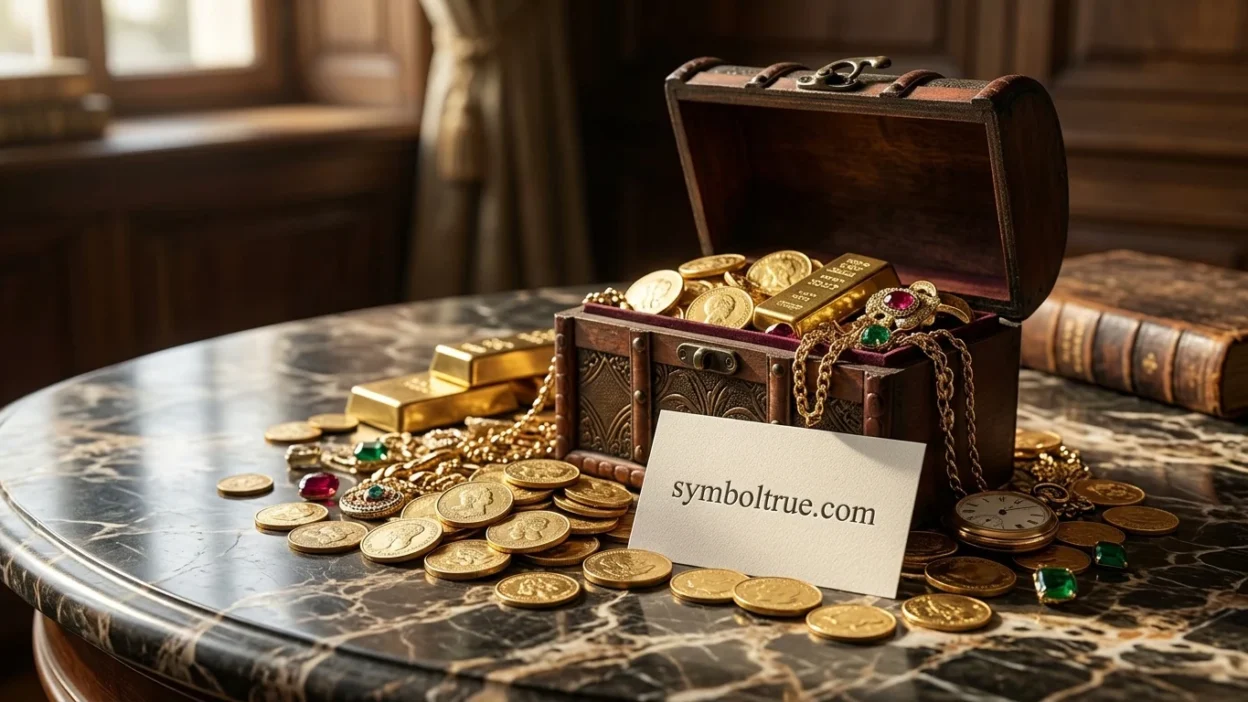
Gold, jewels, elaborate clothing, large homes, precious metals, and other valuable objects have often been used to communicate status and influence. In some historical societies, visible wealth helped distinguish rulers, nobles, merchants, religious institutions, and other powerful groups.
Coins also became powerful symbols because they combined practical economic value with images of rulers, political authority, and cultural identity.
Different cultures have developed their own associations with prosperity. Certain foods, colors, animals, plants, numbers, and objects may be connected with good fortune or abundance in particular traditions.
These meanings are culturally specific. A symbol associated with prosperity in one culture may have a very different meaning elsewhere.
Wealth in Literature and Art
Artists and writers have long used wealth to explore human desires and conflicts.
In literature, wealth can symbolize:
- Ambition
- Social class
- Power
- Temptation
- Corruption
- Freedom
- Security
- Inequality
A treasure chest, golden object, expensive clothing, or luxurious home may visually communicate prosperity without requiring a lengthy explanation.
However, artists may deliberately contrast beautiful wealth with emotional emptiness. A wealthy character may possess everything materially while lacking friendship, love, purpose, or peace.
This contrast makes wealth a useful artistic symbol because it can represent both achievement and illusion.
Wealth in Dreams
Dream interpretations are subjective and depend strongly on personal circumstances. There is no scientifically established dictionary that gives one fixed meaning to every wealth-related dream.
Still, some common symbolic interpretations include:
Finding Wealth
Finding money or valuable objects may represent opportunity, confidence, potential, or discovering something valuable within yourself.
Losing Wealth
Losing money in a dream may reflect concerns about security, control, change, or fear of losing something important.
Receiving Wealth
Receiving money or valuable objects may symbolize recognition, support, opportunity, or a desire to feel appreciated.
Giving Wealth Away
Giving away money can symbolize generosity, emotional release, responsibility, or the desire to help someone.
The strongest interpretation usually comes from the dreamer’s emotions and real-life circumstances.
Positive Symbolism of Wealth
Wealth can carry many positive symbolic meanings.
Prosperity is perhaps the most direct association. Wealth represents having resources available for personal needs and future plans.
Security is another important meaning. Resources can create a sense of preparedness and stability.
Freedom may also be represented by wealth because financial resources can expand a person’s choices.
Generosity becomes an important positive symbol when wealth is shared. A person who uses resources to support family, community, education, charity, or meaningful causes may associate wealth with service rather than status.
Wealth can also symbolize growth. Increasing resources may represent progress from one stage of life to another.
Negative or Hidden Symbolism of Wealth
Wealth does not always have a positive symbolic meaning.
One negative interpretation is greed. When accumulation becomes more important than relationships, ethics, or personal wellbeing, wealth can symbolize unhealthy attachment.
It can also represent fear. Someone may accumulate possessions because they are deeply afraid of uncertainty or loss.
Another hidden meaning is status anxiety. Displaying wealth can sometimes symbolize a desire for recognition, approval, or social acceptance.
Wealth may also represent inequality. In literature, art, and social commentary, large differences in wealth can symbolize unfairness, privilege, or unequal access to opportunities.
This dual nature is one reason wealth remains such a powerful symbol.
Common Interpretations of Wealth
Here are some of the most common symbolic interpretations of wealth:
| Symbolic Meaning | What It May Represent |
| Abundance | Having enough resources or opportunities |
| Prosperity | Growth, success, and favorable circumstances |
| Security | Stability and protection from uncertainty |
| Freedom | Greater independence and personal choice |
| Power | Influence, authority, or social control |
| Status | Recognition and social position |
| Achievement | Results of effort, talent, or persistence |
| Generosity | Sharing resources with others |
| Greed | Excessive desire for accumulation |
| Fear | Anxiety about losing security or control |
| Responsibility | The need to manage resources wisely |
| Temptation | The attraction of material success |
The correct interpretation depends on context rather than the word “wealth” alone.
Why Does Wealth Matter Today?
Wealth remains an important symbol because modern life often connects money with choices, opportunities, security, and social position.
However, people increasingly recognize that financial wealth does not automatically equal emotional or spiritual wellbeing.
Someone can have significant financial resources while still experiencing loneliness, stress, or a lack of purpose. Conversely, a person with modest financial resources may experience strong relationships, meaning, gratitude, and contentment.
This creates an important modern interpretation of wealth: true richness can include more than material possessions.
Time, knowledge, friendship, creativity, health, family relationships, and meaningful experiences can all be described as forms of richness in everyday language.
The symbolic idea of wealth therefore extends beyond the size of a bank account. It can represent what a person values and considers worth having.
FAQs;
What is the main symbolism of wealth?
Wealth commonly symbolizes abundance, prosperity, security, success, freedom, power, and status. Depending on context, it can also symbolize greed or fear of loss.
What does wealth symbolize spiritually?
Spiritually, wealth may symbolize abundance, gratitude, stewardship, generosity, responsibility, or a test of how someone handles material resources. Meanings vary between traditions.
Is wealth always a positive symbol?
No. Wealth can have both positive and negative meanings. It may represent prosperity and freedom, but it can also symbolize greed, inequality, attachment, or insecurity.
What does wealth symbolize in dreams?
Wealth in dreams may be associated with opportunity, security, confidence, recognition, fear of loss, or personal values. Dream interpretation is subjective rather than universal.
What does gold symbolize in relation to wealth?
Gold is often associated with value, prosperity, prestige, permanence, and power. Its exact meaning varies according to historical and cultural context.
Does wealth symbolize success?
It can. In many societies, wealth is used as a visible sign of achievement or social success. However, wealth is only one possible measure of success and does not necessarily reflect personal fulfillment.
What does giving wealth symbolize?
Giving wealth may symbolize generosity, compassion, responsibility, support, or a willingness to share one’s resources. Its meaning depends on the circumstances.
Conclusion
Wealth symbolism reaches far beyond money and possessions. It can represent abundance, prosperity, security, freedom, achievement, power, generosity, and social status. At the same time, it can point toward greed, fear, inequality, or excessive attachment.
Its meaning changes across religions, cultures, historical periods, artistic traditions, dreams, and personal experiences. Ultimately, wealth becomes most meaningful when we consider not only what a person possesses, but what those possessions represent and how they are used.

Ryan Thomas is a passionate writer at SymbolTrue, dedicated to exploring the meanings, history, and cultural significance of symbols worldwide. He creates engaging, well-researched content that helps readers discover the stories and symbolism behind everyday signs, icons, and traditions.