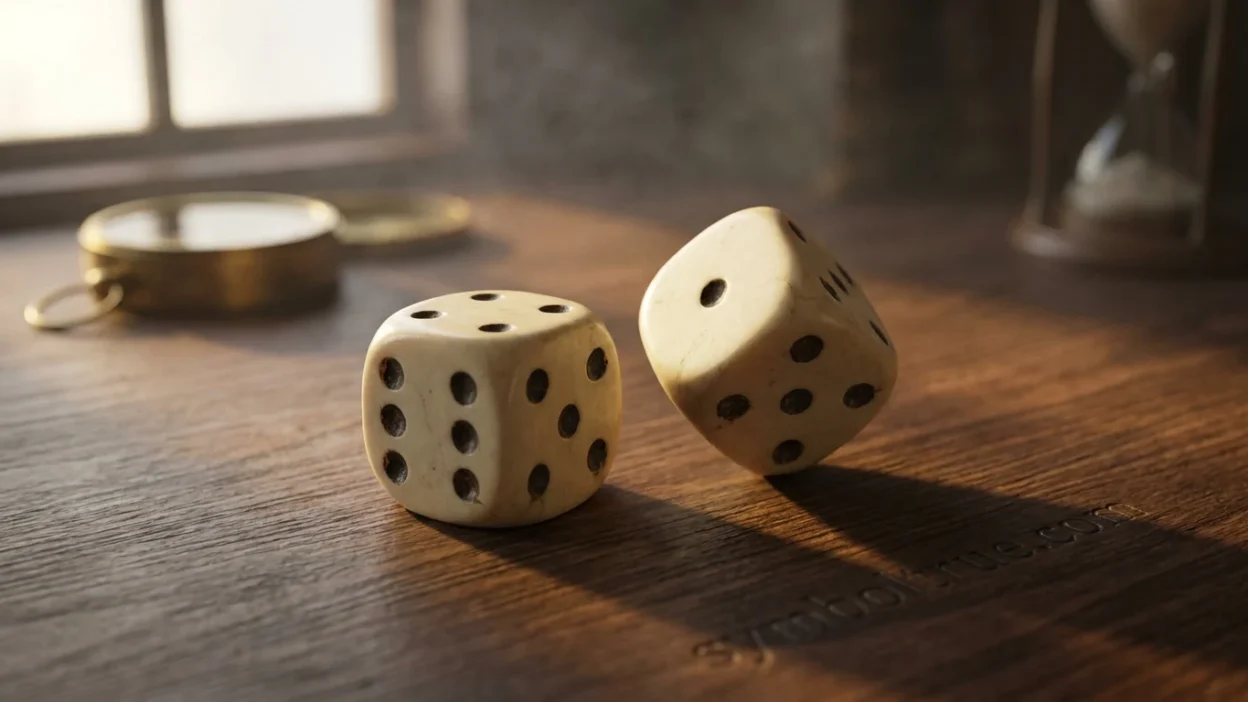
Dice are small objects, but they can carry surprisingly deep symbolic meanings. They are associated with chance, uncertainty, risk, choice, fate, luck, and the unpredictable nature of life. Across history, dice have appeared in games, divination practices, literature, art, and religious stories.
Understanding dice symbolism does not require believing that dice predict the future. Their meaning often depends on the cultural setting, personal beliefs, and situation in which they appear.
Dice Symbolism Meaning (Clear Definition)
Dice symbolism refers to the ideas and meanings people associate with dice beyond their practical use in games.
The most common symbolic meaning of dice is chance. When a die is rolled, the result cannot normally be known with certainty beforehand. Because of this, dice naturally represent situations where outcomes are uncertain.
Dice can symbolize:
- Luck and unexpected opportunities
- Chance and randomness
- Risk and taking chances
- Fate and circumstances beyond personal control
- Choice and decision-making
- Uncertainty about the future
- Adventure and willingness to explore
- Consequences resulting from decisions
A pair of dice can therefore become a simple metaphor for life. Sometimes preparation matters, but sometimes circumstances remain outside our control.
What Does Dice Symbolism Represent?
Dice can represent several ideas depending on how they are used.
Chance and Randomness
The strongest association is chance. Rolling dice means accepting that the result may not be predictable.
Symbolically, this can reflect moments when life does not follow a clear plan.
Risk and Courage
Dice are also connected with risk. Someone who chooses to roll the dice may be accepting uncertainty in pursuit of a possible reward.
In this sense, dice can represent courage, bold decisions, and willingness to take calculated risks.
Fate and Destiny
Because the result of a roll is uncertain, dice have sometimes been used as symbols of fate. This does not necessarily mean that dice control destiny. Rather, they can represent the human experience of wondering what the future holds.
Choice and Consequences
Dice may also symbolize decisions. Once someone rolls, the outcome must be accepted. This creates a useful metaphor for choices: we can control our actions, but we cannot always control every consequence.
Spiritual Meaning of Dice Symbolism
The spiritual interpretation of dice is not universal. Different traditions and individuals may understand them differently.
Spiritually, dice can symbolize trusting the journey while recognizing uncertainty. They may remind someone that not everything can be controlled or predicted.
Dice can also represent the balance between personal effort and circumstances beyond our control.
For some people, seeing dice may encourage reflection on questions such as:
- Am I taking an unnecessary risk?
- Am I afraid of uncertainty?
- Do I need to make a decision?
- Am I trying to control something I cannot control?
- Should I remain open to an unexpected opportunity?
In a spiritual context, dice can therefore serve as a reminder to combine wisdom, preparation, flexibility, and acceptance.
It is important to distinguish symbolic interpretation from established spiritual fact. There is no universal spiritual rule stating that dice always carry one specific message.
Biblical / Religious Meaning of Dice
Dice have a notable connection with religious history, particularly because the Bible contains references to casting lots.
In the New Testament, soldiers are described as casting lots for Jesus’ garments during the crucifixion narratives. The practice involved using a method of chance to determine an outcome.
However, biblical casting lots should not automatically be equated with modern dice. Historical practices involving lots could take different forms, and the exact objects used were not necessarily ordinary gaming dice.
The broader religious symbolism can involve uncertainty, judgment, division, or decisions made through lots.
Some readers may interpret these passages as reminders that human beings sometimes use chance-like methods when faced with uncertain decisions. Others focus more strongly on the specific historical and theological context.
Therefore, it is better to treat religious interpretations carefully rather than claiming that dice have one fixed biblical meaning.
Dice in History and Culture
Dice are ancient objects with a long history. Archaeological discoveries show that dice-like objects and gaming pieces existed in several ancient civilizations.
They have been associated with recreation, gambling, social activities, and, in some cultures, forms of divination or decision-making.
The cultural meaning of dice has changed over time.
In some settings, dice were symbols of gambling and fortune. In others, they were simply recreational objects used for games.
The phrase rolling the dice later developed into a common metaphor for taking a risk. This expression captures one of the central symbolic meanings of dice: accepting an uncertain outcome.
Dice have also appeared in popular culture as visual symbols of luck, gambling, adventure, probability, and unpredictability.
Dice in Literature and Art
Writers and artists often use dice as metaphors because their meaning is immediately understandable.
A character who rolls dice may be portrayed as:
- Taking a dangerous chance
- Leaving something to fate
- Making a difficult decision
- Gambling with an uncertain future
- Seeking luck
- Accepting consequences
In literature, dice can make an abstract idea such as fate versus free will easier to visualize.
Artists may also use dice alongside playing cards, coins, tables, or other gaming objects to explore themes of wealth, temptation, mortality, luck, and human uncertainty.
The meaning depends heavily on the surrounding imagery. A pair of dice beside a treasure chest may suggest fortune, while dice shown in a dark or threatening setting may suggest dangerous risk.
Dice Symbolism in Dreams
Dream interpretations are subjective, and there is no scientifically established dictionary that gives every dream symbol one fixed meaning.
Still, dice appearing in a dream may encourage reflection on uncertainty, choices, risk, or luck.
Rolling Dice in a Dream
Rolling dice may symbolize making a decision without knowing exactly what will happen.
It could reflect excitement about an opportunity or anxiety about an uncertain situation.
Seeing Someone Else Roll Dice
This might represent a situation where another person has influence over an outcome that affects you.
Winning With Dice
A dream involving a successful roll may reflect optimism, confidence, or hope that circumstances will turn in your favor.
Losing With Dice
Losing may represent fear of failure, disappointment, or concern about taking a risk.
These interpretations are possibilities rather than predictions. The emotions experienced during the dream are often more useful than the symbol alone.
Positive Symbolism of Dice
Although dice are frequently associated with risk, they can also carry positive meanings.
Luck
Dice can represent the possibility of a fortunate opportunity appearing unexpectedly.
Adventure
Because dice involve uncertainty, they can symbolize a willingness to step beyond familiar routines.
Flexibility
Dice remind us that outcomes are not always predictable. Symbolically, they can encourage adaptability.
Opportunity
An uncertain situation is not necessarily a bad one. Dice can represent the possibility that something unexpected may create a valuable opportunity.
Courage
Taking a calculated risk can require confidence. Dice may therefore symbolize the courage to move forward despite uncertainty.
Negative or Hidden Symbolism of Dice
Dice can also represent less positive ideas.
Gambling and Excessive Risk
The strongest negative association is gambling. Dice may symbolize impulsive behavior, financial risk, or dependence on luck.
Lack of Control
A person may feel that their future is controlled by circumstances rather than their own choices.
Uncertainty
Dice can represent anxiety about an unpredictable outcome.
Temptation
In certain contexts, dice may symbolize the temptation to pursue quick rewards without considering consequences.
False Dependence on Luck
Dice may also remind us of the danger of expecting luck to replace preparation, judgment, or responsibility.
The same symbol can therefore have both positive and negative meanings.
Common Interpretations of Dice Symbolism
| Dice Symbolism | Possible Meaning |
|---|---|
| One die | Individual choice, chance, or a single outcome |
| Pair of dice | Partnership, balance, or combined possibilities |
| Rolling dice | Taking a chance or making a decision |
| Winning roll | Luck, success, or optimism |
| Losing roll | Risk, disappointment, or uncertainty |
| Broken die | Disrupted expectations or loss of control |
| Large dice | Major risk or important decision |
| Small dice | Minor chance or everyday uncertainty |
| Dice with money | Gambling, wealth, or financial risk |
| Dice in a dream | Uncertainty, choices, or emotional risk |
These meanings are interpretive rather than universal. Context remains important.
Why Does Dice Symbolism Matter Today?
Dice remain relevant because uncertainty is still a major part of everyday life.
People make choices about careers, relationships, finances, travel, education, and personal goals without knowing exactly what will happen.
Dice provide a simple visual metaphor for this experience.
At the same time, modern probability and statistics help explain that random outcomes are not necessarily mysterious. A dice roll can be analyzed mathematically, while its symbolic meaning remains a matter of culture and personal interpretation.
This makes dice especially interesting: they sit between mathematics, entertainment, psychology, culture, and symbolism.
Their message can be practical as well as philosophical: take risks thoughtfully, prepare where possible, and recognize that some outcomes will always remain uncertain.
FAQs:
What is the main meaning of dice symbolism?
The main symbolic meanings of dice are chance, uncertainty, luck, risk, fate, choice, and unpredictable outcomes.
What do dice symbolize spiritually?
Spiritually, dice may symbolize accepting uncertainty, trusting the journey, making choices, and recognizing the limits of personal control. Interpretations vary between individuals and traditions.
Are dice a symbol of luck?
Yes. Dice are commonly associated with luck because their outcomes are uncertain. However, the idea that dice guarantee good or bad luck is a belief rather than an established fact.
What do dice mean in dreams?
Dice in dreams may reflect uncertainty, risk, decision-making, hope, or fear about an outcome. The dreamer’s emotions and circumstances are important when interpreting the image.
Are dice mentioned in the Bible?
The Bible describes people casting lots in several passages, including the soldiers who cast lots for Jesus’ garments. These historical practices should not automatically be treated as identical to modern dice.
Do dice symbolize fate?
Dice can symbolize fate because their results are uncertain and outside the player’s direct control. In symbolism, this often represents the tension between personal choice and circumstances.
What does rolling dice symbolize?
Rolling dice commonly symbolizes taking a chance, accepting uncertainty, making a decision, or allowing an unpredictable outcome to unfold.
Are dice a positive or negative symbol?
Dice can be either positive or negative. They may represent luck, opportunity, courage, and adventure, but they can also symbolize gambling, excessive risk, uncertainty, or loss of control.
Conclusion
Dice symbolism centers on the unpredictable side of life. Dice can represent chance, luck, risk, fate, choice, uncertainty, opportunity, and consequences.
Their meaning changes according to context. In history, they have served practical and recreational purposes, while in literature, art, dreams, and everyday language, they often become symbols of uncertainty and risk.
Rather than suggesting that dice determine destiny, their deeper symbolic value can be found in what they remind us about life: we can make thoughtful choices, but we cannot control every outcome.

Henry Jack is a passionate writer at SymbolTrue, dedicated to exploring the meanings, history, and cultural significance of symbols. He creates clear, engaging, and well-researched content that helps readers understand symbols from around the world.