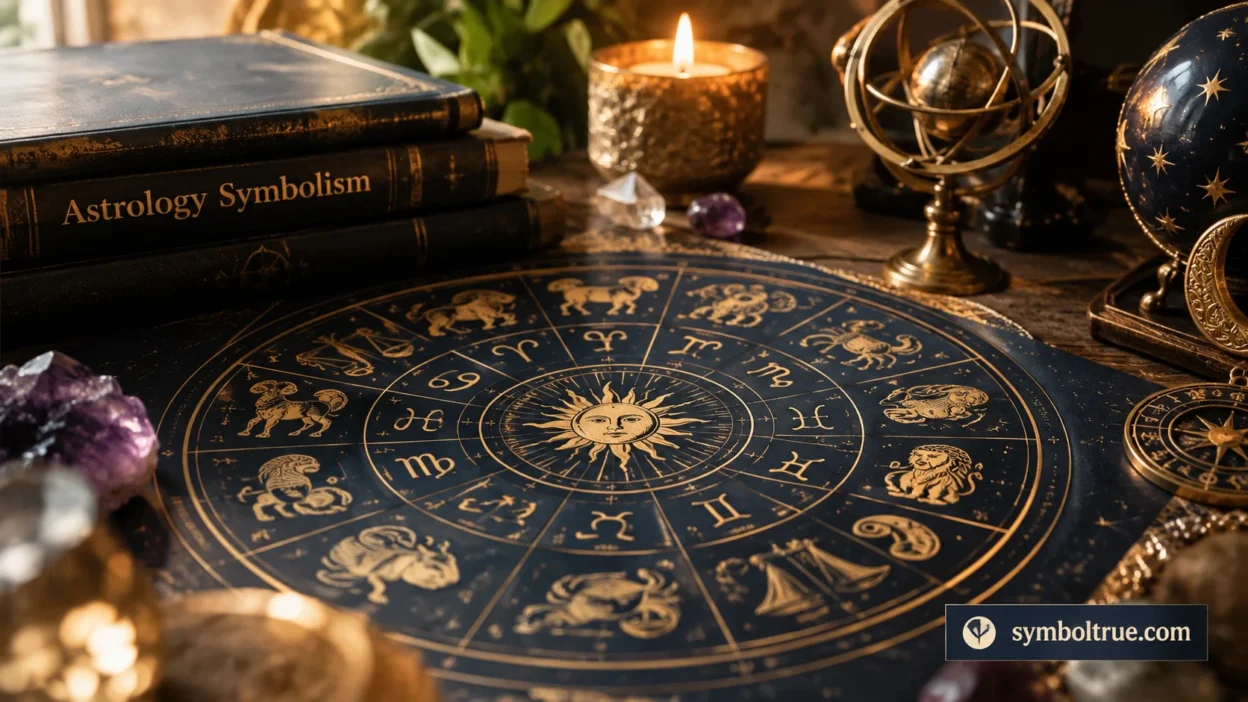
Astrology symbolism explores the meanings traditionally associated with planets, zodiac signs, houses, and other celestial elements. Throughout history, people have looked to the sky for patterns that could help them understand time, identity, relationships, destiny, and human experience.
However, astrology should be distinguished from astronomy. Astronomy is a scientific field that studies celestial objects, whereas astrology uses celestial patterns within traditional symbolic and interpretive systems. Therefore, the meanings discussed in this article are cultural, historical, or spiritual interpretations rather than scientifically proven facts.
Astrology Symbolism Meaning (Clear Definition)
Astrology symbolism refers to the traditional meanings assigned to celestial objects and patterns within different astrological systems.
For example, the Sun is commonly associated with identity and vitality, while the Moon is traditionally connected with emotions and inner life. Similarly, Venus is often linked with love and beauty, whereas Mars is associated with action and energy.
Astrological symbolism can include:
- The Sun and Moon
- The planets
- The twelve zodiac signs
- The twelve astrological houses
- Planetary aspects
- The four classical elements
- Cardinal, fixed, and mutable qualities
- Astrological symbols and glyphs
Although these associations are widely recognized within astrology, their meanings can differ between traditions.
What Does Astrology Symbolism Represent?
Astrology symbolism can represent many aspects of human life. In particular, it provides a traditional language for discussing personality, relationships, experiences, change, and personal meaning.
Personality and Identity
First, zodiac signs are traditionally associated with different qualities and characteristics. For instance, fire signs are often connected with enthusiasm and action, while water signs are commonly associated with emotions and sensitivity.
However, these descriptions belong to astrological traditions and should not be treated as scientifically established personality categories.
Life Experiences
In addition, astrological houses are traditionally linked with different areas of life. These may include relationships, communication, family, career, finances, and personal development.
As a result, an astrological birth chart is often interpreted as a symbolic map of different areas of experience.
Cycles and Change
Astrology also places considerable importance on cycles. The movement of celestial bodies has traditionally been interpreted as representing periods of change, transition, beginnings, and endings.
Therefore, astrology symbolism can provide a framework for thinking about the changing stages of life.
Balance
Furthermore, relationships between planets, signs, and elements are often interpreted through ideas of harmony and tension.
Consequently, astrological symbolism may represent the balance between different qualities, desires, or experiences.
Spiritual Meaning of Astrology Symbolism
For people who practice astrology spiritually, its symbols may provide a framework for reflection and self-examination.
For example, someone may use an astrological chart to think about personal values, relationships, goals, or recurring life patterns. In this way, astrology can become a symbolic tool for asking deeper questions.
Common spiritual associations include:
- Self-reflection: Exploring personal experiences and values
- Guidance: Looking for symbolic direction during uncertain periods
- Connection: Reflecting on humanity’s relationship with the universe
- Growth: Thinking about personal change and development
- Cycles: Recognizing periods of transition and renewal
- Purpose: Exploring questions about meaning and direction
Nevertheless, these spiritual interpretations depend on personal beliefs. There is no established scientific evidence that planetary positions directly control human behavior or spiritual development.
Biblical / Religious Meaning of Astrology Symbolism (if applicable)
The relationship between astrology and religion has been complicated throughout history. Biblical and other religious traditions contain references to stars, celestial objects, and signs in the heavens. However, these references should not automatically be interpreted as support for modern astrology.
For example, some religious traditions have historically used astronomical observations for calendars, seasons, festivals, and timekeeping. At the same time, certain religious authorities have criticized or rejected astrology as a form of divination.
Christian, Jewish, Islamic, and other religious perspectives have therefore differed across periods and communities.
Moreover, astronomy and astrology should remain clearly separated. Astronomy studies celestial objects scientifically, while astrology assigns symbolic or divinational meanings to celestial positions.
Consequently, there is no single universal religious interpretation of astrology symbolism.
Astrology Symbolism in History and Culture
Astrology has a long and diverse history. In particular, ancient Mesopotamian cultures developed important traditions of observing celestial phenomena and recording unusual events in the sky.
Over time, these observations became connected with systems of omens and interpretation. Later, astrological traditions developed further through Greek, Hellenistic, Roman, Persian, Indian, Islamic, European, and other cultural contexts.
Indian astrology, commonly known as Jyotisha, developed its own traditions involving planets, zodiacal divisions, lunar mansions, and systems for interpreting time.
Similarly, Chinese traditions developed distinct celestial frameworks involving concepts of balance, cycles, and relationships between heavenly and earthly patterns.
Therefore, astrology should not be viewed as one completely uniform system. Instead, different societies developed their own interpretations according to their histories and cultural environments.
Astrology Symbolism in Literature and Art
Astrological imagery has appeared in literature, painting, manuscripts, architecture, jewelry, and decorative arts for centuries.
For example, zodiac symbols have frequently been used to represent:
- Time
- Human identity
- Fate
- Cosmic order
- Seasonal cycles
- Mystery
- Transformation
- Humanity’s relationship with the heavens
Furthermore, writers have used celestial imagery as a metaphor for destiny, uncertainty, personality, and the desire to understand life.
In modern culture, zodiac symbols also appear in tattoos, clothing, posters, digital artwork, jewelry, and social media designs. As a result, astrology symbolism continues to influence visual culture even outside traditional astrology.
Astrology Symbolism in Dreams
Dreams involving astrology can have highly personal meanings. However, dream interpretation is subjective and should not be treated as a reliable method of predicting future events.
For example, dreaming about zodiac signs might reflect personal identity or curiosity. Similarly, dreaming about planets could represent change, uncertainty, or fascination with the universe.
Possible symbolic interpretations include:
- Dreaming of planets: Change, direction, or curiosity
- Seeing zodiac signs: Identity or self-exploration
- Dreaming of a birth chart: Searching for meaning or understanding
- Seeing a bright celestial object: Hope or inspiration
- A dark or confusing sky: Uncertainty or unanswered questions
- Dreaming about an astrology reading: Seeking guidance or reassurance
Nevertheless, the emotions and personal circumstances surrounding a dream are usually more relevant than applying one fixed interpretation.
Positive Symbolism of Astrology Symbolism
Astrological imagery often carries positive associations in modern culture. In particular, its symbols can encourage reflection, curiosity, and a sense of connection.
Self-Reflection
First, astrology can provide a vocabulary that some people use to examine their personality, values, and experiences.
Guidance
Similarly, astrological symbols may represent the human desire for direction when facing uncertainty.
Connection
In addition, the shared night sky can symbolize humanity’s connection with nature and the wider universe.
Personal Growth
Astrological concepts are also sometimes used as prompts for thinking about habits, relationships, goals, and personal development.
Curiosity
Finally, astrology can encourage interest in history, mythology, astronomy, and cultural traditions.
Negative or Hidden Symbolism of Astrology Symbolism
Although astrology often has positive associations, its symbolism can also express uncertainty and difficult human experiences.
Fate and Lack of Control
For instance, traditional ideas about destiny can symbolize concerns about whether people control their own lives.
Uncertainty
Furthermore, people may turn toward symbolic systems when they face situations without clear answers. Therefore, astrology can sometimes represent the human desire to reduce uncertainty.
Misinterpretation
Astrological symbols can also have different meanings across traditions. Consequently, treating one interpretation as universally correct can overlook important cultural differences.
Escapism
Finally, symbolic explanations can sometimes become a way of avoiding practical decision-making. For this reason, astrology is better understood as a cultural or personal belief system rather than a replacement for evidence-based professional advice.
Common Interpretations of Astrology Symbolism
Different astrological symbols have traditionally developed different associations. However, interpretations can vary between astrological schools and cultures.
| Symbol | Common Traditional Association |
|---|---|
| Sun | Identity, vitality, expression |
| Moon | Emotions, intuition, inner life |
| Mercury | Communication, thought, learning |
| Venus | Love, attraction, beauty |
| Mars | Action, energy, conflict |
| Jupiter | Expansion, learning, opportunity |
| Saturn | Structure, discipline, responsibility |
| Uranus | Change, independence, disruption |
| Neptune | Imagination, dreams, spirituality |
| Pluto | Transformation and deep change |
| Aries | Initiative and action |
| Taurus | Stability and persistence |
| Gemini | Communication and curiosity |
| Cancer | Emotion and home |
| Leo | Expression and confidence |
| Virgo | Analysis and organization |
| Libra | Balance and relationships |
| Scorpio | Intensity and transformation |
| Sagittarius | Exploration and learning |
| Capricorn | Ambition and structure |
| Aquarius | Innovation and independence |
| Pisces | Imagination and sensitivity |
These associations describe traditional astrological symbolism. Therefore, they should not be presented as scientifically verified personality traits.
Why Does Astrology Symbolism Matter Today?
Astrology symbolism remains visible in modern culture despite major advances in scientific knowledge about the universe.
Today, people encounter astrological symbols through social media, entertainment, fashion, tattoos, artwork, mobile apps, books, and spiritual practices.
For some people, astrology is mainly entertainment. Others use it as a tool for personal reflection, while some study it as a historical or cultural tradition.
Moreover, astrology provides an interesting example of how humans create meaning from observations of the natural world. Although modern astronomy explains celestial objects through scientific methods, astrology shows how earlier societies and modern communities have attached symbolic meanings to the sky.
As a result, astrology remains culturally relevant even among people who do not accept its predictive claims.
Frequently Asked Questions About Astrology Symbolism
What is astrology symbolism?
Astrology symbolism is the traditional system of meanings associated with planets, zodiac signs, houses, aspects, and other elements used in astrology.
What do planets symbolize in astrology?
Different planets traditionally represent different themes. For example, the Sun is associated with identity and vitality, Venus with love and beauty, and Saturn with structure and responsibility.
Is astrology symbolism scientifically proven?
No. The symbolic interpretations used in astrology are not established scientific findings. Instead, they belong to historical, cultural, and spiritual traditions.
What does the zodiac symbolize?
The zodiac traditionally represents twelve divisions associated with particular signs and symbolic qualities. However, different astrological traditions may use different systems and interpretations.
What is the spiritual meaning of astrology?
For practitioners, astrology may symbolize self-reflection, cycles, personal growth, cosmic connection, and the search for meaning. However, spiritual interpretations vary considerably.
What does astrology symbolize in dreams?
Astrology in dreams may symbolize self-discovery, uncertainty, guidance, curiosity, or a desire to understand personal experiences. Nevertheless, dream meanings are subjective.
Is astrology the same as astronomy?
No. Astronomy is a scientific discipline that studies celestial objects and phenomena. In contrast, astrology is a traditional system that assigns symbolic or divinational meanings to celestial positions.
Why is astrology still popular today?
Astrology remains popular because its symbols are familiar, visually appealing, and culturally influential. In addition, some people find them useful for reflection, storytelling, entertainment, or spiritual practice.
Conclusion
Astrology symbolism connects celestial imagery with ideas about identity, relationships, cycles, change, destiny, and personal meaning. Throughout history, different cultures have developed their own interpretations of planets, zodiac signs, and celestial patterns.
However, these meanings are not universal scientific facts. Instead, they belong to cultural, historical, spiritual, and personal traditions.
Ultimately, understanding astrology symbolism is most useful when its traditional meanings are appreciated while keeping them clearly separate from scientifically established knowledge.

Henry Jack is the Administrator of SymbolTrue, ensuring the website runs smoothly while overseeing content quality, user experience, and daily operations. He is passionate about helping readers explore symbols, meanings, and cultural insights.